Times of India
Butterflies may remember humans, Japanese student’s discovery suggests
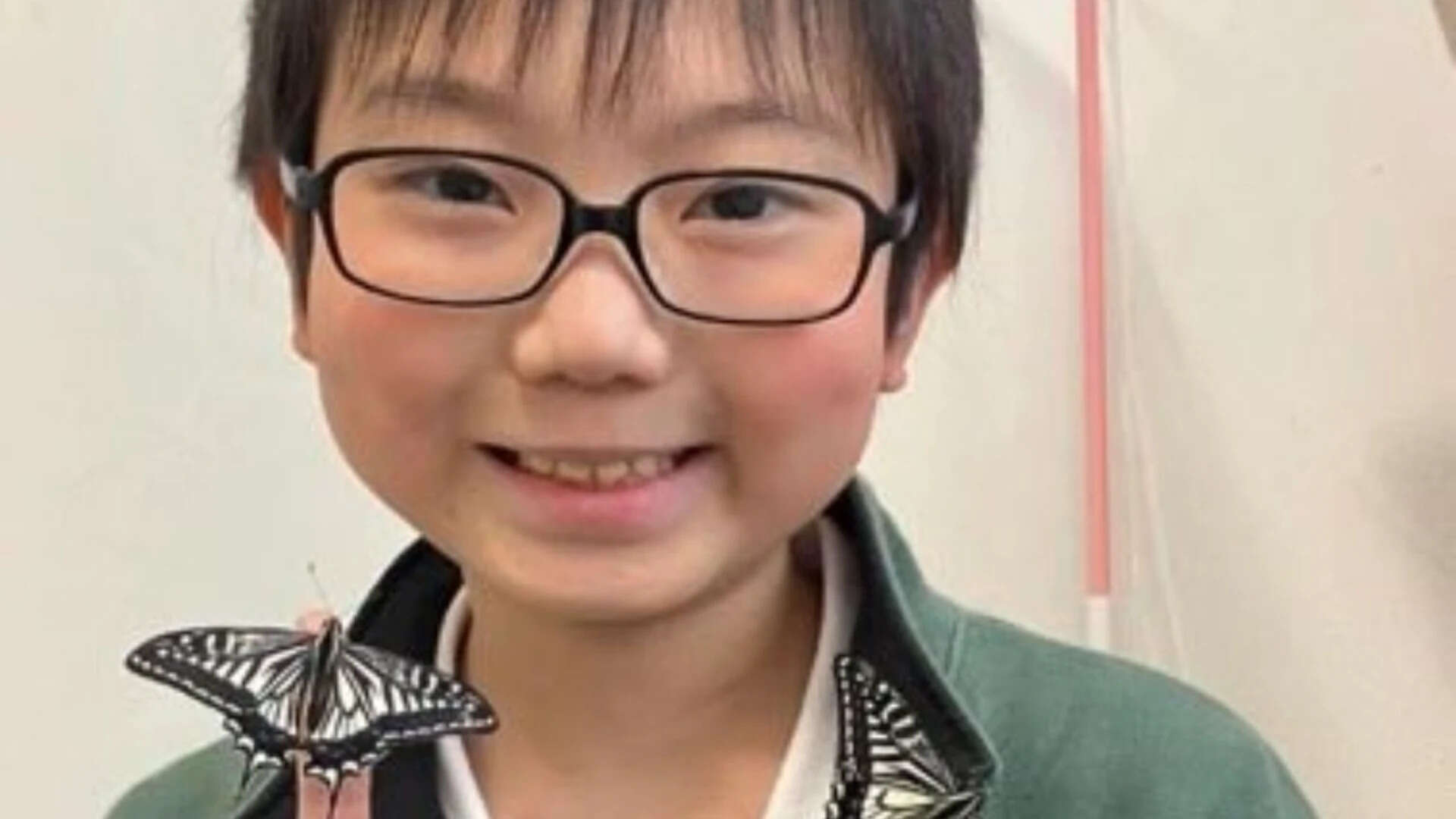
Typical children going to an elementary school in Japan mostly spend their free time studying, playing baseball or reading all the manga they can get their hands on. But Jo Nagai, a ten-year-old resident of Kobe, Japan decided to spend his spare time hand-raising swallowtail butterflies.
Identified with the bright dots that outline their wings, the Asian swallowtails are fantastic pollinators for local plants and flowers.As her cared for them, he noticed a particular heartwarming behaviour. Once he released them into the wild, the butterflies would linger for a bit in the air and then fly right back to him. The observation sparked a curious question in the boy's mind: Did his butterflies actually remember him?
Looking for answers
Jo trained a small group of his caterpillars to associate the scent of aromatic lavender oil with the vibrating stimulus.
Determined to find an answer, Jo started looking online for scientific studies that might correlate to his question.
The answer came in the form of Dr. Martha Weiss, a renowned entomologist at Georgetown University who had previously studied whether moths could retain memories from their caterpillar days.In a recent Radiolab podcast, Dr Weiss recounted how the then second-grader penned a detailed four-page letter to her. He asked if she knew the best way to expand her moth experiment to his butterflies. Delighted by Nagai's precocious curiosity, she wrote back.
Soon, they began a cross-continental scientific mentorship. The university professor and elementary school students collaborated to adapt complex laboratory methods into a brilliant child-friendly experiment conducted at Nagai's home.The memory of the metamorphosisTo transform into a butterfly, a caterpillar has to undergo a process called metamorphosis. The caterpillar walls itself off inside a chrysalis as its body completely breaks down and builds itself, again.
This is sometimes referred to as the "goo phase."Now, Nagai was posed with the question of what memory he would create for his caterpillars to carry forward as they become butterflies? He designed a clever experiment using simple household materials. Starting with a mild electronic pulse from a muscle therapy device, Jo trained a small group of his caterpillars to associate the scent of aromatic lavender oil with the vibrating stimulus.While the swallowtails did not particularly enjoy being near the smell, they were never harmed by it. He left a control group completely untrained. Now that he had one group of caterpillars who disliked the smell of lavender, he was onto the next phase of the experiment. Would their memories of trying to avoid lavender survive the radical, total-body meltdown of metamorphosis?Once the insects emerged as beautiful butterflies, Nagai tested them using a Y-shaped tube maze.
One side contained the initial lavender smell while the other side was scent-free. The control group of butterflies split evenly, flying into the two arms of the Y; meanwhile, the trained butterflies overwhelmingly avoided the lavender scent! Against all odds, Jo proved that sense memories can survive the total reorganisation of the body and brain during metamorphosis.
Is memory a generational thing?
He prepared a 33-page research report that shocked the scientific community.
While Nagai could have stopped here, he was intrigued to find out if memory could travel down through generations.
After breeding his trained butterflies, he tested their offspring and eventually their grandchildren. Shockingly, without ever receiving any vibration-training themselves, the subsequent generations naturally avoided the scent of lavender. Now, Nagai had uncovered definitive evidence of transgenerational memory inheritance in swallowtail butterflies."He did his experiment again, but tested a second generation too, to see if they avoided the same smell he'd trained their parents to hate.
And a few months later, he wrote to my mom that the results were clear. His butterflies had passed their memories on to their children," shared journalist Annie Rosenthal, the daughter of Weiss.He prepared a 33-page research report that shocked the scientific community. Eventually, the young lad even presented his findings at the International Congress of Entomology in Kobe, Japan, in 2024. Dr Weiss also flew out to meet Jo there while briefing global experts, including the Crown Prince of Japan.While butterflies aren't consciously teaching their babies as humans do, this finding hints that life experiences from one generation can influence the next: a phenomenon scientists are exploring under the lens of epigenetics.Weiss also revealed Nagai's future on the Signal Hill podcast. “He told me he doesn’t actually want to be an entomologist when he grows up. He wants to be a veterinarian,” she said.
View original source — Times of India ↗
Related stories

The Punch
PoliticsJul 10, 2026 · 1 min
2027: Nigeria’s political climate toxic for opposition, says Makinde
The Punch
The Punch
PoliticsJul 10, 2026 · 1 min
BREAKING: Tinubu retains Shettima as running mate
The Punch
The Punch
PoliticsJul 10, 2026 · 1 min
VIDEO: ‘Thank you, Mr President,’ freed Oyo pupils, teachers express gratitude
The Punch

Philippine Daily Inquirer
PoliticsJul 10, 2026 · 1 min
Net FDI inflow plunged to 10-year low in April
Philippine Daily Inquirer