I tested PSB's new stereo speaker system and the punchy sound and compact styling are a delight, but don't bother if…
Those after significant scale of sound and/or those who will be using vinyl as their primary source of music are not well served here, but for the rest of us, the PSB iQ2 is a likeable, listenable little system. It has lots going for it where specification, finish, operability and, most importantly, audio quality are concerned.
Pros
+Energetic, punchy and enjoyable sound
+Great control app
+Specification and build quality are equally impressive
Cons
-Not exactly the biggest sound around
-Phono stage sounds insipid
-Up against some stiff competition
Why you can trust TechRadar
We spend hours testing every product or service we review, so you can be sure you're buying the best. Find out more about how we test.
PSB iQ2: Two-minute review
‘Larger’ is not the same as ‘large’, and so while the PSB iQ2 is the larger of the two models in the newly refreshed iQ range, it’s still a very compact little pair of speakers. ‘Compact’ in this instance, though, in no way implies a shortage of features or a restriction on performance
The standard of build and finish is good, the looks clean and understated no matter which of the seven different finishes you choose. The iQ2 has everything you could realistically hope for in a wireless speaker system costing this sort of money. It has — deep breath — wired and wireless connectivity (including a moving magnet phono stage for use with a turntable, and a HDMI eARC socket for connection to a TV), one of the best user interfaces around in the shape of BluOS, a total of 270 watts of power, frequency response that belies the physical size of the speakers, and authentically high-resolution playback. That's a lot.
Though you don’t get everything you could realistically hope for where sound quality is concerned, the PSB nevertheless has plenty to recommend it. Through every input except its phono stage, it’s a lively, engaging and informative listen, can deal confidently with rhythms and tempos, has a fair amount of well-controlled punch, and doesn’t overlook the finer details when it comes to unpicking a recording.
It can sound a little cramped via Bluetooth, sure, and its phono stage is dull when every other input sounds energetic. But as long as you’re not expecting small cabinets with small drivers to deliver hangar-filling sound you'll get from the best stereo speakers on the market there’s plenty to enjoy here.
PSB iQ2 review: Price & release date
$1,399 / £1,199 / $2,299 (approx.)
Released in June 2026
The PSB iQ2 active wireless stereo speaker system is on sale now. In the United States it sells for $1,399 — unless you like the walnut veneer finish, in which case it'll set you back $1,499. The equivalent in the United Kingdom is £1,199 / £1,299. The pricing is yet to be confirmed for Australia, but you’re probably looking at AU$2299 / AU$2499 or thereabouts.
There is neither the time nor the space to reel off all the very many excellent products that PSB is going up against at this price.
PSB iQ2 review: Features
19mm aluminum dome tweeter, 100mm mid/bass driver
24bit/192kHz DAC
Wireless and wired inputs
It’s compact, yes, but PSB's iQ2 has found enough space to ensure it's equipped to justify the asking price. No aspect of its specification is underpowered.
Sign up for breaking news, reviews, opinion, top tech deals, and more.
Getting your audio information on board in the first place can be done in a number of different ways. All physical inputs are on the rear panel of the ‘primary’ speaker. It has sockets for HDMI eARC, digital optical, USB-C, USB-A and a moving magnet phono stage on RCAs for use with a turntable (this input is switchable to line level in the control app). There’s also a pre-out for connecting to a subwoofer.
The wireless stuff is covered off by Bluetooth with aptX Adaptive codec compatibility. The iQ2 is compatible with the BluOS eco-system, which means wireless access to every worthwhile music streaming service, internet radio and any content you may have stored on a device connected to the local network.
Once it’s on board, the digital stuff is handled by a 24bit/192kHz digital-to-analog converter before it’s handed over for amplification — the analog stuff, of course, is passed straight through. There are 270 watts of TI Burr Brown-derived Class D amplification to power the driver array — 45 watts for each 19mm aluminum dome tweeter, and 90 watts for each 100mm mid/bass drivers. The latter, mildly unusually, are positioned above the former. This is an arrangement that, suggests PSB, is good for a frequency response of 64Hz - 20kHz.
Features score: 5 / 5
PSB iQ2 review: Sound quality
Lively and informative sound
Well-organized soundstage but not the largest
Sounds dull via its phono stage
There are caveats here, and they concern the out-and-out scale of sound the PSB is capable of generating (or not), and the efficacy of its phono stage. But it’s probably best to start with the things the iQ2 gets — there are more than one or two.
With a Tidal-derived stream of Geese’s Getting Killed playing as a 24bit/44.1kHz FLAC file, the iQ2 is an energetic, engaging listen with a stack of pertinent observation to make where tone, timbre and basic detail retrieval are concerned. It maintains a nicely even-handed tonality, neither adding to nor subtracting from the organic heat of the recording. At every turn, it is attentive to even the finer details of texture and harmonic variation.
It sounds very much like it extends further down the frequency range than PSB is claiming, and when it’s down there it punches with well-controlled determination (as well as no little variation) and has no problems expressing rhythms believably as a result.
Frequency response is equally well judged, so when the system modulates from low end to midrange there’s no apparent step change. Then, once it's there, the iQ2 invests voices with plenty of character and emotional attitude, as well as revealing the finer details of technique. Move up again into the highest frequencies and, though the PSB is not the most substantial where treble sounds are concerned, it manages to describe shine and bite without becoming hard or glassy. The DSP-assisted crossover occurs at around the 3Khz mark, but it’s basically imperceptible.
There’s a fair amount of dynamic headroom available, so as well as having the grunt to play good and loud, the iQ2 breathes deeply enough to put worthwhile distance between the quieter moments of a recording and the points of greatest intensity and attack. And it can manage these transitions without audible stress or compression, which is not something you can automatically say about some of its nominal rivals.
The soundstage it creates is well defined and properly organized, so even complex recordings are laid out coherently. It’s not the most expansive soundstage you ever encountered, though. These are small-ish cabinets featuring small-ish drivers, and quite obviously there’s a limit to the scale of sound you’re entitled to expect. Got a great big room you want to fill with sound? You’ll be needing bigger speakers than these.
And it’s definitely worth noting that the above applies to most, but not all, of the iQ2’s inputs. It can, inevitably, sound a little squashed when streaming via Bluetooth — this is hardly unheard of, even in systems costing plenty more than this. Yet the integrated phono stage is an authentic disappointment. It gives away the bulk of the vibrant, energetic attitude the system displays through all of its other inputs and replaces it with an altogether more pedestrian, vanilla alternative. No turntable = no problem, of course, but if you have a record player you’d like to use, try and hear the PSB’s phono stage before you commit to spending any money…
Sound quality score: 4 / 5
PSB iQ2 review: Design
246 x 145 x 192mm (HxWxD)
Choice of seven finishes
Rear-firing bass reflex port
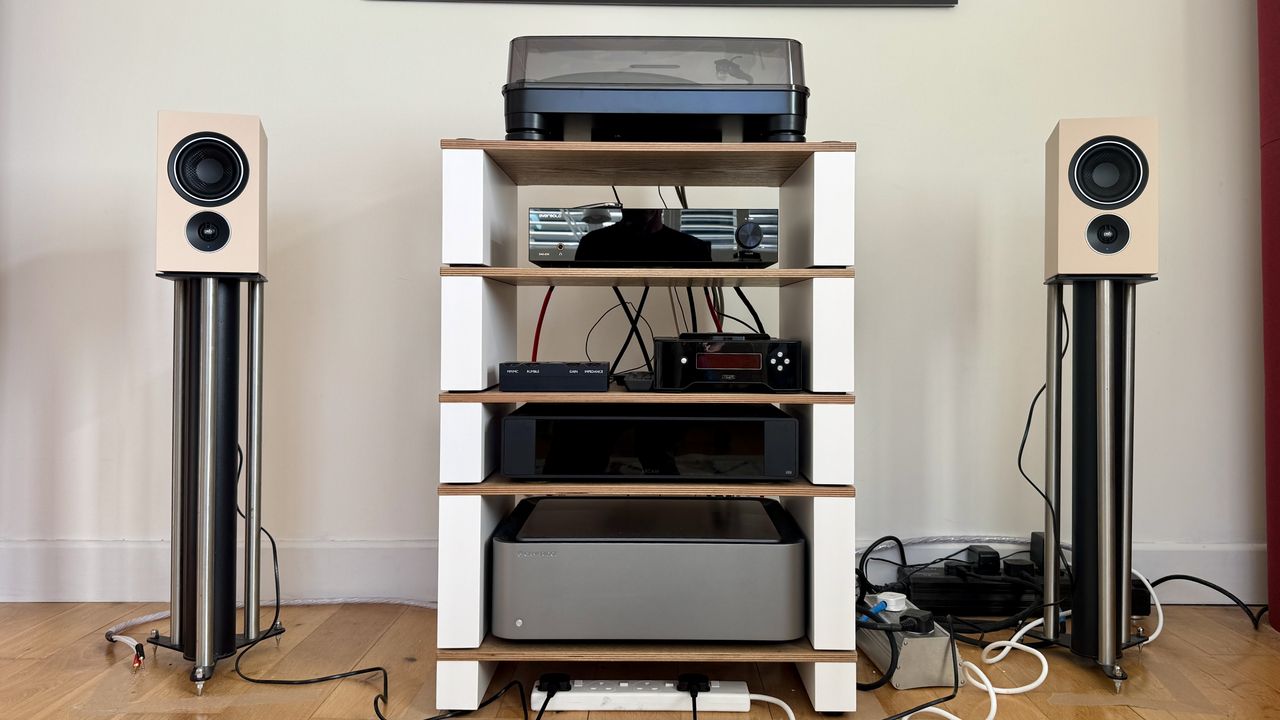
If a significant part of the appeal of systems like this is their relatively discreet nature, then PSB is onto a winner with the iQ2. Even by prevailing standards it’s notably compact at 246 x 145 x 192mm, and as long as you give each cabinet’s rear-facing bass port a little breathing space then it’s very adaptable and flexible when it comes to positioning.
As is generally the case with PSB, the standard of build and finish that’s on display here is more than acceptable. The cabinet edges are crisp and clean, and the combination of MDF and aluminum used in the construction allows the speaker to be fairly light (7.4kg per pair) but notably robust. The main sleeve is of MDF, the rear panel is of aluminum, and the front baffle (which is separated from the main body by a slim slice of brightwork) is MDF on aluminum.
There are seven available finishes, which means there really ought to be something to suit your interior design choices, but I can’t help thinking I got the short straw with my review sample's ‘sandstone’ beige. It’s a rather insipid and non-committal color. I haven't seen them but I’d suggest that any of the black, white, ‘boreal’ green, ‘granite’ gray, ‘ember’ red or (cost option) walnut veneer alternatives are likely to be preferable.
For me, anyway, the fact the iQ2 is supplied with four little magnetically attached grilles that cover only the drivers rather than the entirety of the front baffle is probably a good thing. Unless you’re actually trying to disguise the colour of the speakers in the first place…
Design score: 5
PSB iQ2 review: Usability & setup
BluOS control app
A few physical controls
Easy to create a multi-channel or multi-room system
The primary speaker, the one with all the physical and wireless connectivity, also features a few capacitive (and illuminated) touch controls on its top panel. They’re useful if you happen to be passing, but of much more wide-ranging use is the BluOS control app.
BluOS is an increasingly popular control and management interface, one that’s been adopted by quite a number of manufacturers, and it’s easy to see why. It’s a clean, clear and stable interface, logical in navigation and extensive in its functionality.
Everything you need, from initial set-up — telling the primary speaker if it’s the left or right channel, for instance — and EQ control to establishing a multi-channel or multi-room system using any BluOS-compatible product, can be taken care of from here. Integrating your favorite music streaming service(s), accessing internet radio, checking for updates, so on and so forth — they're all here.
A great operating system is not, in and of itself, a reason to buy a wireless speaker system but it certainly makes it easier when you’re making your mind up.
Usability & setup score: 5 / 5
PSB iQ2 review: Value
Great specification
Very acceptable build and finish
Energetic sound
Just because you don’t get a whole lot in physical terms, doesn’t mean the PSB iQ2 doesn’t represent very decent value for money.
The specification is good, the operating system is better still, the standard of build and finish is very acceptable indeed — and best of all, the sound is energetic and engaging through all but one of the input options.
If you want nicely poised and enjoyable sound from a system that won’t dominate your room, there’s authentic value to be had here.
Value score: 4.5 / 5
Should I buy PSB iQ2?
Swipe to scroll horizontally
PSB iQ2 scorecardAttribute
Notes
Score
Features
No aspect is underpowered; 19mm aluminum dome tweeter, 100mm mid/bass driver, 24bit/192kHz DAC
5 / 5
Sound quality
Lively, informative and well organized; but sounds dull via phono stage
4 / 5
Design
Choice of seven finishes; crisp and clean edges; notably robust
5 / 5
Setup & usability
Excellent BluOS control app; easy to create a multi-channel or multi-room system
5 / 5
Value
Authentic value to be had, with good specification and even better control app; phono stage just a little lacking
4.5 / 5
Buy them if…
Don’t buy them if…
PSB iQ2 review: Also consider
How I tested the PSB iQ2
I put the iQ2 on some Soundstyle speaker stands for the majority of this test — from there they were attached to a turntable and a CD player (via the phono input and the digital optical input respectively), as well as streaming via Bluetooth and from Tidal using the BluOS app.
I also tried them on a shelf for a while, and listened purely wirelessly, but because my shelves are positioned in the traditional way, it was quite difficult to get the rear bass reflex ports far enough away from a rear surface…
Read TechRadar's Reviews Guarantee
First reviewed: July 2026
Simon Lucas is a senior editorial professional with deep experience of print/digital publishing and the consumer electronics landscape. Based in Brighton, Simon worked at TechRadar's sister site What HiFi? for a number of years, as both a features editor and a digital editor, before embarking on a career in freelance consultancy, content creation, and journalism for some of the biggest brands and publications in the world.
With enormous expertise in all things home entertainment, Simon reviews everything from turntables to soundbars for TechRadar, and also likes to dip his toes into longform features and buying guides. His bylines include GQ, The Guardian, Hi-Fi+, Metro, The Observer, Pocket Lint, Shortlist, Stuff T3, Tom's Guide, Trusted Reviews, and more.
View original source — TechRadar ↗
Related stories

FCC grants approval for sun-reflecting space mirror that's been widely criticized by astronomers

Ransomware attacks against education sector rise 16% in one year becoming the new favorite target

Should You Get a Vibration Plate? Here’s What Experts Have to Say
