CNA
How Hangzhou-born jeweller Feng J became one of high jewellery’s most sought-after names
For more than a century, the world of high jewellery has revolved around a familiar constellation of houses: Cartier, Van Cleef & Arpels, Bulgari and their peers. For younger designers trying to break into its upper echelons, the industry has often been defined by heritage, European codes and a high barrier to entry.
Enter Feng J, the Hangzhou-born, Shanghai-based artist-jeweller who trained in Paris to master the codes of high jewellery – before developing a language unmistakably her own.
“I had to carve out a place for myself,” she said. “High jewellery was not naturally associated with China, and 10 years ago there were very few Asian designers in the field. Once people saw my work, many of the prejudices they may have held began to fade.”
Her auction results point to that growing recognition. In 2020, her Les Jardins de Giverny necklace sold at Phillips Hong Kong for US$2.6 million (about S$3.31 million), while another piece, the Fountain On Fire Ruby and Diamond ring,later sold at Sotheby’s for US$1.6 million.
Celebrity clients have also helped bring Feng J to a wider audience. Rihanna has worn her sculptural La Coeur en Rouge bangle, while Victoria Song of K-pop group f(x) appeared in the designer’s Aqua Gingko Leaf earrings. Kylie Jenner has also been linked to Feng J’s international clientele.
So sought after is her work that it has even drawn the attention of museums. Her creations have been displayed or collected by institutions including the Musee des Arts Decoratifs in Paris, the Museum of Fine Arts, Boston, and Shanghai’s Long Museum.
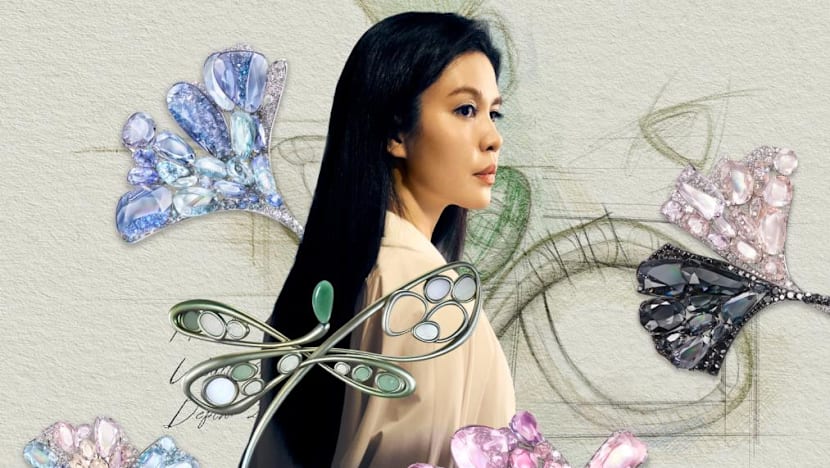
At the heart of Feng J’s appeal is a visual language that expands what high jewellery can be. She blends Impressionist ideas of light and colour with Chinese artistic sensibilities. Organic forms recur throughout her work – dragonflies suspended in mid-air, clovers unfolding in gemstones, flowers rendered in brilliant gradients.
The real surprise is not that Feng J has broken into the upper ranks of high jewellery. It is that, outside collecting circles, her name is still not more widely known.
FROM HANGZHOU TO GIVERNY
Part of what makes Feng J intriguing is that her work resists easy categorisation. Technically, she is a high jeweller. In practice, many of her creations feel closer to painting or sculpture than conventional jewellery.
“I see myself as a creator,” Feng said. “My work happens to take the form of jewellery most of the time, but each piece holds its own distinct artistic value.”
Rather than emphasising pristine symmetry or flawless perfection, her pieces shimmer with movement and atmosphere. Gemstones are layered like pigments, while settings are carefully hidden so the stones appear to float.
Long before Feng J – born Feng Ji in 1985 – began attracting international attention, her visual instincts were shaped by family life and the landscapes of her childhood in Hangzhou. The city’s famed West Lake, with its drifting fog and reflective waters, left a lasting imprint on her imagination. Even now, she speaks about it with tenderness.
“For me, the most beautiful thing in Hangzhou is West Lake – poetic, dreamlike, utterly ethereal,” she said. “It feels woven into my DNA.”
Art and craftsmanship were deeply embedded in her upbringing. Her great-grandfather had served as a painter to the imperial court during the Qing dynasty, while her family collected rare Chinese objects and decorative works that reflected traditional artisanal techniques.
Growing up surrounded by those objects shaped her understanding of beauty and artisanship. She remembers being transfixed by a piece of Chinese calligraphy hanging in her grandfather’s home. Its expressive brushstrokes – both abstract and emotional – influenced her sense of beauty long before she entered the luxury world.
“The Chinese characters, transformed into pure abstraction, revealed to me just how beautiful writing could be,” she said.
Years later, while studying art, Feng J encountered Claude Monet through books on Impressionism and became captivated by the French painter’s work.
“It captivated me so deeply that I began researching his life, and eventually even the gardens of Giverny,” Feng said. “Something within me was touched, and a seed was planted – one that I believe would blossom much later.”
At the time, Giverny existed only as a distant place Feng knew through paintings and books. Decades later, she would arrive there not merely as a visitor, but as an artist whose own work had entered the permanent collection of the Musee des Impressionnismes Giverny.
Earlier this year, the museum unveiled Reverie a Giverny, her dragonfly sculpture fashioned from titanium, bronze, chalcedony, serpentine jade and aventurine, as part of Before the Water Lilies: Monet Discovers Giverny, 1883–1890, a major exhibition marking the centenary of Monet’s death.
For Cyrille Sciama, general director of the museum, the connection between Feng J’s work and Monet extends beyond visual resemblance. “Feng J’s creations pay a remarkable tribute to Claude Monet’s paintings and to the water lilies he depicted with such passion, through their interplay of light, transparency, and balance,” he said in a statement accompanying the exhibition.
PAINTING WITH GEMSTONES
Yet translating those influences – from Chinese ink painting to Monet’s Impressionism – into the language of French high jewellery required Feng J to develop a visual and technical vocabulary of her own.
Unlike many designers working in high jewellery today, she did not emerge from a dynastic European maison or inherit generations of jewellery-making expertise. She initially studied furniture design at the China Academy of Art before moving to London to pursue a master’s degree in Fashion Artefact at University of the Arts London. Jewellery entered her life almost by accident, after a single piece she created unexpectedly sold at auction.
“That unexpected moment opened a new window for me,” she said.
After training at the Haute Ecole de Joaillerie in Paris, she launched her maison in the French capital in 2016. At the time, Asian designers remained relatively rare in the upper tiers of high jewellery, an industry still closely tied to European heritage and tradition. Feng J quickly realised that imitating established maisons would leave little room for her own artistic identity.
“In the early days, I felt that the major maisons had already defined the code of high jewellery,” she said. “But once I uncovered my own style and started inventing my own techniques, I found the confidence to step into the arena in my own way.”
A turning point came when Feng J discovered antique double rose-cut gemstones – thin, translucent stones with muted colours that she likened to watercolour pigments. While the industry largely prized brilliant-cut stones for their intensity and precision, Feng was drawn to softer gradations of colour.
That voice eventually took shape through what she describes as “Painting with Gemstones”, a method in which she treats precious stones as pigments on a painter’s palette rather than as precious objects alone.
Over time, she assembled what she describes as a vast library of coloured stones, many cut in her signature double rose-cut style, allowing her to use them the way a painter might choose pigments for a canvas.
“I have compiled thousands of gems in every imaginable hue and colour,” she said. “In my eyes, they are like brushstrokes on a canvas, almost like Seurat’s pointillism.”
The effect is striking in person. In one of her dragonfly brooches, coloured gemstones are arranged within delicate openwork wings, resembling brushstrokes suspended in air. Shades of pale green, lavender and watery blue shift in soft gradients, giving the brooch a distinctly painterly quality. Rather than filling every surface with stones, Feng J leaves deliberate pockets of emptiness within the composition – an approach influenced by traditional Chinese ink painting and the Lao Tzu philosophy of treating emptiness as a form of invisible beauty.
One of Feng J’s defining innovations is the “Floating Set”, a painstaking process that conceals the metal structures traditionally used to support gemstones. Instead, stones appear almost impossibly suspended in air, connected by tiny hidden loops.
“The stones effectively rise from nowhere,” she said. “I must pre-engineer the entire structure in my mind.”
One of the clearest expressions of that approach is Libellule du Palais Garnier, a showstopping brooch recently exhibited at L’ecole, School of Jewelry Arts in China, supported by Van Cleef & Arpels. Inspired by the architecture of the Opera Garnier in Paris, the piece creates the illusion of coloured stones suspended almost freely in air.
Titanium also appears frequently in her creations because of its unusual combination of strength and lightness. Under changing light, the material takes on subtle tonal shifts that reinforce the dreamlike quality she pursues throughout her work.
“My work has a certain ethereal, almost weightless quality,” she said. “Titanium naturally becomes part of that language.”
REWRITING THE CODES OF HIGH JEWELLERY
As the spotlight around her grew, so did Feng J’s audience. Younger collectors, in particular, have become increasingly receptive to work that moves beyond conventional ideas of jewellery as purely decorative or status-driven.
“I’ve observed a rising generation of younger connoisseurs – keen-eyed, sophisticated and curious – who are especially willing to explore something genuinely new,” she said.
That shift reflects a broader change within luxury. Younger collectors move fluidly between fashion, art and design, often seeking creators with distinctive artistic identities rather than heritage alone. In that landscape, Feng J’s blend of Chinese visual traditions, Impressionist influences and experimental techniques feels less like an outlier than a sign of where contemporary high jewellery may be headed.
Much as designer Guo Pei helped establish a distinctly Chinese voice in haute couture, Feng belongs to a generation of creators reshaping historically European luxury categories through their own cultural and artistic perspectives.
Still, she insists that high jewellery must aspire to something deeper than celebrity placement or material value alone. She creates just 35 pieces a year, working with her ateliers in Hong Kong, while some pieces are made in Paris.
“For me, high jewellery is an artistic practice,” she said. “It is not only about precious materials, but about artistic value – unique aesthetics, innovative techniques, and a signature that contributes to contemporary jewellery history. I believe that once you find a style that truly belongs to you, everything begins to flow from it.”
Today, inside the Musee des Impressionnismes Giverny, Feng J’s dragonfly sculpture sits near the gardens that inspired Monet’s water lilies more than a century ago.
Although the dragonfly was never a defining motif in Monet’s paintings, it feels at home amid the watery landscapes and shifting atmospheres of Giverny.
For the artist who first encountered Impressionism through books as a student in China, the moment carries a sense of return. Her early fascination has become a dialogue: a contemporary Chinese creator entering the landscape immortalised by one of France’s greatest painters.
Source: CNA/bt
Related stories

Variety
EntertainmentJul 10, 2026 · 1 min
Netflix’s ‘Little House on the Prairie’ Writer on Landing Fan Favorite From Original Series for That Scary Cameo
Variety

Variety
EntertainmentJul 10, 2026 · 1 min
‘Star City’ Finale: Creators Explain Why They Couldn’t Resist Rewriting Their Own Alt-Space History by Going to Venus…
Variety

E! Online
EntertainmentJul 10, 2026 · 1 min
Lululemon's Summer Sale is Serving Major Wimbledon Energy for Less
E! Online

The Hollywood Reporter
EntertainmentJul 10, 2026 · 1 min
Legendary DP Robert Richardson on New Doc About His Life, Upcoming Film ‘Madden’ and Why Hollywood Should “Regulate and…
The Hollywood Reporter