CNA
5 things to know about Johor’s state election on Jul 11
JOHOR BAHRU: More than 2.7 million eligible voters in Johor will head to the polls on Saturday (Jul 11) in a closely watched state election that analysts say will largely be a contest between the governing Barisan Nasional (BN) and Prime Minister Anwar Ibrahim’s Pakatan Harapan (PH).
Both coalitions are fielding candidates in all 56 state seats.
Although both BN and PH are partners in Anwar’s federal unity government, they remain political rivals in Johor.
BN won 40 seats in the 2022 election while PH, the state’s main opposition bloc, won 12.
Cost of living, housing affordability and delays to the Johor-Singapore Special Economic Zone (JS-SEZ) masterplan were among the key issues during the two-week campaign.
The campaign also saw claims that a BN victory could pave the way for former PM Najib Razak’s release from prison, while Parti Islam Se-Malaysia (PAS) called on its supporters to back BN in constituencies not contested by its coalition Perikatan Nasional (PN).
Meanwhile, smaller reformist parties such as the Parti Bersama Malaysia (Bersama) and the Malaysian United Democratic Alliance (MUDA) could reshape the contest by “disrupting the balance of votes” among PH’s traditional urban voters, analysts told CNA.
WHEN WILL RESULTS BE OUT?
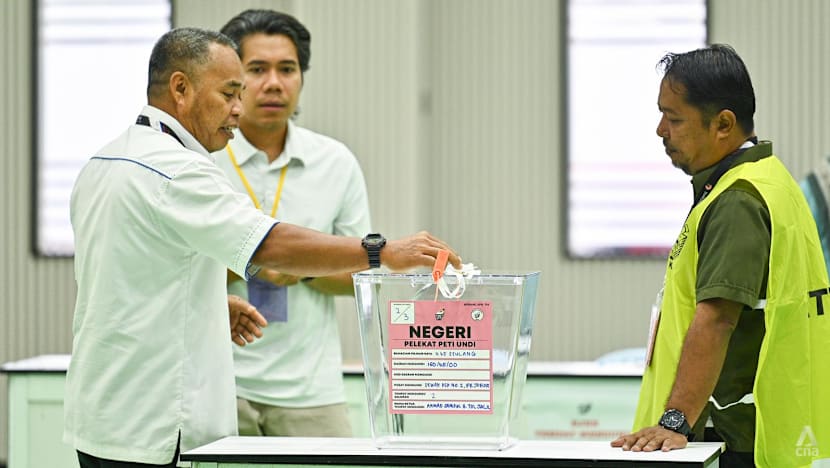
Early voting took place on Tuesday, with the turnout reaching 94.49 per cent, according to local media.
A total of 19,471 eligible voters, comprising members of the armed forces, police and General Operations Force and their spouses, cast their ballots at 62 polling centres across the state.
The turnout was higher than the 87 per cent recorded during early voting in the 2022 Johor state election, local media reported.
Most Johoreans will, however, cast their ballots on Saturday between 8am and 6pm.
Results are expected to be announced from around 10pm on Saturday, following an upgrade to the election results management system.
“We hope and pray that with the system we have, which has now been upgraded, the full results can be known by around 10pm,” said Election Commission chairman Ramlan Harun on Tuesday, as reported by Malay Mail.
WHICH ARE THE SEATS TO WATCH?
A total of 172 candidates are contesting the 56 seats, with multi-cornered fights seen in 42 constituencies.
Three seats will see five-cornered contests, 12 will feature four-cornered battles and 27 will have three-cornered fights. The remaining 14 seats will see straight fights.
Incumbent chief minister and Johor BN chairman Onn Hafiz Ghazi is defending his Machap seat, facing off against PH’s Nur Hafiz Roslan.
Analysts have described Onn Hafiz, 47, as “one of the strongest factors in BN’s favour”, citing his economic track record and hands-on leadership style.
Puteri Wangsa is another closely watched contest. Former education minister Maszlee Malik is contesting for PH, and observers and the media have identified the 51-year-old as PH’s chief minister contender should it secure a majority in the state assembly.
Maszlee faces a crowded field in Puteri Wangsa, which is also being contested by MUDA’s Rashifa Aljunied, BN’s Teow Chia Ling, Bersama’s Nicholas Paul Vincent and independent candidate Wang Wee Siong.
Puteri Wangsa was won by MUDA in 2022 when the party was part of an electoral pact with PH.
Incumbent Amira Aisya Abdul Aziz is not defending the seat, and analysts say the constituency will be a test of whether the youth-based MUDA can retain its support in the densely populated urban mixed constituency in Johor Bahru.
MUDA is contesting four seats in the Johor election.
Analysts also identified urban and mixed constituencies such as Johor Jaya, Permas, Larkin, Stulang, Perling, Skudai, Kota Iskandar and Senai as key seats to watch. Johor Jaya, Stulang, Perling, Skudai and Senai were held by PH’s DAP while Permas, Larkin and Kota Iskandar were held by UMNO.
Their results could indicate if younger, reform-minded and “disillusioned PH voters” may be more open to backing alternative parties.
Voters aged below 40 make up 47.6 per cent of the electorate in Johor.
The seats of Bukit Batu, Bukit Pasir, Parit Yaani, Tangkak, Bukit Kepong and Jementah will also be closely watched, as their winning margins by various parties were among the narrowest in the 2022 state election.
POSSIBLE UMNO-PAS COOPERATION, JS-SEZ AMONG CAMPAIGN ISSUES
Growing tensions within opposition coalition PN, as well as issues of contention among the federal unity government partners, surfaced during the Johor polls.
PN is fielding candidates in 33 seats, with its two main component parties - Parti Islam Se-Malaysia (PAS) and Parti Pribumi Bersatu Malaysia (Bersatu) running separate campaigns despite contesting under the same logo.
PAS has openly urged voters to vote for BN in seats not contested by PN, arguing that doing so would “preserve Malay-Muslim political dominance”.
On Wednesday, its president Abdul Hadi Awang said it is prepared to support BN in forming the Johor government if the coalition falls short of a simple majority.
But BN’s Onn Hafiz rejected the offer, saying the Islamist party will not be part of his state government if BN forms the next administration and he is reappointed to the top post, local media reported.
Bersatu leader and former PM Muhyiddin Yassin has also said that the party’s supporters could vote freely in seats not contested by PN, further outlining a disconnect with PAS’ approach.
Another flashpoint has been the Johor-Singapore Special Economic Zone.
During the campaign, BN’s Onn Hafiz criticised the federal government over delays in launching the masterplan, arguing that it was needed to sustain the initiative’s momentum.
He had claimed the master plan was a Malaysian government document and did not require Singapore’s approval for launch and all that remained was for Putrajaya to launch it.
This prompted Anwar to criticise Onn Hafiz for allegedly using JS-SEZ as campaign fodder.
“The project is ongoing, involves high expenditure and is also receiving assistance from the federal government. Instead of being grateful, he uses it during the campaign to criticise. That is not right and not clever,” he said on Jul 3, as quoted by the New Straits Times.
The election has also been coloured by claims by jailed former PM Najib Razak’s son Nazifuddin Razak, who is UMNO’s Langkawi chief. Nazifuddin said a strong BN victory could signal public support for his father to receive a royal pardon.
BN leaders, including chairman Ahmad Zahid Hamidi, have dismissed the claims while Anwar said his coalition had been dragged into holding the Johor election by “certain parties” who wanted to return to power to secure Najib’s release.
WILL CHINESE VOTE, VOTER TURNOUT BE DECISIVE?
Analysts have said the Chinese vote and voter turnout will be among factors determining the outcome of the election.
A question in this state election is whether Chinese voters will continue to back the Democratic Action Party (DAP) - a PH component party - or drift towards other parties, as seen in Sabah, said Asian studies professor James Chin of the University of Tasmania.
At the November 2025 Sabah state election, the DAP experienced a total wipeout and lost all the constituencies it had previously held.
While Johor's ethnic makeup broadly mirrors Malaysia's national demographic split of about 60 per cent Malay, 30 per cent Chinese and 10 per cent comprising other groups, Chinese voters form the largest voting bloc in around 12 of the state's 56 seats, most of them urban.
Some observers have predicted that smaller reformist parties like Bersama could win over some Chinese voters from PH.
PH candidate for Pemanis, Jalex Lee, has called on the Chinese community to refrain from backing Bersama’s candidates as it would risk splitting his coalition’s votes, FMT reported.
Parties have also urged Johoreans to turn up to vote.
Johor recorded one of the country’s lowest voter turnouts of about 54 per cent during the March 2022 state election. Many overseas voters, including those residing in Singapore, had likely not returned due to COVID-19 border closures, analysts said.
WHAT NEXT?
BN is widely expected to retain Johor.
Think tank Merdeka Centre projected BN to win between 40 and 42 seats, with its programme director Ibrahim Suffian citing a rebound in Malay support for UMNO, reported Malaysiakini.
Another analyst, former DAP MP Ong Kian Ming, projected a landslide victory for BN, saying it may win 53 seats.
According to an analysis by think tank Ilham Centre, BN holds the lead in 39 seats. PH leads in nine while eight others will see close contests.
It said PH appeared to be overly dependent on Anwar to boost its campaign momentum and the coalition lacked a local face for its campaign.
The Centre for Malaysian Chinese Studies said PH has a good chance of wresting several marginal seats from BN if there is a 65-per-cent turnout among Chinese voters.
While PH had a slow start to the Johor state election campaign, its support base has stabilised after a week of campaigning, the think tank said, as reported by local media.
The coalition must galvanise outstationed voters and also woo Malay swing voters who voted for PN in the 2022 state election, it added. Coalitions require 29 seats for a simple majority to form the state government.
After the election, all eyes will be on who will be Johor’s next chief minister, a decision that will be determined by the Johor palace no matter which coalition wins.
The chief minister will have to balance relationships with the federal government, the royalty and neighbouring Singapore while maintaining investor confidence, analysts have said.
The results of Johor’s state election, as well as Negeri Sembilan’s on Aug 1, will help PH gauge public support, providing a better indication of how the pact and Anwar may fare in the looming national polls to be called by February 2028, observers said.
Source: CNA/ia(cc)
Related stories

The Punch
PoliticsJul 11, 2026 · 1 min
Atiku faults Tinubu over delay in signing Audit Bill
The Punch
The Punch
PoliticsJul 11, 2026 · 1 min
Ooni backs Tinubu, says economic reforms yielding results
The Punch
The Punch
PoliticsJul 10, 2026 · 1 min
Tinubu approves upgrade of Nasarawa federal poly to specialised varsity
The Punch

The Hill
PoliticsJul 10, 2026 · 1 min
Apple sues OpenAI
The Hill