Times of Israel
NYC House candidate doubles down in defending attendance at pro-Hamas rally a day after Oct. 7
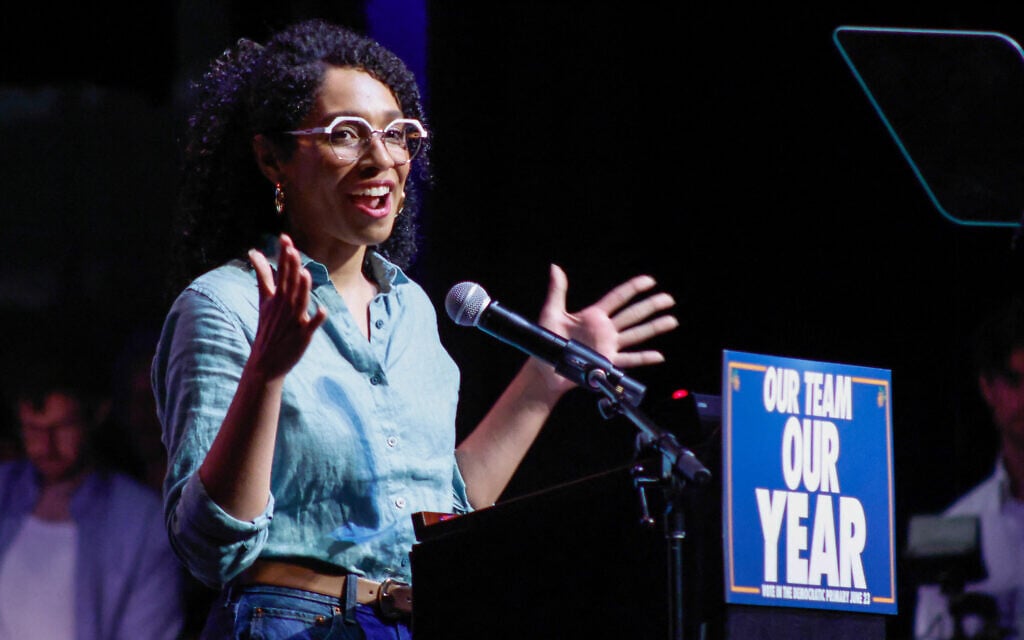
New York Jewish Week via JTA — Democratic congressional candidate Darializa Avila Chevalier defended her presence at a pro-Palestinian rally the day after Hamas’s October 7, 2023, attacks on Israel during a wide-ranging interview Friday with progressive Jewish author Peter Beinart.
“I think the targeting of civilians is wrong in any context, including on October 7,” Avila Chevalier said when asked by the editor-at-large of the leftist Jewish Currents about slogans legitimizing “resistance” that appeared at the rally. Avila Chevalier previously defended her attendance at the rally to City & State in June.
“I think what matters is international law, and what international law condemns and protects,” she said. “And it condemns the targeting of civilians, and it also protects the right to resist.”
Beinart, who is an outspoken critic of Israel and a journalism professor at the City University of New York, pushed back, saying that he “didn’t see any discussion of international law in that rally on the signs or the slogans of the kind that you are offering now … Were you uncomfortable by that?”
Avila Chevalier responded that, at any protest, there will always be “folks who are voicing opinions that you might not agree with.”
Get The Times of Israel's Daily Edition
by email and never miss our top stories
By signing up, you agree to the terms
“I knew even as early as October 8, right, where this cycle was headed, and I knew the things that I did have power over,” Avila Chevalier said. “The thing that we have power over is the fact that our tax dollars are going towards an apartheid state that has a pattern of engaging in this type of retribution against civilians.”
Avila Chevalier, a democratic socialist who helped organize pro-Palestinian encampments at Columbia University, ousted incumbent Representative Adriano Espaillat last month in the Democratic primary for New York’s 13th Congressional District, which covers parts of Upper Manhattan and the Bronx.
“Today, we make it clear. The politics of the past ends today,” Avila Chevalier told attendees at an election night watch party, where the crowd erupted into cheers of “Free Palestine.”
She joined two other progressive and Israel-critical candidates backed by New York City Mayor Zohran Mamdani in winning upset primary victories, cementing the anti-Israel mayor’s influence in the city’s politics and likely extending the left’s gains in Congress since the wins came in deeply Democratic districts.
Beinart’s interview offered an extensive look into the Israel-related positions that became flashpoints during Avila Chevalier’s campaign, including her attendance at the October 8 rally, which was condemned at the time by Mamdani and fellow congressional candidate Brad Lander, and past criticism of former President Joe Biden’s policy toward Israel and Gaza in a since-deleted X account.
Many of the attendees on Friday’s Zoom call appeared unimpressed by the candidate’s responses.
“She is well intentioned, but also clearly is not familiar with the nature of the Israeli-Palestinian conflict,” said Hillel Schenker, a veteran American-Israeli peace activist.
Other attendees defended Avila Chevalier.
“I am surprised and disturbed by many of the comments made here that are just dismissing her comments and her approach to expressing her belief in human rights and a world without hierarchies of peoples,” wrote an attendee with the screen name Benjy Ben Baruch.
To kick off the interview, Avilia Chevalier described her internship in the West Bank as a 20-year-old Columbia University student, saying that at the time she observed “systems and how they were impacting Palestinian people and Jewish folks, and how people were being treated based off of those state structures.”
Beinart then asked Avila Chevalier why she believed Israel had become so “central for progressive politics.”
“I think there is a war machine that is insatiable,” Avila Chevalier replied. “An American war machine, the Israeli war machine, that we fund with our tax dollars as Americans, and instead what we could be funding is our communities.”
When asked by Beinart what she wanted to see as the future of the region, Avila Chevalier voiced her support for a one-state solution, which she described as “one governing body, one state that sees everyone as equal before the law, regardless of race, religion, identity, ethnicity.”
“We have seen over the course of history that attempts at two states have failed, and even so, I think in this question of like, well, do we partition to begin with, that inherently is divisive,” Avila Chevalier said.
Avila Chevalier also stopped short of saying that “Zionism is racism” when asked if she agreed with the statement by Beinart.
“Zionism is an ideology that creates this type of hierarchy that I’m talking about, and I just don’t believe that we should be striving for a world where there is a hierarchy among people,” Avila Chevalier replied.
Toward the end of the conversation, Beinart referenced scrutiny Avila Chevalier had drawn for her 2022 statements in which she condemned Dominican nationalism and said it was the reason she didn’t put the flag in her social media bio.
“What do you see as the fundamental differences between Zionism as a form of Jewish nationalism, the Dominican nationalism that you have had some concerns about, and Palestinian nationalism?” Beinart asked Avila Chevalier, whose parents are Dominican immigrants.
In response, Avila Chevalier referenced racist attacks she had endured for those comments in the lead-up to the election.
“While it’s not the majority of Dominicans, I would never say that, I think there is a faction that supports this ideology that I have just always found incredibly violent, and the type of rhetoric that I was subjected to, I think, is reflective of the very thing I was criticizing, and I see a lot of that in Zionism as well,” Avila Chevalier responded.
The candidate added that, in contrast to Zionism and Dominican nationalism, Haitian and Palestinian discussions of “liberation” were rooted in “a more universalist understanding of human rights before the law.”
“When I was there in Palestine, you know, some of the most dehumanizing language I’ve ever heard, right, was coming from Israeli soldiers toward children,” Avila Chevalier said, adding that she saw the movements “in very different lights.”
When asked whether she worried that “Hamas’s version of Palestinian nationalism may have exclusionary elements as well,” Avila Chevalier replied: “That’s why I worry about nationalism point blank.”
“Nationalism itself always gives me pause, but I think it’s important to also consider the context in which we’re talking about, like what group is engaging in this conversation, right, and the power dynamics at play there,” Avila Chevalier continued.
View original source — Times of Israel ↗
Related stories

Deutsche Welle
PoliticsJul 11, 2026 · 1 min
Poland could cut arms aid to Ukraine as WWII spat continues
Deutsche Welle

The Hindu
PoliticsJul 11, 2026 · 1 min
Trump threatens Iran after Ayatollah Ali Khamenei's funeral saw open calls for his killing
The Hindu

France 24
PoliticsJul 11, 2026 · 1 min
Patriot missile license a 'long-term' investment for Ukraine – but can it afford the wait?
France 24

France 24
PoliticsJul 11, 2026 · 1 min
Live: Trump threatens Iran after Khamenei's funeral saw open calls for his killing
France 24