Indian Express
Around Town: Inside Mumbai’s Cafe Nur, where home-style Mughlai food meets Sufi-inspired design in historic Fort
Tucked into Horniman Circle in Fort is Cafe Nur, only a year old, but already known for its juicy mutton and chicken seekh kebabs and its Mughlai spread. Go post sunset, once the working crowd that fills this neighbourhood by day has headed home, and the street settles into something closer to another era. Surrounded by the Neoclassical and Victorian-Gothic buildings that define this pocket of the city, Cafe Nur sits inside the historic Botawala Building.
Dhool Design Studio has turned a 156-year-old arched shopfront into a neighbourhood of its own, spilling across three premises and the alley connecting them. On the walls are graffiti depicting Bombay — a taxi being hailed outside the Taj in the rain, a local train pulling in, the Gateway, a cobbler bent over his last. Past them are three rooms, each with its own design language but a shared old-world restraint. You are soaking it all in by the time you’re seated. Pro tip: Book ahead, by phone or on Zomato.
Designed by Dhool Design Studio, each dining room has its own design language while sharing the same old-world restraint. Express Photo by Akash Patil
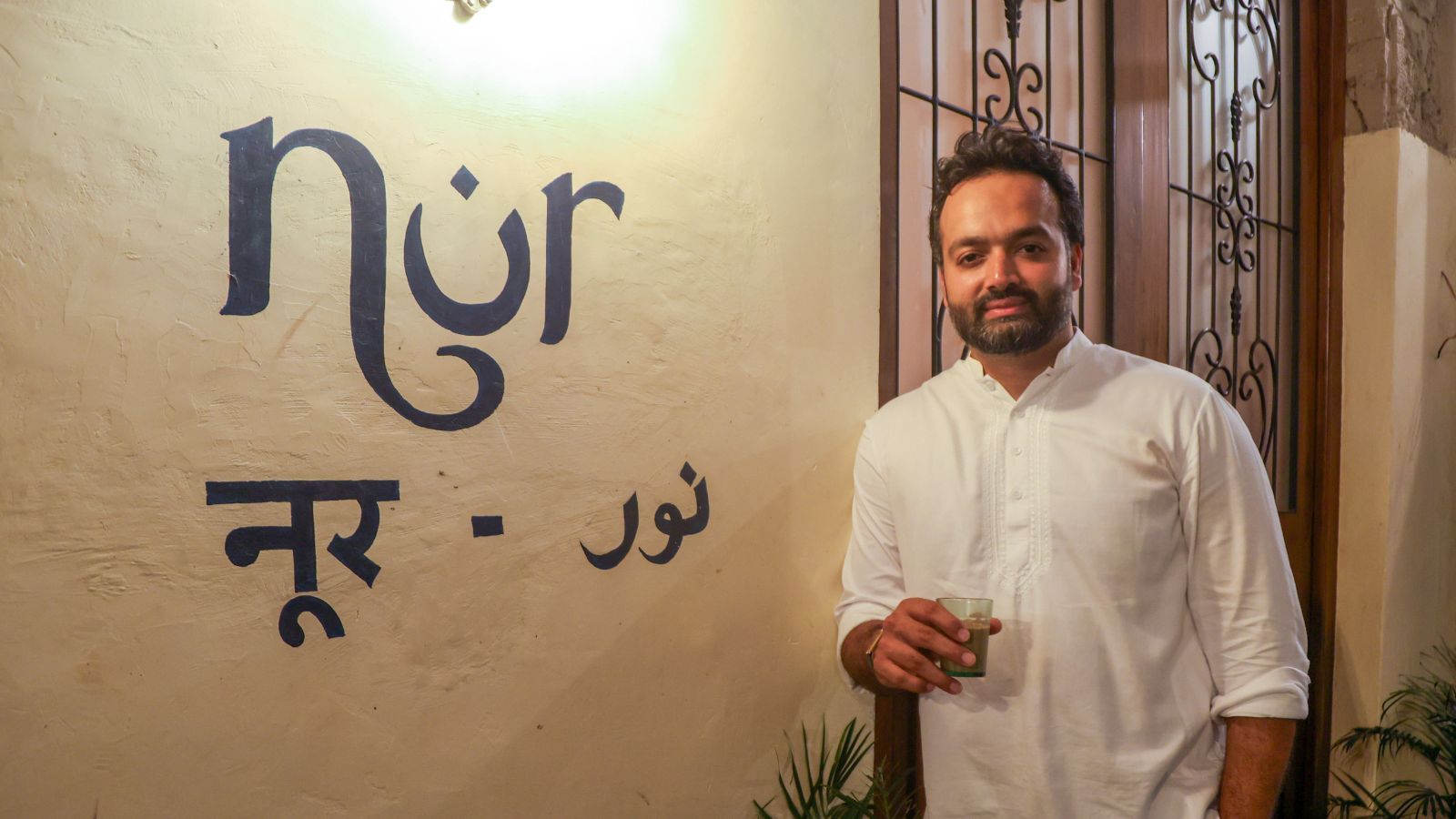
The place is owned and run by first-time restaurateurs Saud Hussain and Rahil Khan. “My partner Rahil is a true foodie, and I also love desi food. However, every new place seemed to be serving matcha or coffee but not Mughlai cuisine that we personally enjoyed. So we thought of bringing the food that we grew up eating to a restaurant,” said Hussain, who previously had a candy manufacturing unit in Ethiopia, adding that they were behind this location for nearly three years. “We picked it because it is a historical location. Other areas, whether Bandra or Lower Parel, more or less look the same. It is Fort that retains the old history, old memories of Bombay. Our food is something like that.”
The menu is only a single page featuring signature kebabs and rolls, Nur dum biryani (available in mutton and chicken), nihari, keema, dal ghost, mutton rosh, nalli barra, chai, coffee, bun maska, malai parantha, tandoori roti, and a khimri naan baked soft with a light polish of ghee, perfect to mop up every bit of the gravy. To drink, there’s a gud sherbat that leans sweet, a litchi rose sherbat where the litchi wins out, and the usual sodas. For dessert: phirni, sewaiyan, kulfi, Pashtun halwa.
Their one-page menu features signature kebabs and rolls, Nur dum biryani, nihari, keema, dal ghost, mutton rosh, nalli barra, malai parantha, and khimri naan baked soft with a light brush of butter. Express Photo by Akash Patil
We went to send off a colleague and ordered fairly widely. The mutton and chicken seekh kebabs were soft and juicy; the chicken malai tikka was well-flavoured too. The nihari didn’t have the spice or the layering you would find at a dedicated nihari joint, but the mutton was cooked through and the gravy did its job soaking into the khimiri roti. The mutton rosh, made with white chana, had a nice bit of crunch from the birista on top — dal-like in texture, and seasoned the way it would be at home rather than in a restaurant.
“The entire menu is oil-free, we use only ghee,” said Hussain, adding that most dishes are made using home recipes. “There is my nani’s slow-cooked nihari, and dal ghost made using three kinds of dals. It was a staple at home every Friday, post prayer. Unlike restaurants, it is not very heavy, and is mildly spiced. There’s Rahil’s mother-in-law’s Nur Special Biryani made during Ramzan. It is a yakhni-like preparation that has dum rice and plain rice, and uses dahi and malai both.”
The food, they insist, is not overtly spiced or made heavy. “We don’t want guest to feel that they are eating restaurant food with a lot of masala, we wanted to keep it as homely as possible.”
Story continues below this ad
In one dining room, parts of the walls and arches are painted a deep red-orange, while century-old chandeliers sourced from Chor Bazaar hang from the ceiling. Express Photo by Akash Patil
The menu is also intentionally kept smaller so that they can give their hundred per cent to every dish. On the vegetarian side — and this is not really a vegetarian menu — the paneer tikka was let down by paneer that was hard and chewy, though the paneer in the paneer tikka gravy was much better. Aatishi aloo was well spiced, and the dal khichdi, finished with ghee and birista, was simple and wholesome. A biryani for non-meat eaters would have been welcome.
It is a request they get often. “People often ask us to add vegetarian biryani and kebabs but we don’t know how to do them right and therefore we haven’t yet,” Hussain said. What did disappoint us was that the malai parantha lacked consistency. While one of them, ordered before our meal, had the right ratio of malai to parantha, it was missing in our post-meal order, which left us with a chewy parantha and craving for some malai.
It’s in the quiet moments that the details come through: a ghisni (the rectangular grater with four legs) propped in a corner, an old iron lock of the kind that once secured home gates, a wooden window with an artificial climbing rose wrapped around it. The walls are bereft of plaster, the original rafters have been left intact. In one room, parts of the walls and arches are painted a deep red-orange, while century-old chandeliers sourced from Chor Bazaar hang from the ceiling. In another, a wall is lined with television sets once found in homes during the 1980s and early 1990s. There is so much to see, all done so subtly, that part of you wants to return, to soak in an era gone by and order another plate of those juicy kebabs.
Saud Hussain co-founded Cafe Nur in May 2025 as a 25-seater space. In a year, it has expanded to three dining rooms, taking its capacity to 110 seats. Express Photo by Akash Patil
“We were in the process of replastering those walls because the old plaster had come off. But when we saw it, we decided to retain it. We haven’t tried to change the natural architecture of the building, and retain whatever we could. The idea was to help people feel at ease, calm when they enter — the way they do in a dargah or gurudwara. The design is inspired by Sufi principles; the place is neither overly decorated nor filled with ornamental design elements. We don’t want the design of the place to take away from the food,” Hussain added.
Story continues below this ad
The reception, he adds, has been strong from day one. “We started with one 25-seater dining room and today we have three dining rooms, taking the capacity to 110 seats, including the alley seating. We have a lot of repeat guests. Whenever somebody visits us, they bring their parents back, which gives us validation.”
View original source — Indian Express ↗
Related stories

Philippine Daily Inquirer
TechnologyJul 11, 2026 · 1 min
Arthur Fery expects to thrive in spotlight after Wimbledon fairytale
Philippine Daily Inquirer

The Guardian
TechnologyJul 11, 2026 · 1 min
‘A new consumer’: how weight-loss drugs are shaking up clothes shopping
The Guardian

TechRadar
TechnologyJul 11, 2026 · 1 min
The more famous people tell me to use AI, the less I want to — it turns out I'm not alone
TechRadar

The Verge
TechnologyJul 11, 2026 · 1 min
Are you filthy enough for a $700 portable shower?
The Verge