Times of Israel
Braving war losses and tough conditions, Thai workers stay rooted in Israeli agriculture
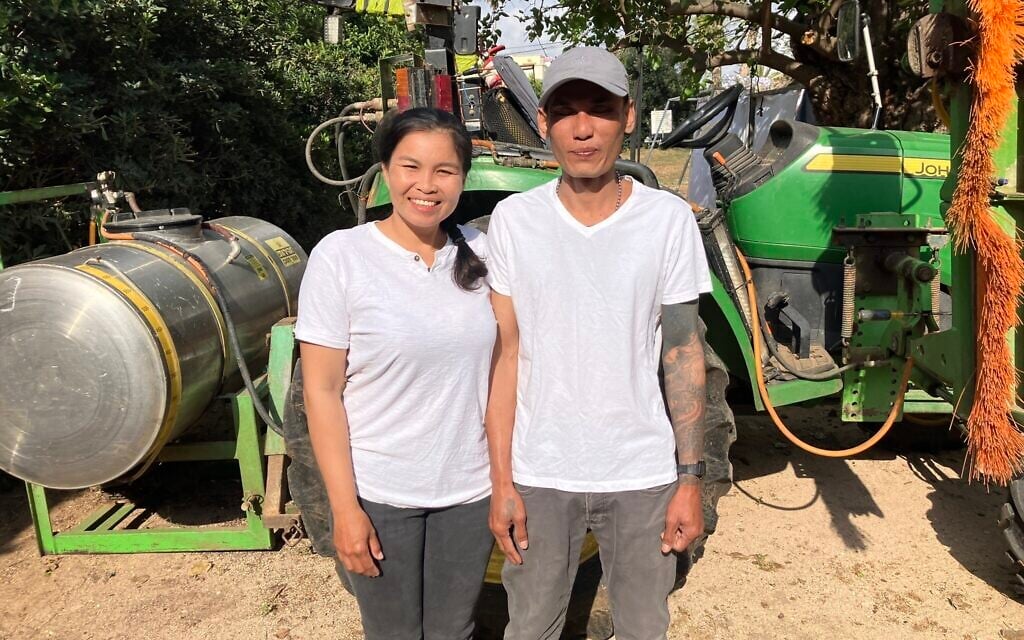
Qwon and her husband, Tay, a Thai couple who tend avocado groves in a small western Galilee farming cooperative, mingled with their Israeli neighbors at a Shavuot celebration in May, marking the Jewish harvest festival near the fields they help cultivate.
A week earlier, four Israeli civilians were wounded, one critically, in a Hezbollah drone attack only 13 kilometers (eight miles) away. Yet, Qwon told The Times of Israel, using her telephone to translate, “I am not afraid because I have confidence in Israeli civilian protection.”
Even after October 8, 2023, when the Iranian-backed terror group began firing almost daily rockets and drones at northern Israel, Qwon and the other nine Thai workers on the cooperative have continued to care for the 1,000 dunams (250 acres) of avocados alongside their Israeli counterparts, often under fire.
Violence has been reduced since a fragile ceasefire between Israel and Hezbollah, mediated by the Trump administration, was implemented on June 19 — though farmers and workers in the north remain exposed.
Despite the danger, Qwon and Tay have stayed in Israel. They are among the tens of thousands of Thai workers who have become essential to Israeli agriculture, helping tend the fields that provide much of the country’s produce.
Get The Times of Israel's Daily Edition
by email and never miss our top stories
By signing up, you agree to the terms
For over two and a half years, they have also borne some of the heaviest costs of war.
Forty-six Thai citizens were killed in southern Israel on October 7, 2023, when thousands of Hamas-led terrorists burst across the border from Gaza, killing some 1,200 people and seizing 251 hostages.
Of those hostages, 31 were from Thailand. Twenty-eight were eventually released. Three died in captivity in Gaza, according to Israeli authorities.
In northern Israel, five Thai farm workers were killed in Hezbollah rocket fire.
Yet looking around at the crowd of Israelis celebrating the holiday, Qwon was visibly upbeat. “I like Israelis,” she said. “Even though I’m a laborer, the people here have never shown any prejudice toward me.”
‘Relatively stable’
Thai workers make up the largest group of foreign workers currently in Israel.
They officially began arriving in the country in significant numbers in 1993, when the Israeli government offered temporary work visas in an effort to reduce Israel’s dependence on Palestinian agricultural laborers for security reasons after the first intifada, which began in 1987.
According to the Knesset Foreign Workers Committee, there were more than 195,000 legally employed foreign workers in Israel as of April 2025, alongside over 33,000 undocumented workers.
At the start of the Israel-Hamas war in 2023, with dozens of their compatriots held captive in Gaza, thousands of Thai workers returned home, and Thailand froze a bilateral agreement allowing more workers to enter Israel. The agreement resumed in summer 2024. Under the program, Thai workers may remain in Israel on valid work permits for up to five years.
“Thai workers are extremely important for the farmers in the north and throughout all of Israel,” said an Agriculture Ministry spokesperson. “Since the wars began, the ministry has finally succeeded in removing barriers that limit the number of workers. It’s now much easier for farmers to obtain Thai workers.”
Assia Ladizhinskaya, a spokesperson for Kav LaOved, a legal aid group for disadvantaged workers, described Thai workers’ conditions generally as “fairly stable.”
Ladizhinskaya explained that because they come to Israel through a government agency, their conditions are “a lot better than those of workers who are recruited through private agencies in other countries.”
“The big picture is positive,” she said.
However, the workers sometimes face substandard living conditions, an hourly wage “which makes them hesitate before they miss any work,” and a lack of legal redress if their employers don’t contribute to their pension fund.
Filling a gap
Thai workers still remain vulnerable to potential drone and rocket attacks from both Hamas in the south and Hezbollah in the north.
“They’ve lived through almost three years of war,” Moti Yanko, manager of Kibbutz Cabri’s 3,000 dunams (750 acres) of banana, avocado, and annona fruit, just south of the Lebanese border, told The Times of Israel, gesturing to some of the 32 Thai workers employed on the kibbutz.
On a cloudy May morning, the men were walking through a banana field, carrying heavy stalks of freshly cut bananas to load onto an open wagon.
Rows and rows of banana trees stretched out in all directions, with no bomb shelter in sight.
“We’re all out here in the fields without any temporary shelters,” Yanko said, referring to the prefabricated concrete structures deployed to provide rapid — albeit partial — cover during incoming missile or rocket fire. “When there’s a siren, I lie down with them on the ground.”
During one Hezbollah rocket attack in 2024, Yanko made a short, satirical video to send to his daughters, reassuring them that he was safe. They suggested he post comic films on social media, which he did.
He reached a wider Israeli audience, then viewers worldwide, as he expressed his appreciation for the Thai workers who labor with him on the kibbutz.
In several videos, Yanko has shouted in his hoarse, signature voice, “Thailand! Thailand!”
Shortly after another Hezbollah rocket attack, Yanko filmed a video of himself wearing a metal remnant of an Iron Dome interceptor missile as a hat.
“When people laugh,” he said, “it raises their morale.”
Yanko then turned to his manager, Najat Badran, 39, who lives in the nearby town of Sheik Danoon, and has been working with Yanko for the past 13 years.
Badran, who speaks Arabic and Hebrew but not Thai, said she communicates with the workers using hand gestures and phone-based translation apps.
She said Thai workers have replaced “the Jews, who went into hi-tech, and then they replaced the Arabs, who also stopped working in agriculture.”
“Nobody wants to carry bananas on their backs anymore,” she said.
Moshav Ben Ami
In Moshav Ben Ami, about seven kilometers (four miles) from the Lebanese border, Benny Senesz lives on the avocado farm that his father, Shaul, started in 1949.
Benny told The Times of Israel that he grew up helping his parents. In addition to agriculture, his mother ran a cat kennel, and his father had a dog kennel. Today, Benny follows in his father’s footsteps at the dog kennel, and his wife, Gila, manages the cats.
When his father was alive, “he did everything in the fields on his own,” Senesz said. “But in addition to our 40 dunams [10 acres], we rent another 60 dunams [15 acres] of avocado groves. We also grow raspberries, so we need workers.”
Inside the pristine property is a small house where two Thai workers live. They grow their own vegetables, including string beans and hot peppers. Senesz put together the flags from Israel and Thailand, and they fly on a tall pole in the avocado groves.
“I don’t send them to work on their own,” Senesz explained. “I’m a farmer. Whatever they do, I do.”
He said that when the war started in 2023, “they were under a lot of stress.”
At first, the workers ran to the mamad, or protected room, and stayed with the extended Senesz family.
“I worry about them, I guard them, and they’re very loyal and appreciate it,” said Senesz, who has since erected a temporary shelter next to the Thai workers’ house where they can go during rocket attacks.
He said that his wife, Gila, takes them to the dentist and medical appointments, and the family celebrates their birthdays with them and gives them gifts.
Napa, who has been working in Israel for five years, told The Times of Israel through a translation on his telephone that he will soon return to Thailand, where his wife and two children “are waiting for me.”
He said he doesn’t yet know what he will do when he goes home.
“I was worried when there were rockets during the war,” Napa said. “My boss told me I could leave. But my livelihood is important to me, my boss is good, and I wanted to stay.”
View original source — Times of Israel ↗
Related stories

The Moscow Times
TechnologyJul 11, 2026 · 1 min
One Killed in Drone Strike on Vessels in Taganrog Bay, Russian Authorities Say
The Moscow Times

Indian Express
TechnologyJul 11, 2026 · 1 min
Television actor Rohit Chandel arrested under POCSO Act over alleged stalking of 16-year-old
Indian Express

TechRadar
TechnologyJul 11, 2026 · 1 min
How to watch The Sentinels from anywhere – it's *FREE*
TechRadar

Philippine Daily Inquirer
TechnologyJul 11, 2026 · 1 min
Vicelles lands IBF world title shot against Simsri in Japan
Philippine Daily Inquirer