Philippine Daily Inquirer
Stratbase urges PH to keep arbitral ruling at center of sea code talks
MANILA, Philippines — The Philippines should insist that the 2016 South China Sea arbitral ruling serve as the legal basis for any future Code of Conduct with China and other claimant states, Stratbase Institute President Victor Andres “Dindo” Manhit said on Friday.
The call came as Manila, which holds the chairmanship of the Association of Southeast Asian Nations this year, pushes for progress on negotiations for a long-delayed and legally binding agreement governing activities in the disputed waters.
READ: Stratbase: Arbitral win is a responsibility, not just a legacy
Article continues after this advertisement
Manhit said the ruling should not be treated as a matter that could be compromised during negotiations.
FEATURED STORIES
WWW
WWW
WWW
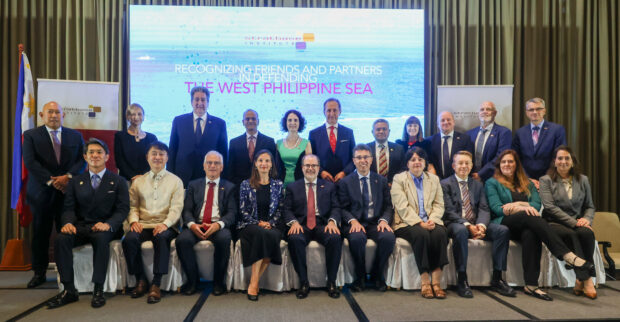
“The Award must be reflected in the ongoing negotiations for a Code of Conduct in the South China Sea,” Manhit said during Stratbase Institute’s commemoration of the 10th anniversary of the landmark 2016 arbitral award.
“Any Code of Conduct must uphold the Arbitral Award as the legal baseline, not treat it as a point for negotiation,” he said.
The Permanent Court of Arbitration in The Hague ruled in 2016 that China’s sweeping claims over the South China Sea had no legal basis under the United Nations Convention on the Law of the Sea (Unclos).
The arbitration stemmed from a 2012 standoff between Philippine and Chinese vessels at Panatag (Scarborough) Shoal.
Article continues after this advertisement
China refused to participate in the proceedings, arguing the tribunal lacked jurisdiction.
On July 12, 2016, the tribunal ruled overwhelmingly in the Philippines’ favor, finding that China’s claimed historic rights within the so-called nine-dash line had no legal basis under Unclos.
Article continues after this advertisement
It also found that none of the features in the Spratly Islands claimed by China generate an exclusive economic zone (EEZ) and that Beijing had violated the Philippines’ sovereign rights by interfering with fishing, petroleum exploration and other lawful activities within the country’s EEZ.
The tribunal also concluded that China had caused severe harm to the marine environment through its island-building and fishing activities.
Beijing has continued to reject the award.
Manhit said completing a regional agreement was important but he warned that a deal that weakened the arbitral award could undermine the purpose of the Code of Conduct.
“Rushing into an agreement that undermines international law, disregards the legally binding 2016 Arbitral Award, would compromise the sovereign rights and maritime entitlements of states,” he said.
Defense Secretary Gilberto Teodoro, who delivered the keynote address at the forum, said the ruling should be viewed as a national interest issue and not a partisan matter.
“The award was not only an award for the Philippines, but an award for the world,” Teodoro said.
He said the decision had shaped the country’s efforts to assert its maritime rights and had strengthened support from other countries for upholding international law in the region.
“It has formed the basis of a national effort to be aware of its entitlements, to be aware of the importance of our maritime rights, not only for us but for future generations of Filipinos,” he said.
Teodoro also said the ruling contributed to changes in the Philippines’ defense posture and expanded cooperation with allies and partners.
Armed Forces of the Philippines chief Gen. Romeo Brawner Jr. said the military’s move toward a multi-domain territorial defense posture was aimed at protecting the country’s ability to determine its own future.
Brawner also praised Filipino personnel stationed in contested areas, including troops aboard the BRP Sierra Madre at Ayungin Shoal, for maintaining discipline during encounters with Chinese vessels.
“They remain disciplined and they remained professional, and that professionalism is one of the strongest forms of deterrence we possess,” Brawner said.
“It demonstrates to the world that the Philippines will defend its sovereign rights firmly but responsibly, with courage but without recklessness, with resolve but always in pursuit of peace,” he added.
Manhit said the 10th anniversary of the arbitral ruling should be a reminder that the decision remains relevant to Philippine policy.
“Ten years ago, the Philippines proved to the world that the law can hold against power. The next 10 years will prove something closer to home: whether we can hold what we won,” he said.
Your subscription could not be saved. Please try again.
Your subscription has been successful.
The Stratbase forum was attended by diplomats and officials from countries including the United States, Australia, Canada, Japan, South Korea, India, New Zealand, the United Kingdom, and members of the European Union. /jpv
For comprehensive coverage, in-depth analysis, visit our special page for West Philippine Sea updates. Stay informed with articles, videos, and expert opinions.
View original source — Philippine Daily Inquirer ↗
Related stories

Antara News
PoliticsJul 11, 2026 · 1 min
Prabowo sets five priorities for NTB after dam inauguration
Antara News

Indian Express
PoliticsJul 11, 2026 · 1 min
Punjab Congress meeting: Channi camp holds talks with Baghel amid leadership row
Indian Express

Dawn
PoliticsJul 11, 2026 · 1 min
Tough living: IT has happened again
Dawn

Al Jazeera
PoliticsJul 11, 2026 · 1 min
Trump threatens Iran after chants for his death erupted at Khamenei funeral
Al Jazeera