Indian Express
‘Risk is not a stranger to us’: Why Mumbai families won’t leave landslide-prone homes
Hours before a tragedy struck a multi-storey chawl in Mumbai’s Mankhurd area amid heavy rainfall on Sunday, July 5, claiming six lives, several informal lodgings on the elevated or stilt homes of Parksite, Vikhroli had already been dealing with another calamity that had befallen them – an event that has so far remained unnoticed. Situated on the least reaches of the massive informal settlement, these houses were reduced to rubble after mud and rocks came crashing down over them.
While no casualty was reported and the authorities did visit to access the damage, tying a ‘danger’ tape bordering the area, the event upended the lives of some of the affected families, leaving them with not even a memory of their belongings.
The affected families said every monsoon, the Brihanmumbai Municipal Corporation (BMC) officials visit the area with a landslide risk alert, asking them to move, but their attachment to the place, where they have spent decades, have kept them rooted.
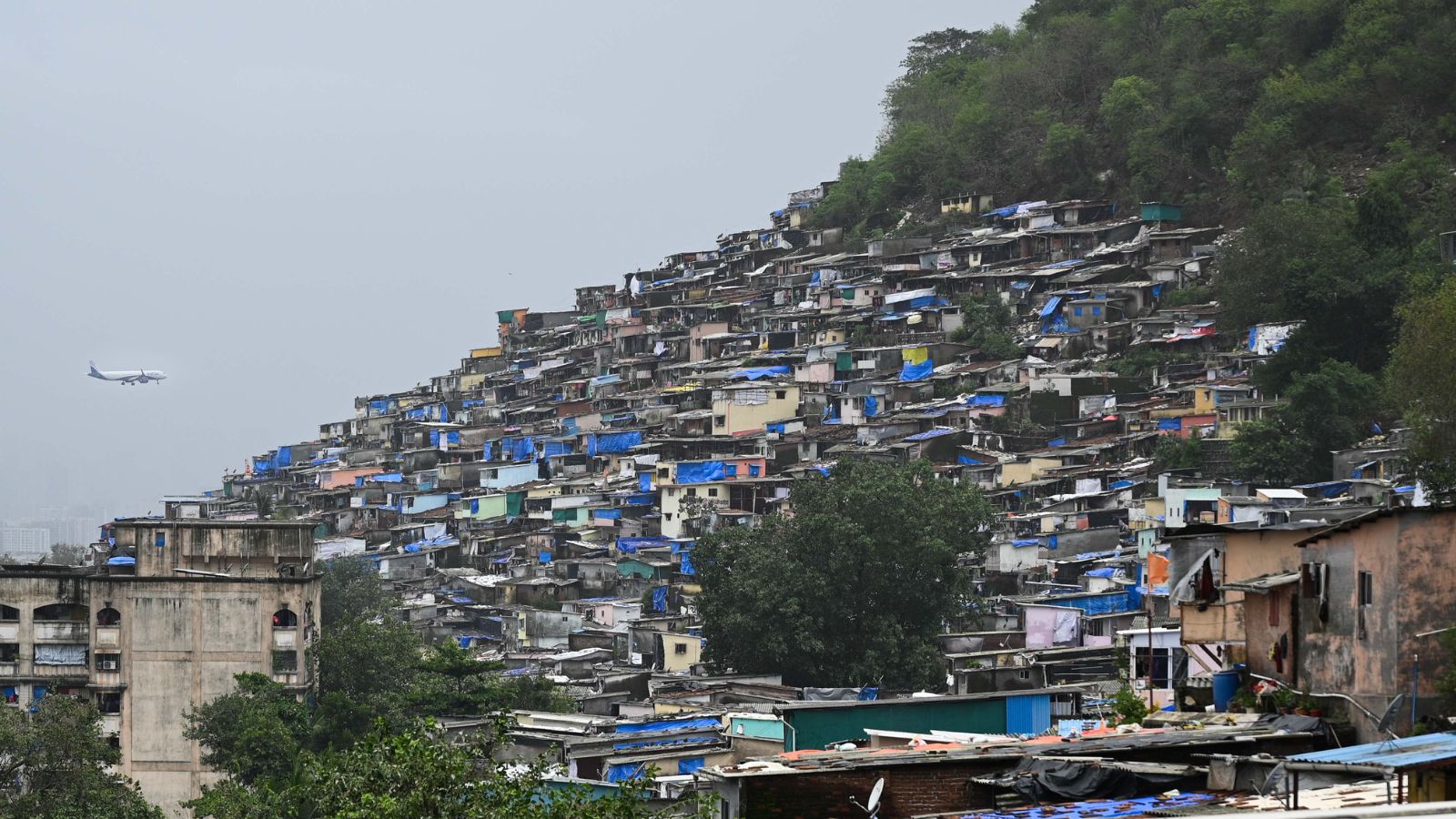
A view of a slum settlement is seen on the slope of a hillock at Vikhroli in Mumbai on 09 July 2026. The area has been marked as a landslide-prone zone by the authorities.
Express photo by Sankhadeep Banerjee.
‘BMC alerts like a ritual’
Living next to four damaged houses, Lakshmi Parab, 58, said, “Risk is not a stranger to us,” as her grandson tugs at her saree. “Every year before the monsoon, like a ritual, the BMC informs us of the risk of landslides and asks us to shift away for the rainy months, washing their hands of any responsibility. But we continue to stay, out of desperation.”
Pushpa Yadav, 65, whose house was completely crushed due to the impact, thanked God thanked God for sparing her and her husband’s lives. Her house, where she has lived since the 90s, was, however, reduced to a pulp.
She said, “It is God’s grace that neither I nor my husband died. I was towards the back of our neighbour’s house, trying to make space for the stream of water coming from the hill to flow down so the water doesn’t add to the load. My husband was sitting on the bed, chanting.”
Yadav said it started small, with only a few rocks and mud sliding down the hill above them. Seeing that, she called for her husband who was still inside their house.
Story continues below this ad
“My husband, a rickshaw driver, is partially deaf. He didn’t hear anything. He was dragged out which saved his life,” she said.
The Yadavs, along with their 30-year-old son who was outside their house when the landslide occurred, stayed with their eldest son for two days at his rented accommodation, but came back to Parksite. Since their house was completely destroyed, they have taken shelter at their neighbour’s house.
“Local leaders have promised they will build our homes back, so that’s what we’re banking on,” said Yadav, adding, “This has been my home since 1992 when I got married, and we gradually made it into a pakka house and brought up my sons. An incident like this has never occurred before this.”
Pushpa Yadav, whose house collapsed due to a landslide, shows her house situated on the slope of a hillock at Vikhroli Parksite area in Mumbai on 09 July 2026. The area has been marked as a landslide-prone zone by the authorities.
Express photo by Sankhadeep Banerjee. 09.07.2026.
Why families continue to live in landslide-prone area?
As the rain continued to batter the area late Sunday night, the residents of Parksite were offered accommodation at a BMC school by the municipal corporation officials, but they refused and demanded a “proper place”.
Story continues below this ad
“If the authorities want us to relocate, they should provide us a proper place to live in,” Parab said.
Parab said, “When it rains in the day, we move away from the walls into a shaded area for some protection. If the rain continues in the night, we go to sleep at our relatives’ home, where it’s relatively safer.”
Newlywed Asmita Mayangade, who had recently moved to the area, has started to shift to another location after the walls of her house developed deep cracks following the landslide.
“We have rented a house opposite to this one, and we’re slowly moving our belongings. But we will continue staying here [at Parksite], and only sleep there [at the rented place] during heavy rains and if we feel the risk is extreme,” said Mayangade, adding that her family was “not willing to shift from the house they’ve called home for years.”
Story continues below this ad
Laxmi Parab and her family are seen inside their house situated on the slope of a hillock at Vikhroli Parksite area in Mumbai on 09 July 2026. The area has been marked as a landslide-prone zone by the authorities.
Express photo by Sankhadeep Banerjee. 09.07.2026.
Are retaining walls a solution?
The residents of the parksite have been pushing for the construction of retaining walls, built to hold the rocks and stabilize slopes. Maharashtra Housing and Area Development Authority (MHADA), the authority which is authorised to build retaining walls in these areas, also supports the idea but the funds are scarce, and retaining walls are few and far between.
A little under half of Mumbai’s population, as per the 2012 census, stays in informal slums that come with structural uncertainty. High up on the hills, this uncertainty is compounded by the risk of landslides.
View original source — Indian Express ↗
Related stories

Indian Express
TechnologyJul 11, 2026 · 1 min
HyperTexting turns web into social media-style feed without algorithms
Indian Express

Philippine Daily Inquirer
TechnologyJul 11, 2026 · 1 min
ADMU issues statement over claims following Dole clarificatory hearing
Philippine Daily Inquirer

Wired
TechnologyJul 11, 2026 · 1 min
Samsung Micro RGB R95H Review (2026): Not the Brightest
Wired

Wired
TechnologyJul 11, 2026 · 1 min
AI Found a Root Bug in Linux That Everyone Missed for 15 Years
Wired