Indian Express
Knowledge Nugget: 200-year old Jodhpuri Mojari gets GI tag — why it matters for UPSC exam
Take a look at the essential concepts, terms, quotes, or phenomena every day and brush up your knowledge. Here’s your UPSC Current Affairs knowledge nugget on GI tags.
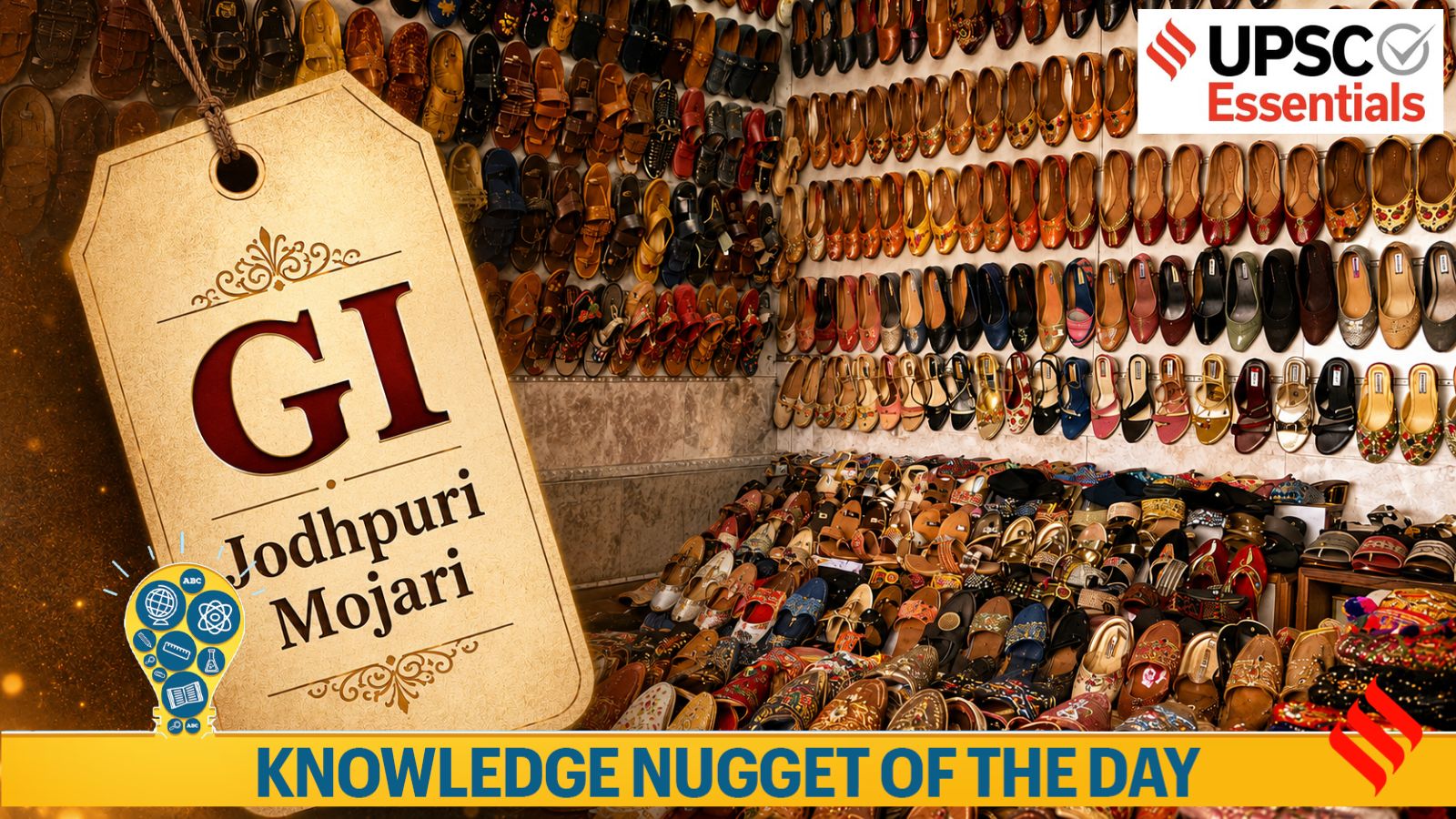
The Centre has granted a Geographical Indication (GI) tag to Jodhpur’s nearly 200-year-old Mojari craft, giving the traditional footwear official recognition and a boost in global branding. The GI Registry handed over the GI certificate to the Jodhpur Handicraft Exporters Association and the Gram Vikas Seva Sansthan. This recognition is a major milestone for Jodhpur’s handicraft industry.
1. Jodhpuri Mojari are crafted by members of a caste called Jinagar, who according to researchers, were traditionally saddle makers. Once patronised by the royals, the Mojari gradually evolved into a distinctive craft giving the city a unique identification. Today, artisans practice the craft in over 5,000 households in Jodhpur
2. Madan Meena, executive member of Kota Heritage Society, said, “The community adopted shoemaking some 250 years ago. They made jeen (saddle) and myaan (leather sheaths for swords and daggers) for the armies. Due to their tradition of making jeen (saddle), they were recognized as Jingars (makers of jeen).”
Infographics by NotebookLM
3. Meena cited a legend that traces the community’s shifting to shoemaking. During the wedding of a Jodhpur ruler’s daughter, the Jingars decided to give a pair of leather shoes with one concealed into the other in such a manner that it looked as if it was only one shoe. Impressed, the ruler appreciated their craftsmanship and suggested they adopt the profession of shoemaking.
4. Mojari, worn by both men and women, suited the hot climate of Rajasthan. It is airy, easy to walk on long distances, tough and flexible, and easy to take off at homes and temples. It was designed as slip-on shoes with the top, side and back of the foot almost bare.
5. Today, Jodhpuri mojari is beautifully embroidered by the local artisans to fit any occasion. With the coming of machine-made lookalikes, this recognition is significant for the survival of this traditional handicraft industry.
Story continues below this ad
6. The domestic market for Jodhpuri Mojari is estimated to be around ₹100 crore, while exports are worth about ₹10 crore. Industry experts believe the GI tag could boost exports and double the business within two years by expanding export opportunities.
How is the GI tag given in India?
1. Geographical Indications of goods refer to the place of origin of a product. Such tags are accorded as they convey an assurance of quality and distinctiveness, attributable to the fact of its origin in a specific geographical locality, region or country.
2. Introducing the Geographical Indications of Goods (Registration and Protection) Act 1999, a sui generis legislation, was a step to recognise such goods. The Act came into force on 15th September 2003. The act was also enacted to comply with the WTO’s TRIPS Agreement (Trade-Related Aspects of Intellectual Property Rights).
3. It provides a legal framework for the registration of geographical indications relating to goods and the prevention and protection of the intellectual property rights granted to a registered geographical indication against fraudulent use. The Department for Promotion of Industry and Internal Trade (DPIIT), Ministry of Commerce and Industry, awards GIs.
Story continues below this ad
4. Further, the National IPR policy, 2016 provides strong emphasis on promotion of GIs across the country. In this regard, the DPIIT set up the Cell for Intellectual Property and Management (CIPAM), to undertake focused action on issues related to IPRs, including GI and address the identified objectives of the policy.
The first product in India to be accorded the GI tag was Darjeeling tea in the year 2004-05.
5. Any association of persons, producers, organization, or authority representing the interests of producers can apply for GI registration. The process involves filing an application before the Geographical Indications Registry which has been established by the Central Government, at Chennai.
6. The Examiner will then examine and scrutinise the application for the tag. Any deficiencies can be remedied by the applicant within a month. Further, if the Registrar has any objections to the application, a show cause notice will be served and the matter will be heard and decided accordingly. Once the application is accepted, it will be published in the GI Journal.
7. Objection can also be made by any person. A notice of opposition must be filled within 3 months of the publication. The applicant can respond to this within 2 months; and if he fails to do so, he will be deemed to have abandoned his application. The parties will then lead their respective evidence, and the matter will be adjudicated. When a GI is finally accepted, it will be registered.
Story continues below this ad
8. Once a product gets this tag, any person or company cannot sell a similar item under that name. This tag is valid for a period of 10 years following which it can be renewed. The other benefits of GI registration include legal protection to that item, prevention against unauthorised use by others, and promoting exports.
9. A GI registration is given to an area, not a trader, but once a product gets the registration, traders dealing in the product can apply to sell it with the GI logo. Authorised traders are each assigned a unique GI number.
BEYOND THE NUGGET: Recent GI tags
Jolbhora Sondesh (Wikimedia commons)
1. Chandannagar’s Jolbhora Sandesh and Janai’s Manohara: In June, West Bengal received GI tags for four more products, taking the total to 21 products. Alongside Chandannagar’s Jolbhora Sandesh, Janai’s Monohara, and Balagarh’s traditional wooden boats have also received recognition.
2. Khurasani Imli of Mandu: The fruit of iconic Baobab trees of mandu, Madhya Pradesh, locally known as Khurasani Imli, was awarded the GI tag in June 2026. It is famous for its distinctive sweet-sour flavour and high nutritional value.
Story continues below this ad
3. Bhagaiya silk, Kuchai silk, Munda jewellery, and bamboo craft of Jharkhand received GI recognition last month. It gives national recognition to crafts rooted in traditional knowledge. The Munda jewellery is known for its distinctive designs, traditional craftsmanship and cultural significance, reflecting the identity of the Munda community.
4. Ponduru Khadi of Andhra Pradesh: Ponduru Khadi is a traditional hand-woven cotton fabric produced in Ponduru village of Srikakulam district in Andhra Pradesh, locally known as Patnulu. The fabric is made using Hill cotton, Punasa cotton, and Red cotton grown in the same region. One of its most distinctive features is the use of the jawbone of the Valuga fish for cleaning cotton, a practice not found anywhere else in the world.
Post Read Question
(1) Which of the following has/have been accorded ‘Geographical Indication’ status?
1. Banaras Brocades and Sarees
2. Jodhpuri Mojari
3. Khurasani Imli
Select the correct answer using the code given below:
(a) 1 only
(b) 2 and 3 only
(c) 1 and 3 only
(d) 1, 2 and 3
(2) India enacted the Geographical Indications of Goods (Registration and Protection) Act, 1999 in order to comply with the obligations to (UPSC CSE 2018)
(a) ILO
(b) IMF
(c) UNCTAD
(d) WTO
Answer Key
1. (d) 2. (d)
Story continues below this ad
(Sources: Why is Pashmina, the ‘Soft Gold,’ important for UPSC Exam?, From red ant chutney to black rice, the 7 Odisha products that have bagged GI tags, From 200-year-old tradition to Rs 100-crore footwear business: Jodhpuri Mojari’s journey to global recognition )
Subscribe to our UPSC newsletter. Stay updated with the latest UPSC articles by joining our Telegram channel – IndianExpress UPSC Hub, and follow us on Instagram and X.
🚨 Click Here to read the UPSC Essentials magazine for June 2026. Share your views and suggestions in the comment box or at [email protected]🚨
View original source — Indian Express ↗
Related stories

Indian Express
TechnologyJul 11, 2026 · 1 min
HyperTexting turns web into social media-style feed without algorithms
Indian Express

Philippine Daily Inquirer
TechnologyJul 11, 2026 · 1 min
ADMU issues statement over claims following Dole clarificatory hearing
Philippine Daily Inquirer

Wired
TechnologyJul 11, 2026 · 1 min
Samsung Micro RGB R95H Review (2026): Not the Brightest
Wired

Wired
TechnologyJul 11, 2026 · 1 min
AI Found a Root Bug in Linux That Everyone Missed for 15 Years
Wired