Indian Express
INS Mahendragiri joins Indian Navy: Rajnath commissions indigenous stealth frigate
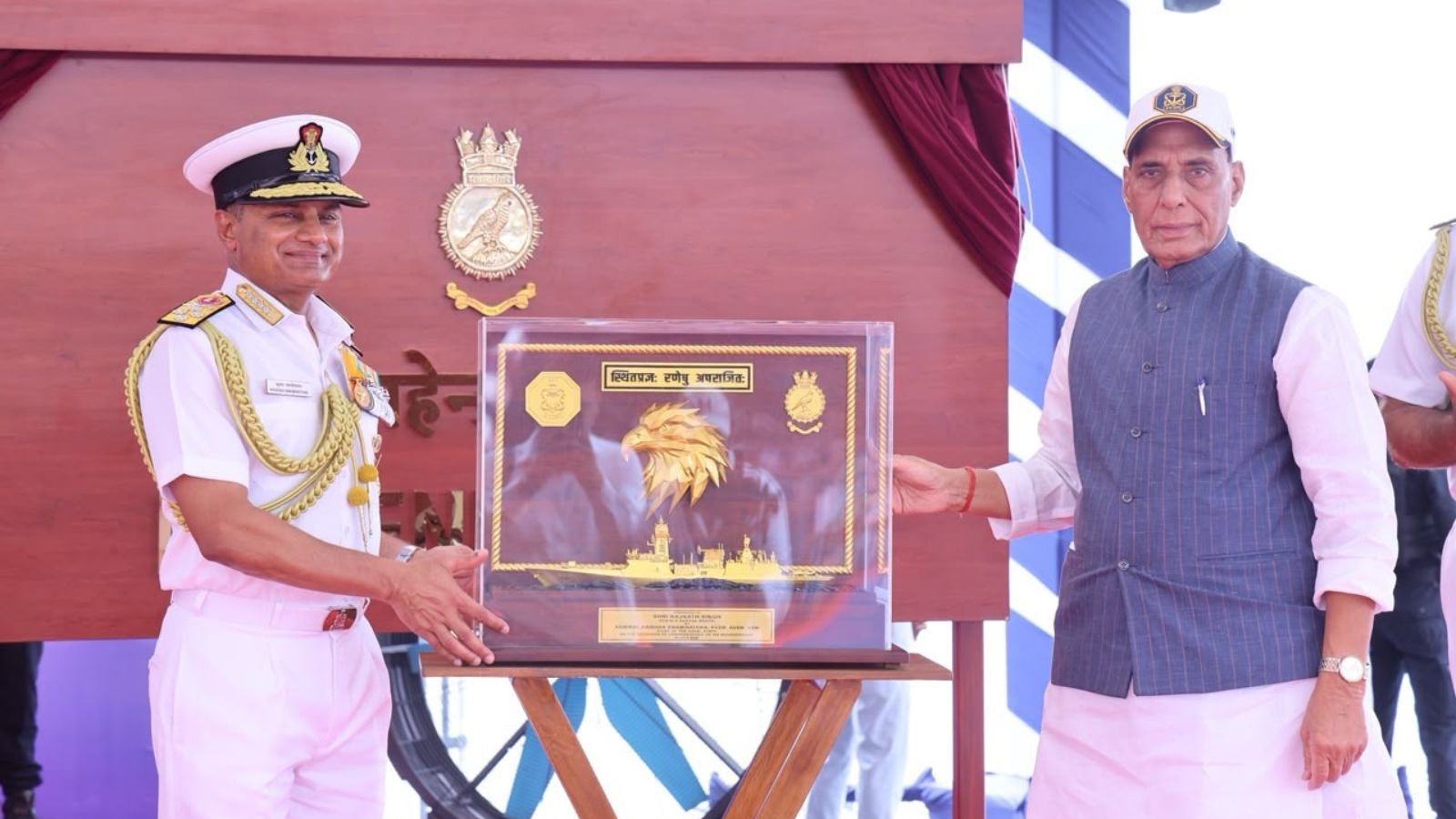
The Indian Navy Saturday inducted the indigenously built advanced stealth frigate INS Mahendragiri into its Eastern Fleet during a ceremony at Visakhapatnam.
Defence Minister Rajnath Singh, who presided over the commissioning ceremony, said the warship will safeguard India’s maritime interests not just near the coast but far out in the deep oceans too. Chief of Naval Staff Admiral Krishna Swaminathan said INS Mahendragiri is a symbol of India’s growing maritime capability and technological self-reliance.
INS Mahendragiri is the sixth Project 17A indigenous stealth frigate to be inducted into the Indian Navy in a span of just 1.5 years.
The first ship of the series, INS Nilgiri, was commissioned in January 2025, followed by INS Udaygiri and INS Himgiri in August 2025, INS Taragiri in April this year, and INS Dunagiri last month.
Designed by the Indian Navy’s Warship Design Bureau and built by Mazagon Dock Shipbuilders Limited (MDL), Mumbai, the ship is capable of undertaking the full spectrum of maritime operations, including fleet air defence, anti-surface warfare, anti-submarine warfare, maritime interdiction, surveillance, and humanitarian assistance and disaster relief (HADR).
Singh, in his address, said the warship is a reflection of India’s growing self-reliance in shipbuilding and its ability to deliver state-of-the-art platforms promptly.
The warship, with over 75 per cent indigenous content, has a displacement of approximately 6,670 tonnes and the capability to reach speeds of up to 28 knots. It is equipped with supersonic surface-to-surface missiles, medium-range surface-to-air missiles, anti-submarine warfare capabilities, and an embarked multi-role helicopter, as well as advanced stealth features, modern sensors, network-centric combat systems, and state-of-the-art weapon suites.
Story continues below this ad
“INS Mahendragiri can be equipped with the BrahMos surface-to-surface missile, one of the world’s fastest and most lethal cruise missiles. It also features a combination of multifunction radar and surface-to-air missiles capable of detecting and neutralising aerial threats at extended ranges,” Singh said.
“Its arsenal also includes an indigenous rocket launcher, torpedo launchers, an integrated anti-submarine defence system, an electronic warfare suite, and a close-in weapon system. All these capabilities make the warship formidable and resilient,” he further said, adding that the “blue-water ship” will safeguard India’s maritime interests not just near the coast but far out in the deep oceans as well.
Singh remarked that while emerging technologies such as drones, artificial intelligence, cyber warfare, space-based capabilities, hypersonic weapons, and unmanned systems have significantly transformed the nature of warfare, conventional military capabilities continue to form the bedrock of effective defence.
“Future wars may be fought with Artificial Intelligence, but they will still be won by national resolve, trained soldiers, and credible military power,” the defence minister said, adding that advanced technologies and conventional platforms complement one another instead of being competitors.
Story continues below this ad
“Operation Sindoor was a prime example of the effective integration of conventional and modern capabilities to safeguard national security,” he said, adding that INS Mahendragiri is a symbol of the nation’s commitment to building a technologically advanced and combat-ready Navy.
Operation Urja Suraksha
Referring to the Indian Navy’s role during the West Asia conflict, he said that under Operation Urja Suraksha, it safely escorted 18 merchant vessels carrying essential cargo valued at over Rs 9,000 crore.
These efforts, he added, reflect the Navy’s role not only as a fighting force but also as a key protector of India’s economic interests. He said INS Mahendragiri will further strengthen this overall maritime strategy, as it will enhance the strength of the eastern seaboard, extend India’s blue-water reach, and further consolidate its presence in the Indian Ocean Region.
He highlighted the government’s vision to establish India as a global hub for shipbuilding and maritime defence innovation, stating that the country is progressing through initiatives such as the Maritime India Vision 2030, which aim to modernise ports, expand inland waterways, strengthen logistics networks, and develop a world-class maritime ecosystem.
Story continues below this ad
Admiral Swaminathan said INS Mahendragiri is a symbol of India’s growing maritime capability and technological self-reliance.
He stated that the commissioning of the sixth Project 17A frigate marks another milestone in indigenous warship construction, significantly enhancing the Indian Navy’s operational capability. He reaffirmed that the Indian Navy remains a combat-ready, credible, cohesive, and future-ready force.
He added that, alongside achieving over 75 per cent indigenous content, MDL and the Navy have set several new benchmarks in this project, including reducing the timeframe from launch to delivery by approximately 50 per cent, from 63 months to 31 months.
He further stated that the total construction time has decreased by 20 per cent, falling from 95 months to 75 months, and all technical analyses have been completed in just a single sea trial instead of the usual five to seven sea trials. These achievements, he said, reflect the collaborative efforts of MDL, Indian manufacturers, MSMEs, the Warship Overseeing Team, trial agencies, and the crew.
View original source — Indian Express ↗
Related stories

The Hindu
WorldJul 11, 2026 · 1 min
Iran’s Supreme Leader pledges revenge for slain father and predecessor
The Hindu

Antara News
WorldJul 11, 2026 · 1 min
New carbon credit issuance supports sustainability: ministry
Antara News

Al Jazeera
WorldJul 11, 2026 · 1 min
China prepares as Typhoon Bavi leaves Taiwan
Al Jazeera
TASS
WorldJul 11, 2026 · 1 min
Iran's Supreme Leader vows to avenge death of Ali Khamenei, other Iranians
TASS