Indian Express
PM to flag off India’s first hydrogen train: How they work, and why they haven’t picked pace globally
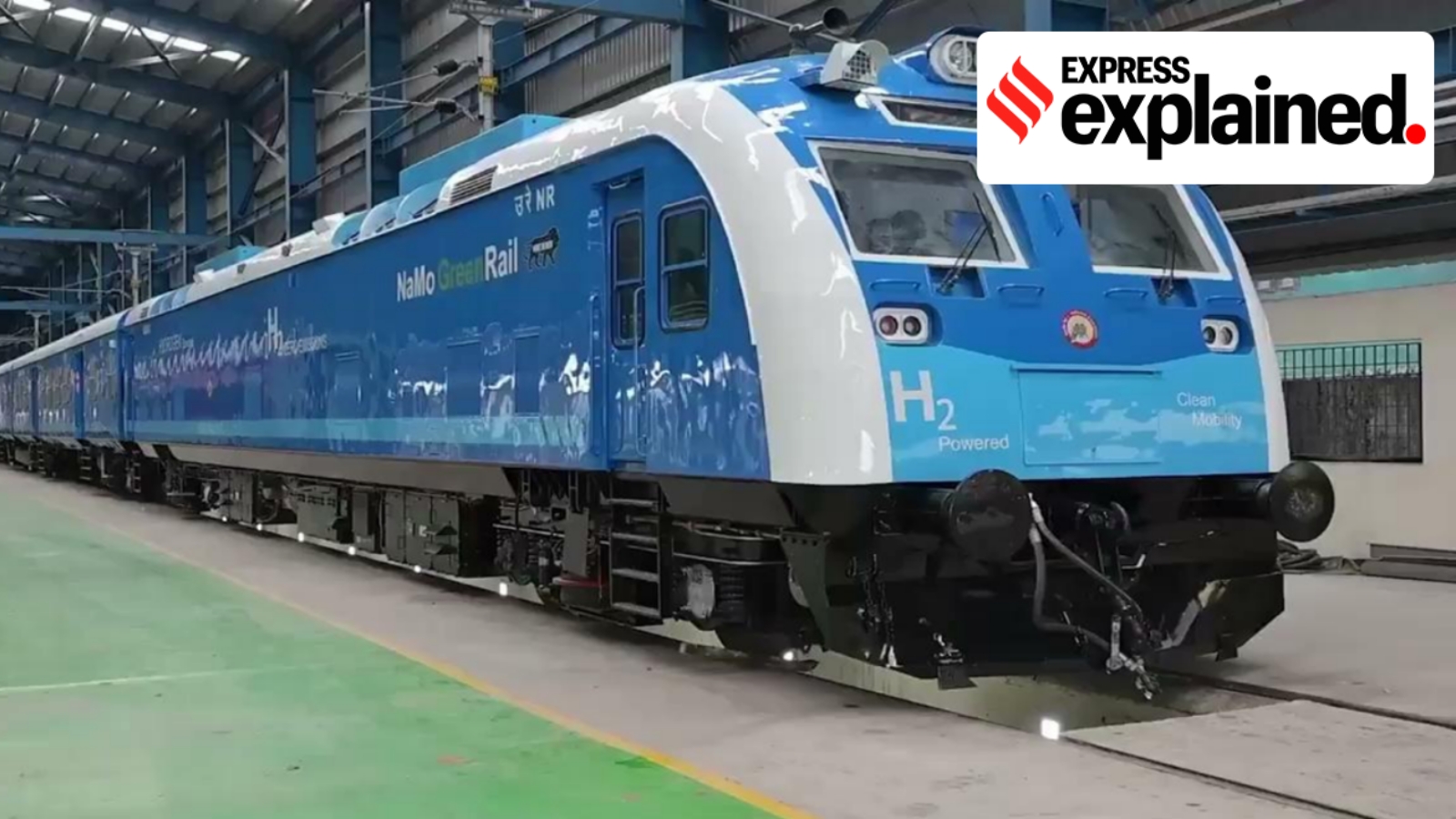
Prime Minister Narendra Modi will flag off India’s first hydrogen-powered train in Jind, Haryana on July 17. This will mark a major milestone for the Indian Railways in a green technology where few countries have ventured so far.
According to the Railways, this is one of the world’s longest (eight passenger cars and two driving power cars) and most powerful (2400 kilowatt) hydrogen trainsets.
The train can carry at least 682 passengers on the 89-km Jind-Sonipat railway section at a maximum operational speed of 75 km/h. It will make two round trips a day, covering 356 km and consuming an estimated 300 kg of hydrogen.
Hydrogen is highly flammable and needs to be transported at very high pressure. How will the Railways do this? And how will the train work? We explain.
Hydrogen trains elsewhere
French rolling stock giant Alstom presented the technology for the first time at a 2016 exhibition in Berlin. Its two-car trainset, the Coradia iLint, was launched in Germany two years later, becoming the world’s first hydrogen-powered passenger train.
Later, countries such as Japan, China and the US also launched their own hydrogen-powered trains.
The technology, however, is still evolving to cater to the mass transportation of passengers and freight. That is why few countries have hydrogen train services, and those that do use them mostly for relatively short trips.
Story continues below this ad
How do hydrogen trains work?
Normal electrical locomotives require overhead wires to draw the alternating current that powers their movement. Hydrogen trains don’t. They run on the simple formula of combining hydrogen with oxygen to produce the tractive electricity.
In the Indian hydrogen train’s case, each of the two driving power cars will have four sets of integrated power packs, comprising hydrogen fuel cells and a lithium ferro phosphate battery.
The hydrogen fuel cell will draw in the hydrogen stored on board (440 kg) at high pressure and oxygen from the outside air, then combine them to release electrical energy.
One power pack will release 300 kW of energy — 115 kW from the fuel cell and 185 kW from the lithium ferro phosphate battery. The four power packs will provide 1200 kW of power.
Story continues below this ad
Since the train has two power cars, the total power generated doubles to 2400 kW (3200 hp). This is comparable to the power generated by normal ‘electrical multiple unit’ or ‘diesel electric multiple unit’ trains, which cover similar short-haul distances.
A senior Northern Railway official said that the train was essentially created by replacing the diesel engines on old ‘diesel electric multiple unit’ rakes with a zero-emission hydrogen-electric propulsion system.
The layout of the power car of a hydrogen train
The official explained the working of the power pack of the hydrogen cell and battery.
Story continues below this ad
“The fuel cell provides a constant power output, meaning it does not fluctuate with the train’s changing power demand. When the train starts moving, it initially draws the power from the fuel cell, and since the train’s power requirement at that stage is lower, the surplus electricity from the fuel cell goes into charging the onboard battery. As the train reaches higher speed and its power demand increases, the battery kicks in to provide power in addition to the fuel cell,” he said.
“Later, when the train’s power requirement goes down, especially when the train is nearing the station, the battery power cuts off and the excess energy of the fuel cell starts charging the battery. Thus, after covering a complete circuit, the battery is almost 80% charged at the end of the journey,” said the official.
The main part of the system — the fuel cell — has been imported from the Canadian company Ballard, which specialises in its production.
Storing and supplying hydrogen
Normal atmospheric pressure is measured as one “bar”. Hydrogen, however, has to be stored at 200-500 bar. This is the biggest challenge in using hydrogen as a clean fuel in trains. There are other issues too. Hydrogen production levels are low and transporting is difficult.
Story continues below this ad
To ensure the continuous supply of hydrogen for the trains, the railways has set up a 3000-kg-capacity fueling facility at Jind. A chiller plant has also been developed to keep the hydrogen at minus 15 degrees Celsius during dispensing — the low temperature will transform it into a liquid state and, thus, ensure its easy dispensing.
The approvals
Northern Railway took on the Rs 136-crore project in 2020-21, with work starting in April 2022 after the tender was awarded to the Hyderabad-based company Medha, which supplies propulsion equipment to the Indian Railways.
The train set has completed all its trials, and the Ministry of Railways granted a sanction for its operation on May 22.
Story continues below this ad
The Railways, however, has not yet announced any other hydrogen train project. The official quoted above said that the future of the project would depend on how the first train works.
View original source — Indian Express ↗
Related stories
Indian Express
TechnologyJul 11, 2026 · 1 min
Abu Salem in prison: Jail seeks clarity over Rs 16.51 lakh pending fine
Indian Express

TechCrunch
TechnologyJul 11, 2026 · 1 min
OpenAI bets on families as ChatGPT goes deeper into households
TechCrunch

Engadget
TechnologyJul 11, 2026 · 1 min
Engadget review recap: Steam Machine, Samsung Music Studio 7, Oura Ring 5 and more
Engadget
Indian Express
TechnologyJul 11, 2026 · 1 min
UPSC Key: PM Modi in New Zealand, Kerala birth rate and E20
Indian Express