Indian Express
How Mumbai’s Kanjurmarg landfill recorded decline in complaint numbers
Two months after the University of California, Los Angeles (UCLA) classified Mumbai’s Kanjurmarg landfill among the world’s top 25 methane hotspots, Brihanmumbai Municipal Corporation (BMC) records show a sharp decline in complaints related to foul odour from the site.
The decline follows the Bombay High Court’s (HC) direction earlier this year to constitute a monitoring committee and implement immediate measures to curb the persistent stench emanating from the landfill.
According to BMC data, the civic body received 555 odour-related complaints in January, 811 in February, 616 in March, 435 in April, 320 in May and 204 in June. No complaints have been recorded so far in July, despite heavy monsoon rainfall over the past week.
Landfill odour typically intensifies during the monsoon as rainwater percolates through waste, accelerating decomposition and the release of foul-smelling gases. However, complaint numbers have remained low this season.
Deputy Municipal Commissioner (Solid Waste Management) Kiran Dighavkar attributed the decline to a series of mitigation measures implemented over the past six months following the High Court’s directions.
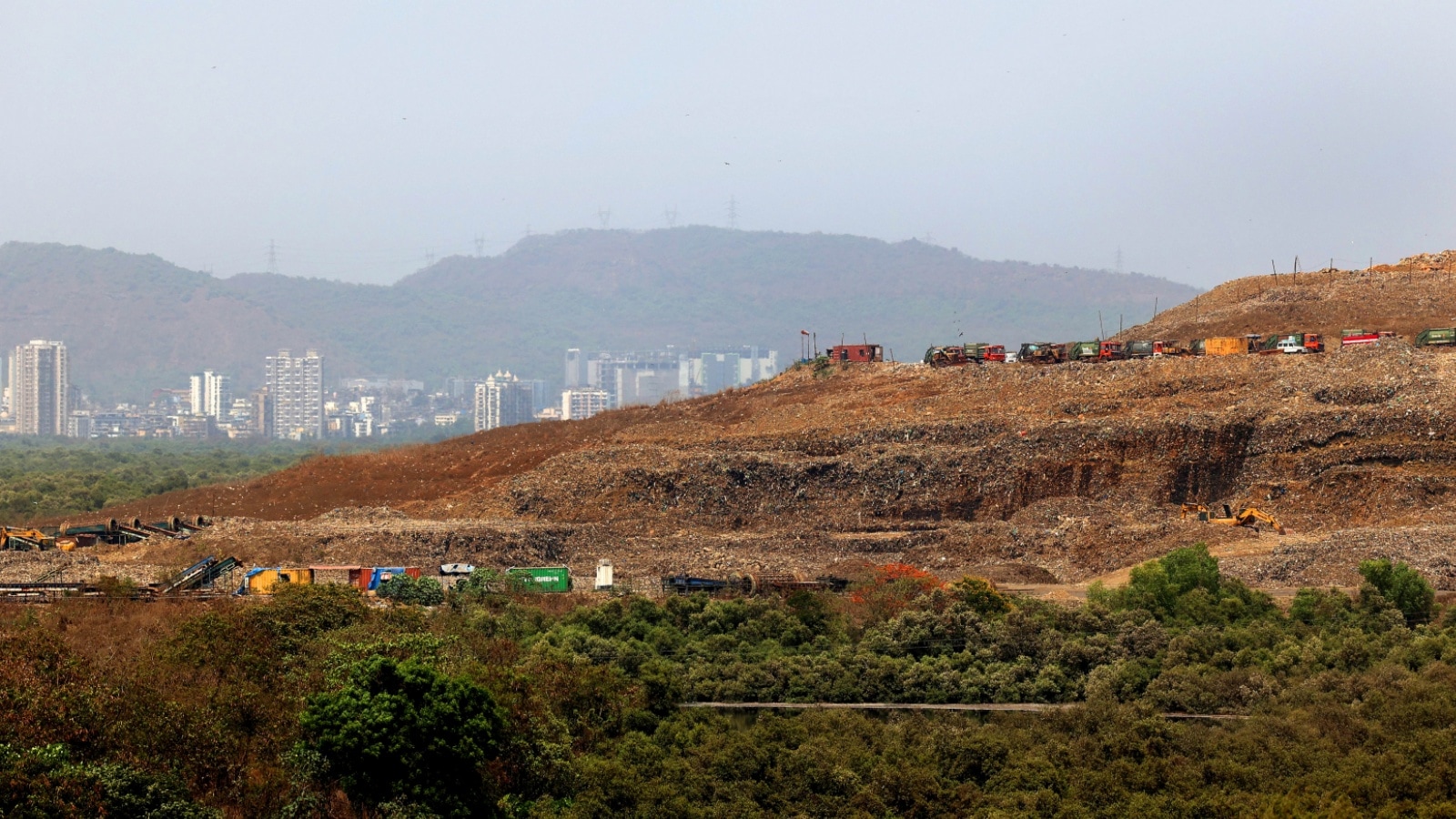
“We have capped the exposed waste mounds with soil, preventing solid waste from coming into contact with the atmosphere,” Dighavkar told The Indian Express.
He added that the BMC has also deployed odour-neutralising chemicals and enzymes through misting systems to suppress foul-smelling emissions.
Story continues below this ad
“As an additional measure, Tarpaumatic Covers have been imported and deployed over the bioreactor landfill cells in line with the Monitoring Committee’s directions,” he said.
Located on Mumbai’s eastern edge, the 144-hectare Kanjurmarg landfill receives around 6,100 metric tonnes of waste every day—about 86 per cent of the city’s daily waste generation of 7,100 MT. Operational since 2011, the site has accumulated nearly 189 lakh metric tonnes of waste, with garbage mounds rising between 40 and 50 metres.
Residents of Kannamwar Nagar, which borders the landfill, have for years complained of persistent foul odour and respiratory ailments, forcing many to keep their windows shut throughout the day. Several residents subsequently approached the Bombay High Court seeking closure of the landfill.
In May 17 — days after the UCLA report was published, The Indian Express had reported how the landfill’s odour was affecting the health and well being of residents not only in Kannamwar Nagar but also in neighbourhoods 5-10 km away, including Bhandup and Vikhroli. Following the report, Deputy Chief Minister Eknath Shinde and Municipal Commissioner Ashwini Bhide visited the site, while the court-appointed monitoring committee conducted multiple inspections.
Story continues below this ad
“In the last one-and-a-half months, more than 16,000 trees and saplings have been planted at the site, and the number is expected to reach 25,000. Combined with round-the-clock mist spraying, these measures have significantly reduced the smell,” a member of the court-appointed monitoring committee told The Indian Express.
Experts said green buffers help slow wind speeds and disperse odorous air before it reaches residential areas.
“Tree plantation can help reduce the spread of odour, but it cannot address the source of emissions. Landfill gases such as hydrogen sulphide, ammonia, volatile organic compounds and methane are generated by decomposing waste and require engineering solutions for long-term control,” said biologist Prakash Rai.
Residents, however, cautioned that while the foul smell has reduced, methane emissions remain a concern.
Story continues below this ad
“While the foul smell has reduced, methane and other landfill gases continue to be a concern. The authorities must focus on significantly reducing methane emissions, as methane is odourless yet extremely harmful. In the long term, this issue needs to be addressed comprehensively,” said Sanjay Yelve, a Kannamwar Nagar resident and petitioner before the Bombay High Court.
Civic officials maintained that shutting down the landfill is not a practical option despite the ongoing litigation.
“In a land-starved city like Mumbai, identifying another 100-hectare site is virtually impossible. Any alternative landfill would have to be located 25-30 km beyond the city limits, increasing fuel consumption, transportation and operational costs, which would ultimately burden taxpayers,” a senior civic official said.
Officials said the BMC’s long-term plan includes setting up a waste-to-energy plant to process daily waste and a biomethanation facility for wet waste treatment at the site.
View original source — Indian Express ↗
Related stories

Times of Israel
TechnologyJul 11, 2026 · 1 min
Trump admin subpoenas NYT journalists over report on Air Force One security concerns
Times of Israel

TechRadar
TechnologyJul 11, 2026 · 1 min
Laptop specs are getting more confusing – here’s what actually matters in 2026
TechRadar

The Verge
TechnologyJul 11, 2026 · 1 min
Nintendo’s Talking Flower got a small price cut
The Verge

The Verge
TechnologyJul 11, 2026 · 1 min
FL Studio head Constantin Koehncke turns to Reddit for feedback and fun
The Verge