CNA
Move over brownies and matcha, beautifully designed flats are the new home-based business venture
In 2020, a couple reached out to Ms Geraldine Toh on Instagram with an unusual request: would she help style their bookshelf?
Ms Toh had just finished renovating her Housing and Development Board (HDB) flat and had been documenting the experience on her account for fun.
By then, her account had amassed thousands of followers and messages asking almost daily where she found a lamp or a chair.
But the request to enlist her expertise was a first, and she soon found herself in the couple's living room in Ang Mo Kio.
Ms Toh, 34, who now works as a freelance artist, recalled: "It seems quite crazy in hindsight because we were total strangers.
"But it was very exciting to me because my house was already fully furnished. So if someone else offered me their space (to play with), sure!"
Soon enough, the art teacher in her took over.
Thoughts raced through her mind: Should she colour-code the books on the shelves or arrange them by size? Which ones should be laid horizontally? How could she create little vignettes, or curated clusters of objects, within the shelves?
She took an afternoon to finish styling the bookshelf.
"I didn't charge for it, but they gave me a red packet (a token monetary gift) to thank me for my help. That became my first 'portfolio'," she said.
Slowly, more followers started approaching her for help styling their rooms and even renovating their homes.
Then came requests to paint murals in their living rooms and, later, commercial spaces.
By Feb 2021, Ms Toh had left her teaching job to focus on her growing suite of services full-time.
"I created the Instagram account purely to post pictures at first. So it's quite miraculous to see how things have panned out."
AN ARTISTIC EYE, A GROWING BUSINESS
Ms Toh belongs to a group of homeowners capitalising on Singaporeans' growing appetite for well-designed and styled living spaces.
Those with an eye for design are offering their styling services and using their own homes to showcase their skills.
Others are opening up their beautifully curated homes as locations for photoshoots and video productions.
Ms Toh explained that her services fill a specific gap: it is easy to assemble a "moodboard" – a collage of images with design ideas – on popular visual discovery platform Pinterest, but much harder to pull it off in real life.
For starters, the furniture featured in those images can rarely be found in Singapore.
That is where Ms Toh steps in with her curated list of sources, from lesser-known retailers to vintage sellers on e-marketplace Carousell.
"I often save nice things that I see online and go window-shopping to 'update' myself. I like to tell people that I have a little inventory in my mind."
But even when homeowners know where to buy what they want, putting everything together is another challenge.
A dining table and a pendant lamp might each look beautiful on their own, for example, but clash with the wall's colour tones or feel out of place within the room's proportions.
Realising that styling should not be done in silos, she at first partnered with an interior design firm to complement its services.
More recently, she has even branched out into end-to-end interior design services, with fees starting from S$8,000 for homes that are about 600 to 700 sq ft.
In the meantime, a separate thread of her business has also been gaining traction: murals.
After followers spotted a pink peony she had painted on her wall, they started commissioning Ms Toh to paint tropical plants in their living rooms and exotic animals in their nurseries.
A mural that measures 2m to 3m on each side costs between S$2,500 and S$5,500, and takes her up to three days to complete.
Her most memorable project was a mural of poppies painted for a client who was battling cancer.
Despite her illness, the woman was enthusiastic about personalising her new home and was advised by her fengshui master to incorporate an element of fire.
"I know that for some homeowners, it may just be a painting on the wall. But for her, I think it meant a lot more.
"I felt honoured to be able to do that for her."
These days, Ms Toh has also begun taking on commercial projects, including her most recent floral mural along River Valley Road.
KEEPING IT REAL IN THE CREATOR ECONOMY
For other homeowners with a knack for styling, showcasing their homes on social media is the primary gig, with income driven by paid partnerships and affiliate marketing.
Just last year, Ms Dee Lee, whose Instagram account is @hometrulee, left her full-time teaching job to focus on content creation.
In 2019, she started the account to document her new marital home.
The account, which now has more than 27,000 followers, evolved into one that spotlighted good buys for the budget-conscious homeowners.
In less than a year, an email from clothing brand Uniqlo landed in their inbox, asking whether they would like to feature its new line of bed linen.
The 36-year-old, who works as a full-time content creator today, said: "We were so excited. Back then, most of the (early) influencers were doing lifestyle content, and we didn't think our home account could land us in the social media space."
When brands collaborate with content creators such as Ms Lee, they typically offer some combination of complimentary products, cash vouchers or direct remuneration in exchange for a post or the use of their visuals.
This first partnership with Uniqlo didn't come with payment, but the couple was thrilled to work with an established brand.
"The fact that Uniqlo saw potential in our account gave us a confidence boost."
Soon, paid partnerships began to roll in.
However, as her influence grew, Ms Lee started to question if she was comfortable with her work.
Was she encouraging people to achieve an ideal home at all costs? This would run counter to the couple's own prudent ways, given that they had spent only S$20,000 to renovate their home.
To keep things real, she also decided to be more selective about the gigs she accepted.
As a cat owner, for instance, it would not make sense to promote aroma diffusers, many of which can be harmful to her pet. Nor does her three-room HDB flat need multiple robot vacuum cleaners.
"Our whole idea is to do only what aligns with us. If we feature products we don't actually use, purely for the sake of money, we would be moving in the wrong direction."
One solution she found was affiliate marketing.
As an affiliate of e-commerce platform Shopee, she shares links to products she uses with her followers, earning a small commission when a purchase is made through the site.
These commissions can range from a few cents to a couple of dollars, depending on the seller and product type.
While these links may attract hundreds or even thousands of clicks, only about 10 per cent of users go on to make a purchase.
"I don't feel bad or guilty about sharing them, because these are things I truly use," she said.
Ms Lee revealed that the income from content creation does not match that of full-time employment, but it gave her enough confidence to leave her teaching job last year – after years of juggling it alongside content creation on weekends.
Since making the leap, her account has expanded to include travel, lifestyle and personal stories.
Although full-time content creators such as herself remain a minority today, she believes that it could change in the next few years, especially as the job market becomes less stable.
"Some people might think, 'Even if I lost my job now, I have this account that I can work on while looking for something else'."
WHEN HOME BECOMES A FILM SET
Even without a strong social media following, some homeowners have found opportunities to turn their well-designed homes into side hustles.
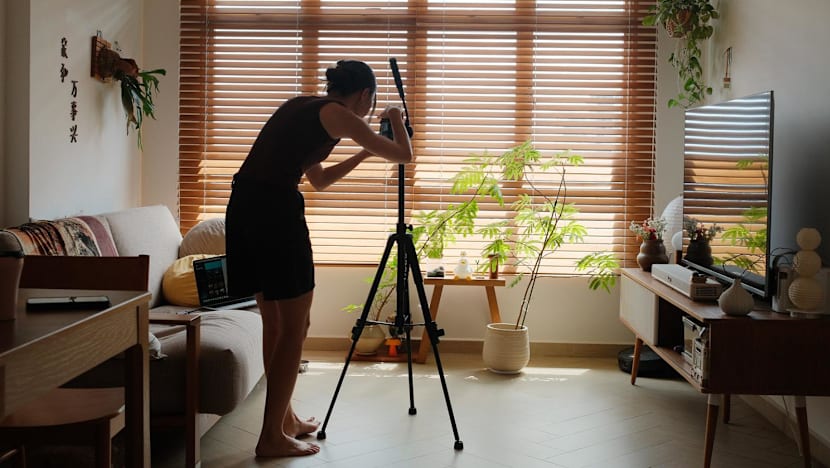
Ms Seah Jia En, 32, who works in marketing, has been offering her home as a filming venue.
Shortly after moving into her four-room Build-to-Order HDB flat in Ubi, a friend told her about online platforms that allow homeowners to do just that.
"It seemed like a viable source of income. Because I'm now freelancing, I can be home on weekdays and fit the shoots into my schedule."
Her clients include production houses and brand marketing teams shooting television commercials, social media content and even music videos.
A four-room HDB flat such as Ms Seah's can fetch up to S$120 an hour, with extra charges for site visits and weekend bookings.
She also requires a minimum six-hour booking to make each shoot worth her while, given the preparation work and the clean-up involved.
Since listing her home on the platform in late 2024, Ms Seah has received a booking almost every other month and hosted more than 10 shoots.
Her largest production to date saw a crew of 30 take over her home for three days, giving her minimalist space a makeover and styling it with photographs to make it feel more "lived in".
Overnight, Ms Seah and her husband were surrounded by images of strangers in their own home.
"That was the most memorable because we had to live with the decor for three days."
Her dining area also became a "gaming room" for the production, but she could not disclose any further details due to a non-disclosure agreement signed with the company.
The clean look, her lack of personal items and few built-in fixtures seem to be a key selling point for her home, she said, because it allows production teams to create whatever set they need.
It also helps that she has a spare room that can be used as a holding area for the models and actors appearing in front of the camera.
While Ms Seah dabbles in content creation, opening her living space in this way also has the side benefit of learning from professionals at work.
These include how they harness natural light or how they frame a shot, which has been an "eye-opening experience".
However, she cautioned that this arrangement is not for everyone, especially those who are protective of their homes.
After all, moving bulky equipment in and out can lead to scuffs and scratches, and hosting large groups of strangers comes with a degree of unpredictability.
"Your home is your safe space, but the 10 to 20 people present will just treat it as a place to shoot for a few hours," she said.
"Over time, I got better at setting house rules like no shoes (in the flat) and no smoking."
For shoots set in the master bedroom, Ms Seah requires clients to provide their own bed linen. She also emphasises having contracts in place to hold clients accountable for any damage.
To minimise disruption to her neighbours, Ms Seah briefs her clients on where to stow equipment outside the flat without obstructing fire escape routes or corridors.
"Fortunately, most of the work does not disrupt the neighbours too much, because the shoots are held during working hours on weekdays. I'm also thankful for my neighbours' understanding."
The most important step, she stressed, is getting buy-in from everyone you live with, because shoots can be disruptive, especially when they run into the wee hours or require plans to be set aside.
Ms Seah's husband needed some convincing at first, but came around after seeing the finished product on screen.
She said: "We spent a lot on our home renovation journey and put a lot of thought into it. To see our 'project' come to life on the big screen is quite cool."
Source: CNA/ma/sf
Related stories

The Punch
WorldJul 11, 2026 · 1 min
What you need to know: UK tightens immigration rules affecting work, study, family visas
The Punch

Dawn
WorldJul 11, 2026 · 1 min
'Our land, our sky:' West Bank Palestinians fly kites in defiance of Israeli settlers
Dawn

Straits Times
WorldJul 11, 2026 · 1 min
US delegation in Lebanon to discuss Israel ‘pilot zone’ withdrawal: official
Straits Times

BBC
WorldJul 11, 2026 · 1 min
'Where can I get blonde highlights?': The most unusual requests to British embassies
BBC