CNA
Can you afford to have kids? It's not just the expenses to consider, but what you'd give up
Voices
While the costs of raising a child do add up, starting a family may seem even more financially unattainable if couples aren't willing to give up their current lifestyles, says finance blogger Dawn Cher.
New: You can now listen to articles.
This audio is generated by an AI tool.
11 Jul 2026 09:30PM
Before the Child LifeSG credits expired on Jul 6, I posted a well-meaning reminder on my Instagram account.
I assumed only a handful of parents needed this reminder, and that most would have already used the credits to offset their expenses. However, to my surprise, I was mistaken.
Many parents around me suddenly realised they were "richer". Some had forgotten about the credits entirely, while others knew vaguely that they had received something, but had not figured out how to use them before the deadline.
These Child LifeSG credits were introduced by the government last year to families with Singaporean children aged 12 and below to help defray household expenses. Eligible families received S$500 (US$387) per child via the LifeSG mobile app.
For a family like mine with two children, S$1,000 covers groceries, diapers, school supplies, enrichment classes or a month of childcare-related expenses.
Yet the fact that many parents had not spent or claimed the credits struck me as surprising, because I often hear fellow parents say the same thing: raising a child in Singapore is expensive.
When my husband and I contemplated having kids, we considered the obvious financial expenses like pregnancy check-ups, delivery fees, infant care and milk powder, among other things.
But now as a mother of two, I've realised that when questioning whether a couple can afford a child, the answer isn't a simple mathematical calculation of tallying the long laundry list of expenses.
Sure, necessities and enrichment costs do add up. But there's also the potential cost of trying to sustain our pre-parenthood lifestyle with a child in the mix.
How willing are we to adjust our regular routines? Can we still save, invest and afford a holiday or two alongside a baby?
THE HIDDEN COSTS
When people discuss the cost of having children, we often focus on the obvious financial expenses.
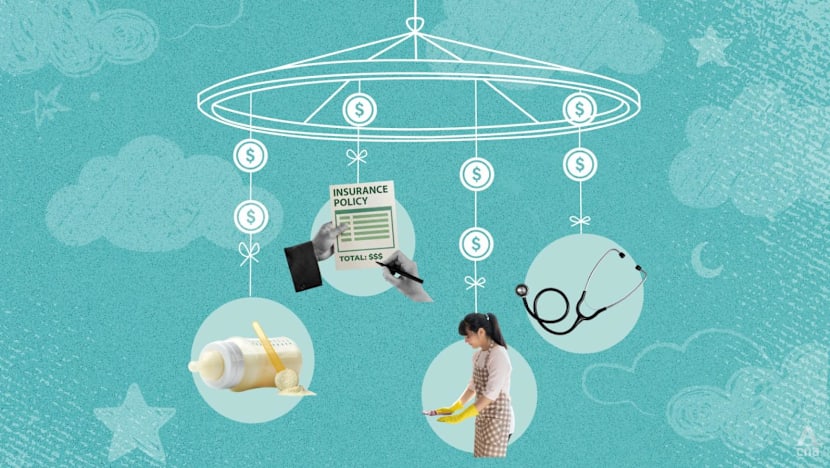
Diapers. Medical bills. Childcare. Birthday parties. Family holidays. Domestic help. The list goes on and on.
Beyond that, there's also the cost of wanting our children to have the opportunity to be their better selves, such as signing them up for enrichment classes to broaden their horizons or tuition classes to help them keep up with the academic rigour of our education system.
These are real costs, but they are only part of the picture.
The bigger adjustment is that the arrival of a child changes the financial structure and rhythm of a household.
Before having children, a couple may be able to survive comfortably on two incomes. They can eat out, travel, save, invest and recover from financial mistakes more easily. If one person loses a job, the other person’s income can help cushion the blow.
After having children, the same household may suddenly have higher fixed expenses and less flexibility. A couple who previously felt financially comfortable may start to feel stretched because the disposable income they could once set aside for a rainy day is now needed for childcare expenses. The margin of safety they once had has disappeared.
One parent might also opt to put their career on hold to focus on parenting for a few years.
This is where many couples underestimate the real cost of parenthood. It isn't just simply affording to pay the bills, but also whether one’s household can still function well when life becomes less predictable.
Becoming a parent may also seem unattainable financially because many are unwilling to give up their current lifestyles.
We want children, but we also hope to go to the same restaurants, take the same holidays and the same home upgrade plans. We expect to be able to still spend the same number of hours and focus on our careers, gym workouts and personal me-time despite having another mouth to feed.
That is not realistic, because a child changes our priorities.
For some families, this may mean fewer holidays for a few years because their excess disposable income now needs to pay the child’s childcare fees. For others, it may mean delaying a property upgrade, cutting discretionary spending, or accepting that one parent’s career may move more slowly for this season of life.
PREPARING FOR THE COSTS OF HAVING A CHILD
Ultimately, there is no absolute number for how much money you need. Some families can raise children well even on a modest income. Others earn much more but still feel constantly stretched.
However, there are some indicators that you can, or can't, afford to welcome a child.
If a couple is already struggling with mortgage payments, car loans, credit card debt or high lifestyle spending, adding a child will intensify the pressure.
Having an ample emergency fund would be ideal before starting a family. This would provide a financial buffer for job loss, medical needs, caregiving disruption and unexpected expenses – things that can feel like a heavier financial burden when there's another mouth to feed.
Insurance is important as well. If a child will depend on our income, then having death, disability, critical illness and hospitalisation coverage becomes more important. The point is to buy enough to ensure the family is not financially devastated if something happens to either parent.
But beyond this, there is also a need to discuss childcare arrangements and lifestyle adjustments before beginning the parenthood journey.
Admittedly, this is something my husband and I did not do before we started our parenthood journey, because no one told us beforehand of the importance of doing so.
If there was one thing I could do differently, it would be to have a conversation about things such as job stability, expenses, and what lifestyle habits we were willing to give up to become parents – or, simply put, our expectations for child-rearing and lifestyle ideals as parents.
I also wish someone had made us answer questions such as what kind of childcare arrangement we wanted, who would be the child’s primary caregiver or who would pick the child up from school each time they fell sick.
Infant care, childcare, grandparents, a helper, flexible work or one parent staying home all come with different financial and emotional costs.
But these questions also address more than just the financial costs of having a child – they also address the trade-offs and lifestyle costs.
Avoiding these conversations will not make the trade-offs disappear. It simply means the couple may end up struggling to resolve them later, while lacking sleep from their child's crying and with limited headspace to talk about difficult topics.
CAN YOU EVER FEEL READY TO BE A PARENT
While we may contemplate the visible and hidden costs of raising a child, there is no perfect time to start a family or dollar amount to have in the bank.
If we wait until we feel perfectly ready, many of us may never have children. There will always be another promotion to chase, another mortgage instalment to pay, another investment goal to hit, another reason to delay.
Our government has several measures to support families, such as Child LifeSG credits, Baby Bonus benefits and other measures. But government policies can help only so much if a couple does not plan and make adjustments in their lives to welcome a child.
So the better approach is not to ask whether we can afford a child, but whether we are willing to redesign our lives around one.
This does not mean that having children requires a life of sacrifice and misery from us. In many families, the changes are also accompanied by new joy, purpose and meaning.
For me, it's the joy of watching my children grow. The small, everyday moments. The way children force us to become more patient, more responsible and more intentional with what we do and how we speak. The way they change not just our household budget, but our sense of what matters.
My husband and I may no longer eat out at restaurants as often, but I now hear my children’s laughter during their evening playground trips and their unbridled pride when they create new art pieces.
Our holidays may become less glamorous but more memorable, as I see the kind of awe on their little faces I’ve not seen before. Our old lifestyle changed, but a new family life has taken shape.
At the end of the day, a couple willing to make trade-offs may find parenthood more financially manageable than they expected after all. But for those expecting their lives to stay exactly the same, no matter how much their pay cheque or income grows, they may never stop feeling that raising children is "unaffordable".
Dawn Cher, also known as SG Budget Babe, is the bestselling author of Take Back Control of Your Money. She has been running a popular blog on personal finance for the last 12 years.
Source: CNA/lo
Related stories

Antara News
WorldJul 11, 2026 · 1 min
Govt eyes north Bali air hub through Lt. Col. Wisnu Airfield expansion
Antara News

The Hindu
WorldJul 11, 2026 · 1 min
Watch: Blackouts, scattered debris, as Typhoon Bavi passes by Japan’s Ishigaki island
The Hindu

Indian Express
WorldJul 11, 2026 · 1 min
Throat slit, pushed down a gorge in Himachal, woman climbs back; husband, 2 others arrested
Indian Express

NPR
WorldJul 11, 2026 · 1 min
The biggest steam locomotive is whistle-stopping across the U.S.
NPR