Indian Express
UPSC Weekly Current Affairs Quiz (July 05 – July 11) : 10 key questions with detailed answers for Prelims 2027
As UPSC CSE Prelims 2027 is still ahead, building a strong foundation alongside regular current affairs preparation is essential. UPSC Weekly Quiz is a current affairs–based quiz on relevant topics from the past week, curated for aspirants of competitive examinations. Attempt the weekly quiz every Saturday and review the detailed answers with explanations to strengthen conceptual clarity and exam readiness.
🚨 Click Here to read the UPSC Essentials magazine for June 2026. Share your views and suggestions in the comment box or at [email protected]🚨
With reference to the Prambanan Temple complex, consider the following statements:
1. India has inaugurated a joint project for the restoration and conservation of the UNESCO World Heritage Prambanan Temple Compound.
2. The complex is located in Nepal.
3. The complex was built in the 9th century under the Mataram Kingdom.
Which of the statements given above are correct?
(a) 1 and 2 only
(b) 2 and 3 only
(c) 1, 2 and 3
(d) 1 and 3 only
Why this question for UPSC Prelims 2027?
UPSC can ask questions on UNESCO World Heritage Sites, their locations, and their historical significance, especially when they are in the news.
Explanation
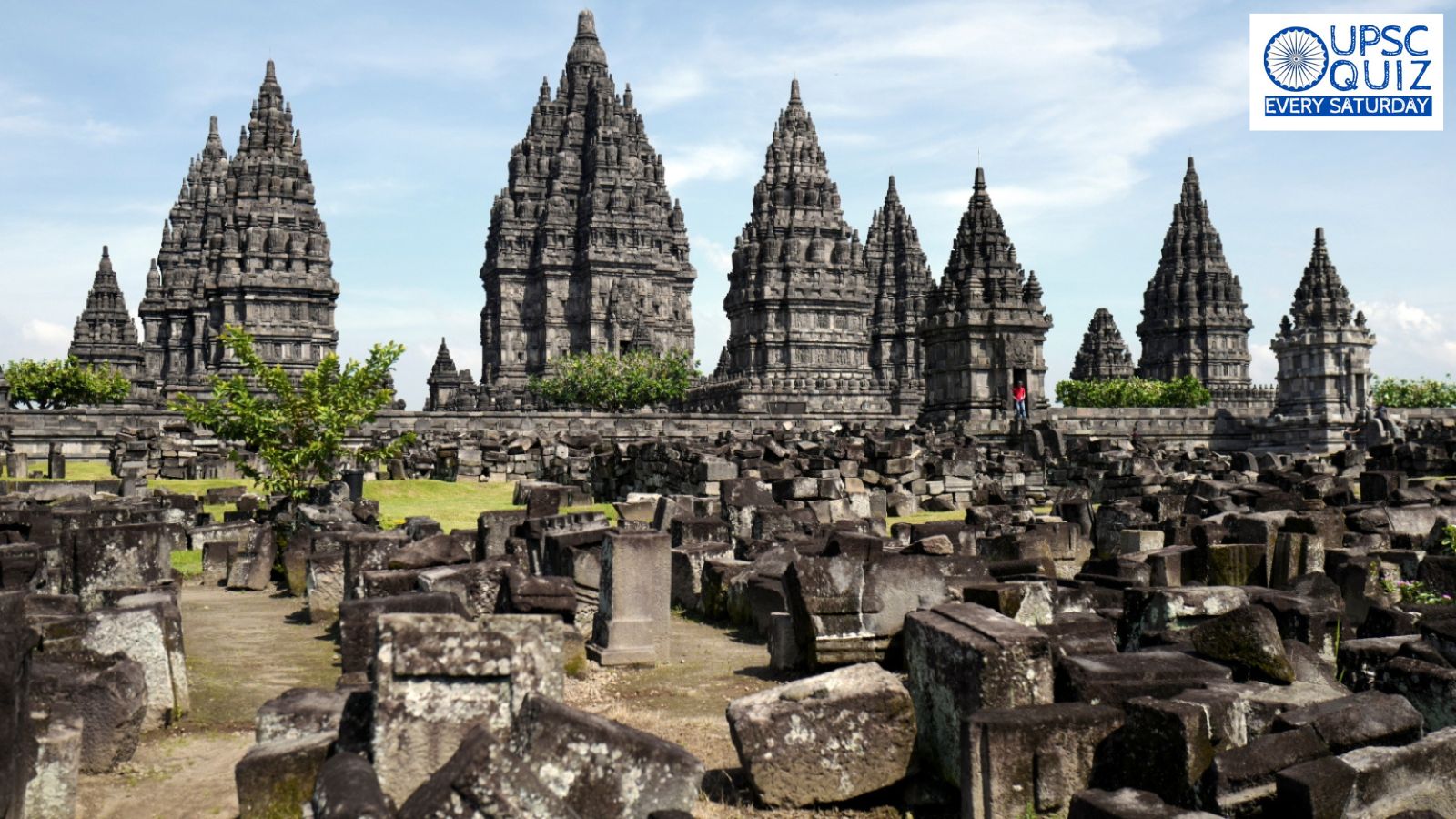
— Prime Minister Narendra Modi, before concluding his Indonesia visit, visited the 9th-century Prambanan Temple complex in Yogyakarta along with Indonesian President Prabowo Subianto to inaugurate a joint conservation project for the UNESCO World Heritage Site. The project will be led by the Archaeological Survey of India (ASI). Hence, statement 1 is correct.
Story continues below this ad
— The central focus of the project is the restoration of the Pervara temples — 224 subsidiary shrines arranged in four concentric rows within the middle zone of the compound, official sources told The Indian Express. Of these 224 temples, only six have been restored to date and the remaining 218 stand as extensive ruins.
— The project, spanning 10 years (2026–2036) with a total outlay of Rs 65 crore, will be executed by ASI in collaboration with the Indonesian Heritage Agency, sources added. The key activities of the project include LiDAR (Light Detection and Ranging) sensor, and photogrammetric documentation of scattered stone members, archival research, structural, hydrological, and geotechnical studies.
— The Prambanan Temple Compound, inscribed a UNESCO World Heritage Site in 1991, is considered among the most magnificent ensembles of Hindu temple architecture in the world. Built in the 9th century under the Mataram Kingdom in Central Java, the compound contains over 500 temples, including the soaring 47-metre Shiva temple. Hence, statement 2 is not correct and statement 3 is correct.
— India said its support for the restoration and conservation of the temple complex “reflects its enduring commitment to preserving shared civilisational heritage”.
Story continues below this ad
— From conserving key sections of the Angkor heritage complex in Cambodia to providing grant assistance for restoration of one of Sri Lanka’s five ancient temples dedicated to Lord Shiva, India has extended help to multiple partners in the past 12 years in reviving the “shared civilisational heritage”, according to officials.
Therefore, option (d) is the correct answer.
QUESTION 2
Consider the following ships of the Indian Navy:
1. INS Nilgiri
2. INS Udaygiri
3. INS Mahendragiri
4. INS Taragiri
Which of the ships of the Indian Navy given above are part of the Project 17A indigenous stealth frigate?
(a) 1 and 3 only
(b) 1, 3 and 4 only
(c) 2 and 4 only
(d) 1, 2, 3 and 4
Why this question for UPSC Prelims 2027?
Project 17A is a flagship indigenous stealth frigate programme under India’s naval modernisation and Aatmanirbhar Bharat initiatives. The commissioning and launch of its ships have kept the project in the news. UPSC frequently asks questions on indigenous defence platforms, their classes, and associated projects.
Explanation
— The Indian Navy is set to commission its sixth Project 17A indigenous stealth frigate, Mahendragiri (F38), at Visakhapatnam. It was designed by the Navy’s Warship Design Bureau and built by Mazagon Dock Shipbuilders Limited, Mumbai.
Story continues below this ad
— ‘INS Mahendragiri’ is the sixth Project 17A indigenous stealth frigate to join the Indian Navy in under 1.5 years. The first ship in the series, ‘INS Nilgiri’, was commissioned in January 2025, followed by ‘INS Udaygiri’ and ‘INS Himgiri’ in August, ‘INS Taragiri’ in April this year, and ‘INS Dunagiri’ last month.
— The ship, designed by the Indian Navy’s Warship Design Bureau and built by Mazagon Dock Shipbuilders Limited (MDL) in Mumbai, can carry out a wide range of maritime operations, including fleet air defence, anti-surface warfare, anti-submarine warfare, maritime interdiction, surveillance, and humanitarian assistance and disaster relief (HADR).
Therefore, option (d) is the correct answer.
(Other Source: http://www.pib.gov.in)
QUESTION 3
With reference to the India-New Zealand relations, consider the following statements:
1. India and New Zealand decided to elevate their bilateral relationship to a ‘strategic partnership’.
Story continues below this ad
2. India and New Zealand agreed to double bilateral trade by 2040.
3. India and New Zealand recently inked a pact on hydrographic cooperation.
4. India and New Zealand decided to launch the ‘Kiwifruit Action Plan’ and establish 2 Centres of Excellence for Kiwifruit in Gujarat and Sikkim.
How many of the statements given above are correct?
(a) Only one
(b) Only two
(c) Only three
(d) All four
Why this question for UPSC Prelims 2027?
The recent India–New Zealand agreements have expanded cooperation in strategic affairs, maritime security, trade, and agriculture, making the relationship significant from a current affairs perspective.
Explanation
Story continues below this ad
— India and New Zealand decided to elevate their bilateral relationship to a ‘strategic partnership’ after Prime Minister Narendra Modi met his counterpart, Christopher Luxon, and endorsed the ‘India-New Zealand Strategic Partnership: Roadmap to 2030’. Hence, statement 1 is correct.
— The statement added that the Prime Ministers agreed to an ambitious long-term vision for the strategic partnership, which aims to take bilateral relations to a new level, strengthen existing cooperation mechanisms, and explore new avenues for deepening cooperation, both bilaterally and multilaterally.
— The two sides signed pacts on maritime cooperation between defence forces and logistics support between their navies, set up a joint working group on counter-terrorism, disaster management, dairy farming, and tourism, adopted a joint action plan on sports, and launched a maritime security dialogue, among other initiatives.
— India and New Zealand also agreed to double bilateral trade to NZ$7 billion or Rs 35,000 crore by 2030, in the context of the Free Trade agreement signed in April this year. Hence, statement 2 is not correct.
Story continues below this ad
— According to the Ministry of External Affairs, the two sides decided to establish a maritime security dialogue to strengthen cooperation, coordination and information exchange. They also signed a ‘Memorandum of Arrangement on Maritime Cooperation’ between their defence establishments, creating a framework for enhanced Indo‑Pacific collaboration through dialogue, coordination, information exchange, and joint activities.
— India and New Zealand also inked a pact on hydrographic cooperation through joint production of navigational charts, hydrographic data sharing, training, and capacity building. They also signed an arrangement related to mutual logistics support between the Indian Navy and the New Zealand Defence Force. The two sides also set up a joint working group on counter-terrorism to strengthen cooperation, exchange information, and coordinate efforts to fight terrorism. Hence, statement 3 is correct.
— The two sides also signed a pact for enhanced cooperation in animal husbandry and dairying through technical collaboration, knowledge exchange, and best practices. They also decided to launch the ‘Kiwifruit Action Plan and Establishment of 2 Centres of Excellence for Kiwifruit in Nagaland and Uttarakhand’. Hence, statement 4 is not correct.
Therefore, option (b) is the correct answer.
QUESTION 4
Which one of the following best describes the source of propulsion in a hydrogen fuel-cell train?
Story continues below this ad
(a) Hydrogen is directly burned inside a diesel engine to produce mechanical energy.
(b) Electricity generated in a hydrogen fuel cell powers electric traction motors.
(c) Hydrogen is converted into steam, which drives a steam turbine.
(d) Hydrogen is used only for auxiliary systems, while diesel powers the engine.
Why this question for UPSC Prelims 2027?
Hydrogen-powered trains are an important component of India’s green mobility and clean energy transition. UPSC frequently asks questions on emerging technologies and sustainable transport systems, especially those linked to current developments in science, technology, and infrastructure.
Explanation
— Prime Minister Narendra Modi will flag off India’s first hydrogen-powered train in Jind, Haryana on July 17. This will mark a major milestone for the Indian Railways in a green technology where few countries have ventured so far. According to the Railways, this is one of the world’s longest (eight passenger cars and two driving power cars) and most powerful (2400 kilowatt) hydrogen trainsets.
How do hydrogen trains work?
— Normal electrical locomotives require overhead wires to draw the alternating current that powers their movement. Hydrogen trains don’t. They run on the simple formula of combining hydrogen with oxygen to produce the tractive electricity. In the Indian hydrogen train’s case, each of the two driving power cars will have four sets of integrated power packs, comprising hydrogen fuel cells and a lithium ferro phosphate battery.
The layout of the power car of a hydrogen train
— The hydrogen fuel cell will draw in the hydrogen stored on board (440 kg) at high pressure and oxygen from the outside air, then combine them to release electrical energy. One power pack will release 300 kW of energy — 115 kW from the fuel cell and 185 kW from the lithium ferro phosphate battery. The four power packs will provide 1200 kW of power.
— The fuel cell provides a constant power output, meaning it does not fluctuate with the train’s changing power demand. When the train starts moving, it initially draws the power from the fuel cell, and since the train’s power requirement at that stage is lower, the surplus electricity from the fuel cell goes into charging the onboard battery. As the train reaches higher speed and its power demand increases, the battery kicks in to provide power in addition to the fuel cell.
— When the train’s power requirement goes down, especially when the train is nearing the station, the battery power cuts off and the excess energy of the fuel cell starts charging the battery. Thus, after covering a complete circuit, the battery is almost 80% charged at the end of the journey.
Therefore, option (b) is the correct answer.
QUESTION 5
Security Action for Europe (SAFE) is a:
(a) European Union mechanism to provide macro-financial assistance to member states
(b) European Union initiative to jointly finance defence procurement through loans to member states
(c) NATO programme for coordinating military exercises in Europe
(d) European Union fund exclusively for humanitarian assistance during armed conflicts
Why this question for UPSC Prelims 2027?
With growing geopolitical tensions and Europe’s emphasis on strengthening its strategic autonomy, such initiatives have gained prominence in international affairs. UPSC has consistently asked questions on international organisations, defence initiatives, and new multilateral mechanisms, making SAFE a relevant topic for Prelims 2027.
Explanation
— For months, President Donald Trump’s attendance at the NATO leaders’ summit in Ankara appeared unlikely amid the widening rift between the US and Europe. Trump did attend, in typically stormy fashion — ordering a cutoff in trade with one member, Spain, and renewing claims on Greenland before recommitting himself to the alliance.
— Leaders of the 77-year-old transatlantic alliance, would count this as a successful outcome from the gathering that concluded this week with no breakthrough on its internal divisions. The real winner of the summit, however, was the host, Turkey, which is looking to boost its stature within the bloc and overcome longstanding issues with the US.
— NATO in 2026 is a divided house. The US is driven by its America First policy, and the UK and Turkey remain outside the EU. At the core of this divide is the burden-sharing dispute that has jeopardised US-Europe relations for months. Europe has also almost abstained from ceasefire forums in Gaza, Iran, Libya and Sudan.
— Now, for the first time, NATO has pledged €70 billion in military aid to Ukraine that will be fully financed by the EU. For American weapons, Ukraine must buy from the US in Trump’s buy-back plan. Trump has already asked the EU members to reimburse $350 billion that the US has spent on Ukraine so far because these funds have stabilised European security. Meanwhile, non-EU NATO members accuse the EU of overregulation and lack of innovation. Turkey remains isolated for its staunchly pro-Palestine views in the pro-Israel military alliance.
— The EU defence fund Security Action for Europe (SAFE) mandates at least 65% procurement in the $150 billion projects should be EU-origin, towards reducing EU’s dependency on the US and to expedite EU’s defence innovation.
Therefore, option (b) is the correct answer.
QUESTION 6
Which of the following Indian states shares a border with Myanmar?
1. Arunachal Pradesh
2. Meghalaya
3. Nagaland
4. Manipur
5. Mizoram
6. Tripura
Select the correct answer using the codes given below:
(a) 1, 4 and 5 only
(b) 3, 4 and 6 only
(c) 1, 3, 4 and 5 only
(d) 1, 2, 3, 4 and 6
Why this question for UPSC Prelims 2027?
India–Myanmar border issues, including security, connectivity projects, border management, and the Free Movement Regime (FMR), have remained in the news. UPSC frequently asks map-based questions on India’s international borders and the states sharing them, making this an important topic for Prelims.
Explanation
— Union Home Minister Amit Shah said the government was fencing the 1,610-km stretch of the India-Myanmar border at a cost of Rs 31,000 crore as he cautioned against demographic changes in border areas.
— There are four Indian states (Arunachal Pradesh, Nagaland, Manipur, and Mizoram), which share a land border with Myanmar.
Therefore, option (c) is the correct answer.
QUESTION 7
With reference to the new study ‘The impact of climate change on water availability in the Indus River system’, consider the following statements:
1. The catchment areas of the three eastern rivers — Ravi, Beas and Sutlej — saw an increase in precipitation in the period between 1951 and 2024.
2. The precipitation in the catchment areas of three western rivers — Indus, Jhelum and Chenab — saw a decline in the period between 1951 and 2024.
Which of the statements given above is/are correct?
(a) 1 only
(b) 2 only
(c) Both 1 and 2
(d) Neither 1 nor 2
Why this question for UPSC Prelims 2027?
The study is significant as it highlights the impact of climate change on the Indus River system, with implications for water security, agriculture, and the Indus Waters Treaty. UPSC can ask questions on river basins, climate change studies, and environmental findings that are in the news.
Explanation
— In the first-of-its-kind assessment of the impact of climate change on water availability in the Indus river system, a new study has revealed that the catchment areas of the three eastern rivers — Ravi, Beas and Sutlej — saw a 20 per cent decline in precipitation in the period between 1951 and 2024. Hence, statement 1 is not correct.
— On the other hand, rainfall in catchment areas of three western rivers — Indus, Jhelum and Chenab — was largely stable, with only a 6 per cent reduction observed over the same period, “which is statistically non-significant”, the study has found. Hence, statement 2 is correct.
— The findings are relevant in view of India’s argument that the Indus Waters Treaty with Pakistan, which governs the sharing of waters of the Indus basin between the two countries, needs to be renegotiated to account for new ground realities created by climate change and other factors like demographic changes. Under the treaty, the waters of the three eastern rivers have been fully allocated to India, while that of the three western rivers are mostly meant for use by Pakistan.
Therefore, option (b) is the correct answer.
QUESTION 8
Which of the following countries have launched the Partnership on Cyber, Critical Technologies and Supply Chains (PACTS)?
1. United States
2. India
3. Russia
4. China
5. Australia
Select the correct answer:
(a) 1, 2 and 5 only
(b) 2 and 5 only
(c) 1 and 4 only
(d) 2, 3 and 6 only
Why this question for UPSC Prelims 2027?
UPSC can ask questions on new international initiatives and agreements that are in the news and have implications for India’s foreign policy and strategic interests.
Explanation
— Signalling a significant deepening of bilateral ties, India and Australia sealed a series of pacts across sectors, from defence and maritime security to energy, including one that paves the way to operationalise their 2014 Civil Nuclear Agreement that secures a stable corridor for uranium supplies to India for peaceful purposes.
— The strengthening of ties comes at a time when China’s assertive behaviour in the Indo-Pacific region has caused concern among like-minded Quad partners, while the ongoing conflict in West Asia between the US and Israel on one side and Iran on the other has affected maritime traffic in the Strait of Hormuz over the past four-and-a-half months.
— Following the talks, the two sides signed a joint statement alongside separate statements covering defence and maritime security, energy security, and critical minerals. The statement noted tangible benefits already reaching businesses and consumers under the existing India-Australia Economic Cooperation and Trade Agreement (ECTA), while emphasising the need to dismantle non-tariff barriers further and coordinate institutional financing to drive private-sector investment.
— Another key outcome was the finalisation of the administrative arrangement to operationalise the Civil Nuclear Agreement signed in 2014 and enable supply of uranium from Australia to India. “The arrangement facilitates Australian uranium exports to India to help increase the share of non-fossil fuel power capacity, providing an additional market for the Australian resources sector,” Albanese said.
— The two leaders also launched the Australia-India Partnership on Cyber, Critical Technologies and Supply Chains (PACTS). The partnership targets supply chain diversification, cybersecurity, digital resilience, and joint semiconductor research.
Therefore, option (b) is the correct answer.
QUESTION 9
The El Niño has the potential to influence:
1. Global temperatures
2. Rainfall patterns across different regions
3. Frequency of heatwaves
Select the correct answer using the code below.
(a) 1 only
(b) 1 and 2 only
(c) 2 and 3 only
(d) 1, 2 and 3
Why this question for UPSC Prelims 2027?
El Niño remains a key driver of global weather and climate variability, with implications for monsoon, agriculture, water resources, and disaster management. UPSC frequently tests the climatic impacts of major atmospheric-oceanic phenomena that are in the news.
Explanation
— The prevailing El Niño in the Pacific Ocean could intensify during the coming months and turn into one among the largest events in the historical records, US-based National Oceanic and Atmospheric Administration (NOAA) said.
— El Niño and La Niña are the two phases of the El Niño Southern Oscillation (ENSO), a naturally occurring ocean-atmosphere interaction. These events influence global weather patterns and can trigger extreme weather, droughts, and heatwaves across the globe. El Niño has a general warming impact on the planet. Over the Indian region, it has the effect of suppressing rainfall. This year, the monsoon in India is expected to be well below normal, mainly on account of the developing El Niño.
— With El Niño conditions rapidly strengthening, India could soon start to feel its negative effects. According to Mrutyunjay Mohapatra, director general, India Meteorological Department (IMD), strong El Nino can have a more adverse impact on rainfall. “In the past, 60 per cent of the El Nino years have reported either below normal or deficient seasonal rainfall. The other 40 per cent El Nino years have received normal rainfall during the monsoon season over India,” he said.
Therefore, option (d) is the correct answer.
QUESTION 10
The ‘Coller-Dolittle Prize’ is associated with:
(a) Development of commercially viable nuclear fusion technology
(b) recognise and support groundbreaking scientific research in two-way interspecies communication
(c) Conservation of endangered species through community participation
(d) Innovations in quantum computing and artificial intelligence
Why this question for UPSC Prelims 2027?
The Coller-Dolittle Prize is a newly instituted international scientific award that has brought the study of the origin of life into the spotlight. UPSC can ask questions on new awards, scientific initiatives, and emerging developments in science and technology that are in the news.
Explanation
— Scientists have taken another significant step toward understanding how animals communicate, with a researcher from the University of California, Berkeley winning a $1,00,000 international prize for decoding the core “vocabulary” of zebra finches. The breakthrough is being hailed as an important advance in the long-term goal of enabling meaningful communication between animals and humans.
— Dr Julie Elie received the 2026 Coller-Dolittle Prize for Two-Way Interspecies Communication after spending more than 15 years studying zebra finches, small and highly vocal songbirds known for their constant chatter. Her research identified 11 core calls used by the species and explained what those sounds mean.
— According to Elie, the birds use different calls to announce who they are, what they are doing, and to recognise one another through unique vocal signatures, regardless of the message being communicated.
Therefore, option (b) is the correct answer.
Previous Weekly Quiz
UPSC Weekly Current Affairs Quiz (June 28 – July 04)
UPSC Weekly Current Affairs Quiz (June 21 – June 27)
UPSC Weekly Current Affairs Quiz (June 14 – June 20)
UPSC Weekly Current Affairs Quiz (June 07 – June 13)
UPSC Weekly Current Affairs Quiz (May 31 – June 06)
UPSC Weekly Current Affairs Quiz (May 24 – May 30)
UPSC Weekly Current Affairs Quiz (May 17 – May 23)
Subscribe to our UPSC newsletter and stay updated with the news cues from the past week.
Stay updated with the latest UPSC articles by joining our Telegram channel – IndianExpress UPSC Hub, and follow us on Instagram and X.
View original source — Indian Express ↗
Related stories
TechRadar
TechnologyJul 11, 2026 · 1 min
Don't sleep on this upcoming cinematic action game that could rival The Last of Us
TechRadar
Indian Express
TechnologyJul 11, 2026 · 1 min
2 bridges set to become operational by August 31, BMC sets deadline
Indian Express

TechPana
TechnologyJul 11, 2026 · 1 min
AI Deepfake Video Misuses Nepal Police Uniform to Promote Illegal Betting on Facebook
TechPana

The New York Times
TechnologyJul 11, 2026 · 1 min
Videos Shed Light on Pursuit Before ICE Killing in Houston
The New York Times