The Guardian
I spent many of my childhood weekends among gamblers in the local TAB. That seems almost quaint now
The experience of the Cessnock TAB began with the tinny click of its big door handle, followed always by the smell of old cigarettes and the racket of 2KY racing radio turned up full blast.
In front of the TVs was a long table and behind the table were four bar stools, their padded tops covered in red pleather. Enter any time during business hours and three of the bar stools would likely be occupied by the same three men, all in their 60s at least.
Sometimes the fourth stool would be occupied by my father.
My father was not a good gambler and didn’t seem to take it particularly seriously. But he was compulsive. He gambled money we didn’t have, usually either given to him by my mother for something else or taken out of her purse when she wasn’t in the room, in the almost always doomed hope she wouldn’t notice it was gone.
For most of my childhood my mother worked Saturdays and Sundays, and that meant I spent quite a lot of Saturdays and Sundays at the Cessnock TAB in a state of almost unendurable boredom. The only flecks of stimulation there for me were the newspapers, which didn’t chew up too much time as I only read the sport sections, and the single small TV playing Channel Nine, always on silent, and only any use during cricket season. My sister, three-and-a-bit years younger than me, showed more imagination – my mother was told more than once that she had been seen clambering around on the carpet playing with the lawn jockey that stood with a jaunty expression in the shopfront.
I can’t remember seeing many other kids there, if any, but I also don’t remember seeing many young adults there either. This was a domain for men aged between 35 and 75.
The regulars all knew each other, and it was a noticeable thing when a non-regular wandered in. The only women there, mostly, were the tellers. I remember part of the betting windows once being coloured over with “WELCOME FAY ON HER FIRST DAY”, painted on in big fluoro letters.
Sign up for a weekly email featuring our best reads
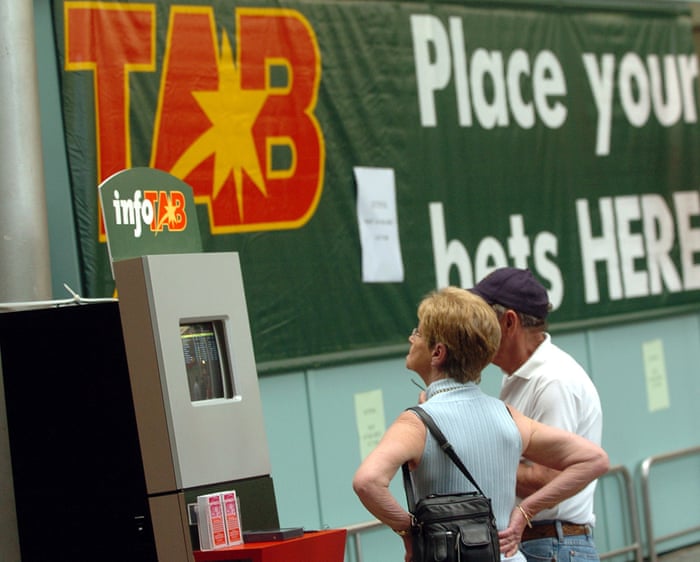
For decades, in the main streets of suburbs and country towns all over New South Wales, the TAB stood swathed in green, its purpose as clearly understood as that of Blockbuster Video and the one-hour photo shop: this is the place you go for gambling. As I learned from bitter and regular experience, there wasn’t anything else to do there. There was a clear line around it.
TAB outlets have been allowed in NSW pubs and clubs since the 1980s, but throughout the 90s more and more venues had TABs put in. In 1997 there were about the same number of PubTAB facilities as there were stand-alone bricks and mortar TAB agencies – about 550 apiece. Today, there are about 80 bricks and mortar TAB agencies left in NSW. In 2022 Tabcorp, by then a national company with 4,000 touchpoints around the country, told the supreme court that 1,100 or so NSW pubs were responsible for 56% of their entire $4bn in-person turnover Australia-wide.
The Cessnock TAB closed more than a decade ago. These days in Cessnock there are three pubs and two clubs with TAB facilities, each within walking distance of at least one other, four of them in a near-straight line.
The TAB agency was, of course, as voracious and unfeeling as any gambling place is, and there can be no doubt that many a problem gambler wallowed there. While my family’s dinner was never eaten by the punt, many others’ were.
The explosion of TABs in pubs removed the clicking door behind which the world of punting had stood, separate and sealed. You could have a Saturday at the pub and a day at the races all in one, tangling carousing and punting and chicken schnitzel into a single gorging indulgence. Instead of having to go looking for somewhere to have a bet, it would come looking for you.
Things have evolved again since the PubTAB ascension. Tabcorp alone has 792,000 active digital users now, generating more than $8bn in turnover. The smartphone has made gambling more convenient and more private than it has ever been. More money can be lost, faster, and without anyone seeing you lose it.
Everywhere is a TAB now. Nobody is particularly known as a punter, because so many of us are punters.
And the local TAB agency, so unrelentingly bleak when it served as my daycare centre, now looks somehow quaint, a cultural artefact from a gentler time.
View original source — The Guardian ↗
Related stories

The Hollywood Reporter
EntertainmentJul 11, 2026 · 1 min
Christopher Nolan Addresses ‘The Odyssey’ Backlash, Explains Why Film Uses Modern Dialogue
The Hollywood Reporter

Variety
EntertainmentJul 11, 2026 · 1 min
‘Elle’ Bosses on Lexi Minetree’s Elle Woods Transformation and How the Late James Van Der Beek Rewrote His Character’s…
Variety

Deadline
EntertainmentJul 11, 2026 · 1 min
How ‘Little House On The Prairie’ Showrunner Crafted “Compelling” Fever Dream Flashbacks To Fill In “Stakes” Of Ingalls…
Deadline

Variety
EntertainmentJul 11, 2026 · 1 min
Byron Allen Donates $100,000 to Nolan Wells Family’s GoFundMe as Tyler Perry Covers Funeral Costs
Variety