Times of Israel
Coalition hopes to pass raft of contentious bills in final week before Knesset dissolution
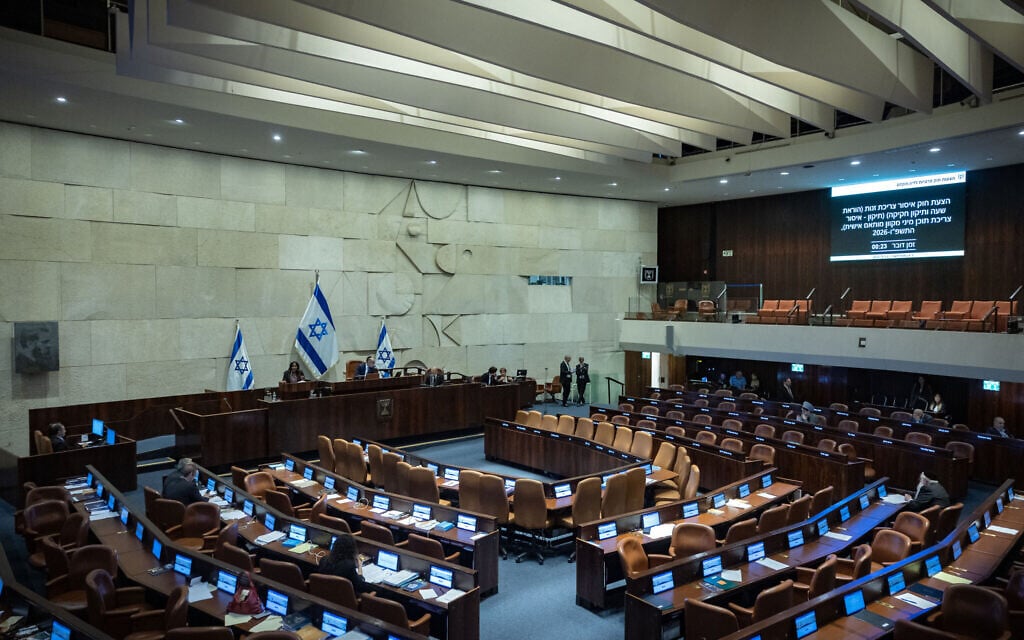
Prime Minister Benjamin Netanyahu’s governing coalition is expected to rush multiple contentious bills through final Knesset readings and into law over the coming week, the last time legislation can be passed before parliament dissolves ahead of the legislative election, due to be held on either October 20 or October 27.
Among the laws it intends to pass is the quasi-constitutional Basic Law establishing Torah study as a “foundational value” of the Jewish people and the State of Israel. Haredi parties have pushed to pass the law as part of their ongoing push to ensure ultra-Orthodox men continue to receive blanket exemptions from IDF conscription.
The latest version of the law, approved in the Knesset House Committee on Thursday, no longer explicitly places Torah study on par with military service. But maverick Likud MK Dan Illouz argued that removing the key clause “does not change the essence of the law.”
He warned that enshrining Torah study as a quasi-constitutional value without explicitly stating that it cannot be used to justify draft exemptions would still “serve in practice to legitimize draft evasion and continued funding and benefits” for yeshiva students.
Illouz announced on Saturday night that he would not be standing in the upcoming Likud primaries due to his opposition to legislation aimed at keeping Haredi men out of the military.
Get The Times of Israel's Daily Edition
by email and never miss our top stories
By signing up, you agree to the terms
Opposition lawmakers have claimed that since the law would make Torah study the only value explicitly enshrined in a Basic Law — not military service, caring for soldiers with PTSD, or other national values — it effectively elevates Torah study above all other values.
A ban on arresting draft dodgers
The government is also aiming to pass legislation banning the arrests and prosecution of young ultra-Orthodox men evading IDF service.
According to the text of the bill released by the Foreign Affairs and Defense Committee, the temporary order would suspend arrests, investigations and other enforcement measures against yeshiva students for 90 days, but in effect the ban would be valid for six months.
A yeshiva student would be defined as either a single man who studies for at least 45 hours a week, or a married man who studies for 40 hours a week, at a recognized institution designated by the defense minister and approved by the committee.
The IDF and the committee’s legal adviser oppose the legislation, and the opposition is seeking to block it procedurally by arguing that it is being pushed through improperly as a “new topic” grafted onto another bill without adequate substantive debate.
Extended mandatory service
At the same time as it pushes to prevent the arrest of ultra-Orthodox draft dodgers and keep them from serving in the military, the government also intends to pass a law extending mandatory service for all other Israelis from 30 months to 32 months. Earlier attempts to extend mandatory service to 36 months have been deferred.
Weakening the AG
Also set for its final reading this week is legislation that will weaken the role of the attorney general — the government’s chief legal adviser and the head of the state prosecution — and enable a process by which the government can fire them.
Due to a shortage of time, the bill being advanced into law has been adapted from its initial format, and as such will no longer split the role into two separate offices — an attorney general and a prosecutor general — as the coalition had sought to do throughout the legislative process.
Instead, criminal prosecution powers will remain under the attorney general for now, and the coalition apparently intends to draft a separate bill splitting the role into two at a later date.
Media oversight
The coalition also hopes to pass media overhaul legislation prepared by Communications Minister Shlomo Karhi.
The legislation would give the government significant control over broadcast media, news sites and other media, and it has provisions designed to benefit the pro-coalition hard-right Channel 14.
It has been criticized by the Knesset’s professional legal staff and by Attorney General Gali Baharav-Miara, who have warned that the bill undermines press freedom and allows for political interference in the media.
Its potential passage has been complicated due to opposition from the ultra-Orthodox United Torah Judaism and Shas parties over a clause regarding the establishment of a government media app that would broadcast on Shabbat.
As part of an agreement with Shas, a kosher certification bill is also set to pass, which would restore the Chief Rabbinate’s exclusive control over kosher certification, reversing reforms introduced by former religious services minister Matan Kahana that opened the certification market to competition.
Racing the clock on Oct. 7 probe
The hugely contentious bill that would establish a coalition-appointed and coalition-mandated inquiry into the failures surrounding the October 7, 2023, Hamas-led attack, instead of a state commission of inquiry, passed its first reading in the Knesset plenum on Monday, but it is not clear whether there is sufficient time for it to be finalized and brought for its final two readings before the scheduled dissolution of parliament.
The legislation, should it pass, would give the government that was in power when the massacre unfolded the authority to unilaterally appoint the body investigating its own conduct.
The opposition has boycotted the bill throughout the legislative process and has vowed not to cooperate with the proposed political commission.
View original source — Times of Israel ↗
Related stories

The Punch
PoliticsJul 11, 2026 · 1 min
Olubadan, Alaafin hail Tinubu, others over Oyo kidnapped victims rescue
The Punch
The Punch
PoliticsJul 11, 2026 · 1 min
APC chieftain hails Tinubu over Oyo pupils’ rescue, wants safer schools
The Punch
ABC News
PoliticsJul 11, 2026 · 1 min
Risks and rewards of playing diplomatic football in the Pacific
ABC News
Times of India
PoliticsJul 11, 2026 · 1 min
Claim Hindu law is based on 'Manusmriti' wrong, says SG Tushar Mehta
Times of India