Indian Express
In Punjab villages, crowds at Satluj shows, a chorus: ‘Those dark days should never return’
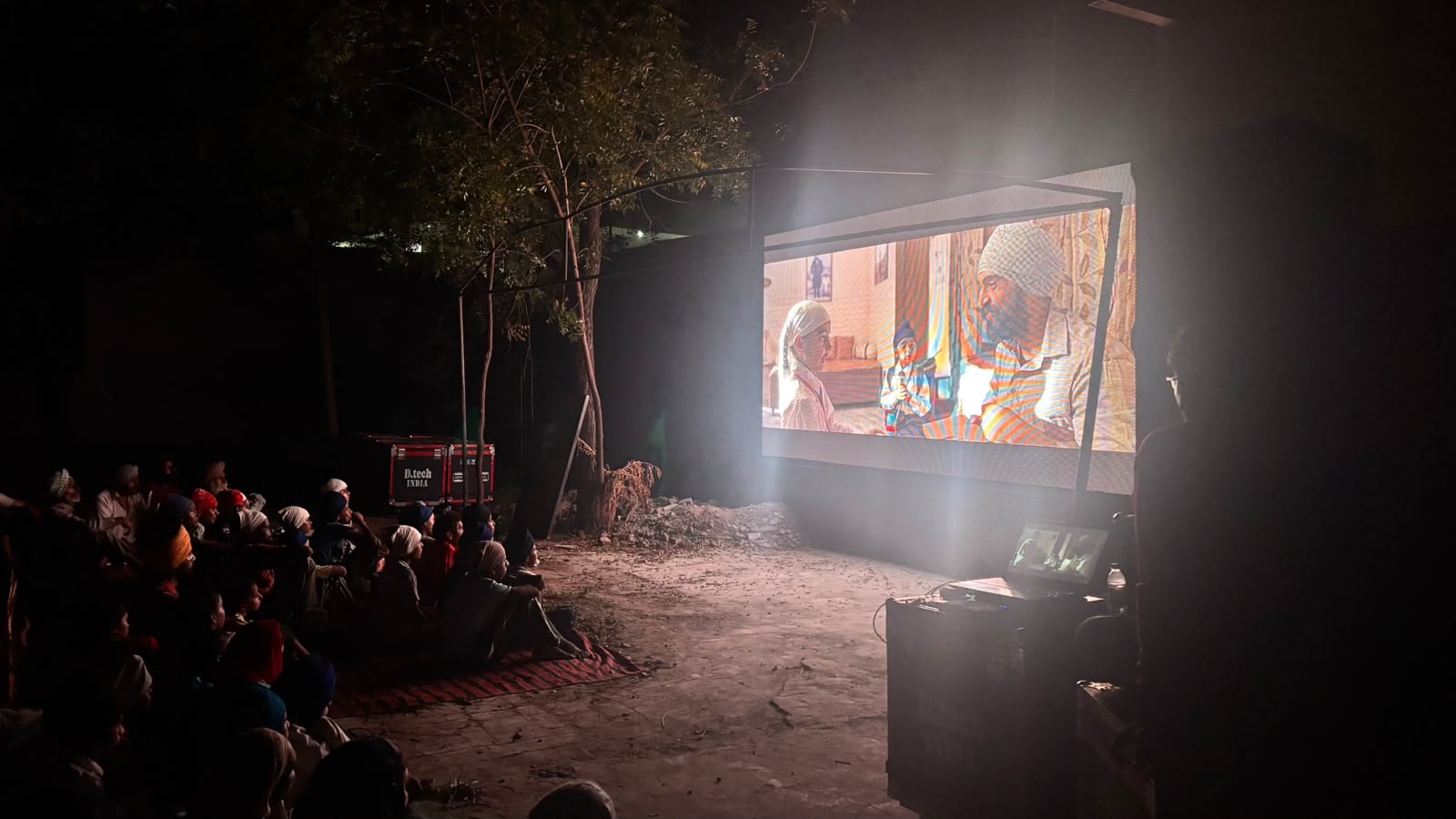
At 8.30 pm on Thursday, a vacant plot next to the Guru Tegh Bahadur Sahib Gurdwara in Jangpur village of Ludhiana is packed. Women and men sit on mats, their heads covered, including with handkerchiefs, just like at a gurdwara. The elderly occupy plastic chairs, while the young are perched on the ground’s boundary walls.
Their eyes are glued onto an 85-inch screen playing Satluj. The contested film on human rights activist Jaswant Singh Khalra that saw a brief OTT release before being blocked in India, has found a new life in Punjab, in similar mass screenings being held across the state.
Also seeing a new life are memories of “the aukha (dark, difficult) time” in Punjab, which those gathered at the Jangpur ground and elsewhere stress, “should not return”.
While gurdwaras and the SGPC were the first to announce these screenings, the Akali Dal and now the ruling Aam Aadmi Party are also showing the Diljit Dosanjh-starrer. One of the screenings held by the AAP on Friday — with the film played on a mobile and projected onto the side of a van — was near the house in Dugri, Ludhiana, where Dosanjh moved to study music as a boy.
The Inter-Departmental Committee set up by the Centre to review Satluj has recommended that the movie remain blocked from access in the country as it has the potential to threaten the security of the State.
In an interview to The Indian Express, Khalra’s daughter Navkiran Kaur Khalra said that this, however, is having the opposite effect. “Ironically, the attempt to stop the film has drawn more attention to it. People are now reading about that period, discussing it and asking questions. That, in itself, is significant… Khalra has haunted the system for three decades because the issues he raised have never been fully addressed. Until the truth is confronted honestly, his story will continue to return.”
In Jangpur, Thursday, this seems evident. The screening is organised by supporters of Dakha MLA Manpreet Singh Ayali, who is vice-president of the Akali Dal Waris Punjab De (WPD), a splinter group of the Shiromani Akali Dal floated by supporters of jailed Independent MP and alleged Khalistan sympathiser Amritpal Singh.
Story continues below this ad
Jasdeep Singh Jassa, who is overseeing the arrangements, says: “We contacted a DJ and he brought a downloaded copy of the movie. We are paying Rs 5,000 for one screening.” Jassa plans to hold three of those, “because everyone cannot watch it in a single evening”.
As he speaks, Gurdev Kaur, who is in her 70s, quietly walks out of the screening venue and sinks into a chair. Villagers rush to offer water, saying she has been unwell and felt uneasy.
Gurdev has another explanation. One hour into the film, she felt she couldn’t take any more. “Oh sama dubara nahin chahida… Bhot aukha si (We don’t want those days to return… They were extremely difficult).”
Jaswant Singh, 61, has come from Mullanpur town, around 2 km away, with his wife and elder brother. “Had they not removed the film from OTT or created a controversy, people probably would not have gathered like this in villages to watch it,” Jaswant says.
Story continues below this ad
It’s all politics and vested interests, and people understand this, he adds. “With elections approaching, the timing is perfect… Saanu sab pata hai (We know everything).”
During the height of the militancy, Jaswant had moved his entire family to West Bengal where he was posted in the Army. And so he cautions against reading too much into people flocking to the screenings. “Eh film nu movement na samjho (Don’t mistake this for a movement). It’s just an attempt to revisit our painful past.”
Around 9 km away, at Gahour village, a screening at a village park near another gurdwara has drawn over 1,000 people on a hot and humid night.
At around 9 pm, the organisers who are workers of the Sukhbir Badal-led Shiromani Akali Dal announce a short interval, serving sherbat and samosas. One of the Akali Dal workers, Vicky Chaudhary, says he has coordinated screenings at Mohi, Gahour and Sawaddi villages. “At Mohi, we even organised a proper langar during the interval.”
Story continues below this ad
There is no politics behind it, Chaudhary, 52, insists. “We simply want people to know their past… and learn lessons so that such an era never returns,” he says.
Chaudhary himself remembers being sent away to his aunt’s house in Ludhiana at the time. “Mothers worried constantly about the safety of their children. Cities were still safe.”
At the screening at Dehrka village about 40 km from Ludhiana city, Akali Dal leader Chand Singh Dalla is present. While announcing another show at his native village the next day, he suddenly falls silent.
A villager explains in a whisper: “His uncle was picked up in the early 1990s and never returned.”
Story continues below this ad
Later, Dalla talks about the episode. “It was perhaps 1990. I was at my uncle Bachittar Singh’s clinic. He was a doctor and a retired Army man. Four men in civil clothes and carrying carbines arrived, forced my uncle into their vehicle and drove away. That was the last time we saw him.”
It was often hard to tell who the perpetrator was, Dalla adds. “Nearly 20 youngsters from our village died during that period. Some in rivalries, some after being picked up by police, perhaps others at the hands of militants. God alone knows.”
A 75-year-old retired Punjab State Electricity Board employee from Mullanpur, who does not want to be identified, also worries about “the politics behind the row”.
“The movie shows what happened during Congress governments and later. Now different parties have their own political interests in taking the film to villages,” he says, pointing out that Congress-turned-BJP leader Ravneet Singh Bittu’s motive seems to be to defend his grandfather Beant Singh, who headed the Congress government in the state at the time of Khalra’s disappearance and killing. (Khalra disappeared six days after Beant Singh’s assassination.)
Story continues below this ad
At Jangpur, as the screening ends around 11 pm, groups of women discuss the film as they walk home. Sukhwinder Kaur, 65, recalls how “markets would shut by 4 pm then” and “people would not light stoves at home at night till all members of the family had returned safe”.
Yes, some people are trying to incite violence even now, she says. “But people will never allow those times to return.”
Dilip Singh, 24, says that as a youngster who did not see the period, he wants the government to know “not to fear the past”. “We watched Satluj because we were stopped from watching it. The government should let people realise what happened.”
As he folds up and removes the chairs after the show ends at Sawaddi village, organiser Aman Sawaddi feels the film ban, the screenings may turn out to be for the best. “Were we not watching the film together, perhaps assi ohne darawne sameyan nu ena gehra yaad vi na karde (we would never have recalled those horrific times so vividly).”
Story continues below this ad
It is making their resolve stronger, he adds. “May those days never return.”
View original source — Indian Express ↗
Related stories

TASS
WorldJul 12, 2026 · 1 min
Over 10 blasts heard in Iranian city of Bandar-e-Jask — IRIB
TASS
ABC News
WorldJul 12, 2026 · 1 min
Perth man, 26, charged over death near Fremantle entertainment strip
ABC News
ABC News
WorldJul 12, 2026 · 1 min
Numbat population improves amid warning there is a long way to go
ABC News
South China Morning Post
WorldJul 12, 2026 · 1 min
Youth suicides in Hong Kong hit 10-year high: court report
South China Morning Post