Indian Express
China lands a reusable rocket for the first time: Why this matters for the space race
China on Friday successfully landed a reusable rocket for the first time — a milestone for the country’s space programme that will challenge American companies’ dominance in the technology.
The Long March 10B rocket — which can carry a payload of up to 16 metric tons to low Earth orbit — lifted off from the Wenchang Commercial Space Launch Site in Hainan, Southern China around noon (local time). Low Earth orbit is a region between 160 km and 2,000 km above the Earth.
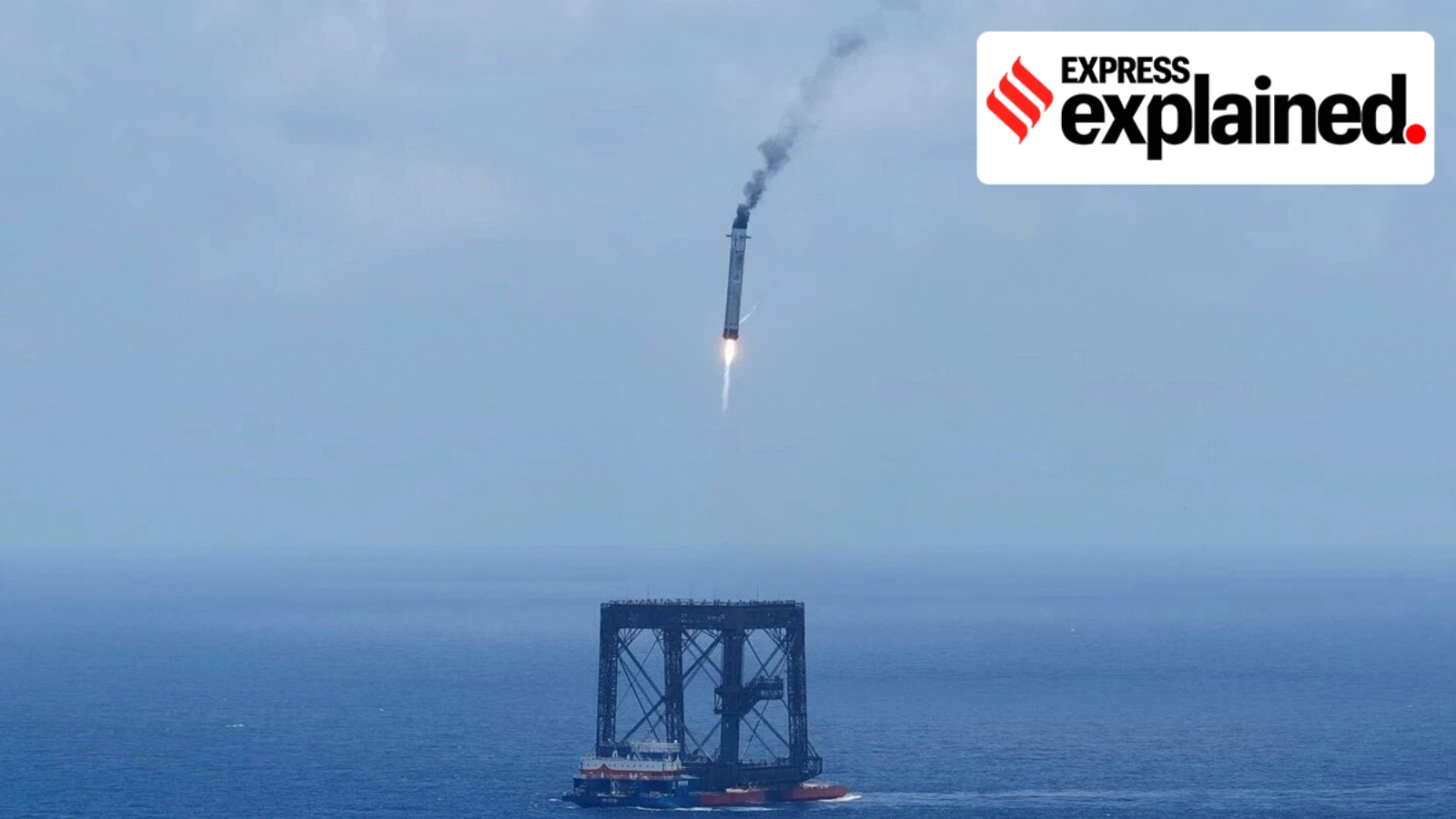
Six minutes after liftoff, the rocket’s booster — the part that houses the engine and provides the initial thrust — separated from its upper stage and began a controlled descent to a floating platform on the sea. There, it was caught by a net.
Before China, only Elon Musk’s SpaceX and Jeff Bezos’s Blue Origin demonstrated the ability to launch and land rockets.
So how does China’s technology differ from previous reusable rockets and what strategic implications does this step have? We explain.
The mechanics of re-entry
All rockets lift off in the same way. Multiple segments, beginning with the first stage, power its ascent one by one before being discarded and destroyed.
A reusable rocket, however, is one that can land on Earth after lifting off, thus allowing its valuable booster to be used again. This substantially reduces the cost of a launch and, by extension, space exploration.
Story continues below this ad
SpaceX’s Falcon 9 rocket lands on a floating platform. Wikimedia Commons
This is how a booster typically heads back towards Earth:
The booster first separates from the rocket’s upper section, which ignites its own engines and continues into space.
Then, the booster uses pressurised nitrogen to flip and orient its engines along the return trajectory.
While re-entering the atmosphere, the booster, which by then is travelling at the speed of sound (1,225 km/h), deploys “fins” — lattice-like structures that allow air flow — to help with aerodynamic control.
The final deceleration requires firing the engine in the opposite direction of the vehicle’s trajectory — essentially a braking mechanism.
But given that an empty booster is basically a lightweight shell, there is a chance that this braking mechanism may propel it back upwards. This is why the greatest challenge during touchdown is thrust management — controlling the declaration to ensure that the rocket does not self-destruct or reaccelerate back into the sky.
So how does the Chinese rocket differ?
There is one key difference between the SpaceX-Blue Origin reusable rockets and China’s Long March — the final capture mechanism.
Traditional reusable rockets rely on hydraulic landing “legs” to touch down on a ground pad or ‘drone ship’ (floating platforms on the sea). Space X pulled off a major feat in 2024 when it used giant mechanical arms — termed “chopsticks” — to catch its Starship rocket booster out of the air.
Story continues below this ad
SpaceX’s mechanical ‘chopstick’ arms catch the Starship rocket’s booster. Wikimedia Commons
The Long March, though, uses a different system. Its onboard computer coordinates with a maritime landing vessel, which, in turn, aligns a suspended wire net directly below the descending rocket. The rocket is equipped with “landing hooks” that catch the net as the engines shut down. Auxiliary cables and an automated locking platform immediately clamp around the captured booster to prevent it from swinging violently.
Why does this test matter?
Space exploration is expensive. Reusable rockets make this process economical. China went a step further by removing the hydraulic landing legs in favour of the landing hooks — reducing the rocket’s mass and thus increasing its payload margin.
Anushka Saxena, Research Analyst at the Takshashila Institution’s Geostrategy programme told The Indian Express: “The technological and commercial base in China is faring very well despite having been shaken up by internal wrangling and corruption in the past.”
A floating platform captures China’s Long March rocket using a net. AP
This test comes as the global aerospace sector races to deploy massive commercial satellite constellations and prepares for crewed lunar landings and puts China in direct competition with SpaceX.
Story continues below this ad
The US’s reusable rocket technology, meanwhile, remains within the purview of the private sector. “This is not a major hurdle, however, as the US has historically been experienced with extracting national alignment from the private sector– be it a pure defence contractor like Lockheed Martin or conglomerate like General Electric” Saxena said.
Here’s a more detailed look at the various strategic implications of the Chinese milestone:
Lunar race: The Long March 10 series of rockets is central to China’s plans to put astronauts on the moon by 2030. This timeline directly competes with the American Artemis program, escalating the stakes of the race to secure real estate at the Moon’s South Pole. This is where permanently shadowed craters contain billions of tonnes of ice water that can be used to create rocket propellant — making them key for any future deep space exploration.
Low-Earth orbit missions: Low Earth orbit missions are important for Earth observation and communication. China plans to deploy three communications satellite constellations comprising thousands of satellites each. Deploying such large numbers through traditional rockets is economically inviable. The Long March 10B’s success (and its 16-tonne payload) provides the cost-effectiveness required to challenge Western rivals such as SpaceX.
Story continues below this ad
“SpaceX and the Chinese are competing on two fronts — the frequency of launches and the capacity to fill up the lower-earth orbit. The Chinese have demonstrated that they can do whatever the Americans can and are actively bridging the gap that SpaceX had created a decade ago” Saxena said. “For other spacefaring nations like India, it might take a long time before they can conclusively enter this current circle” she said.
Military-civil fusion: China’s space program is heavily influenced by its “military-civil fusion” (MCF) strategy.
This strategy dictates that commercial aerospace innovation be aggressively channeled into dual-use technologies. “In 2015, Xi Jinping elevated the MCF as part of the National Development Strategy, which mandates whole-of-nation mobilisation,” Saxena said. “It is a reality — the creation of a new PLA force focussed on aerospace was also another step. Further, the Chinese Aerospace Science Technology Corporation is a massive defence and state-owned enterprise offering them a more granular level of control.”
View original source — Indian Express ↗
Related stories

TASS
TechnologyJul 12, 2026 · 1 min
UAE air defenses repel missile, drone attack from Iran — ministry
TASS

Philippine Daily Inquirer
TechnologyJul 12, 2026 · 1 min
Marcos inspects Navotas fish port rehabilitation
Philippine Daily Inquirer

TASS
TechnologyJul 12, 2026 · 1 min
Kiev air defenses fail to cope with Russia’s new strikes — Le Monde
TASS

Indian Express
TechnologyJul 12, 2026 · 1 min
Mumbai’s Dharavi has 590 religious structures. A state panel has begun deciding which stay, move or go
Indian Express