Indian Express
For the love of sport: How Himani Mor is helping Neeraj Chopra build a legacy
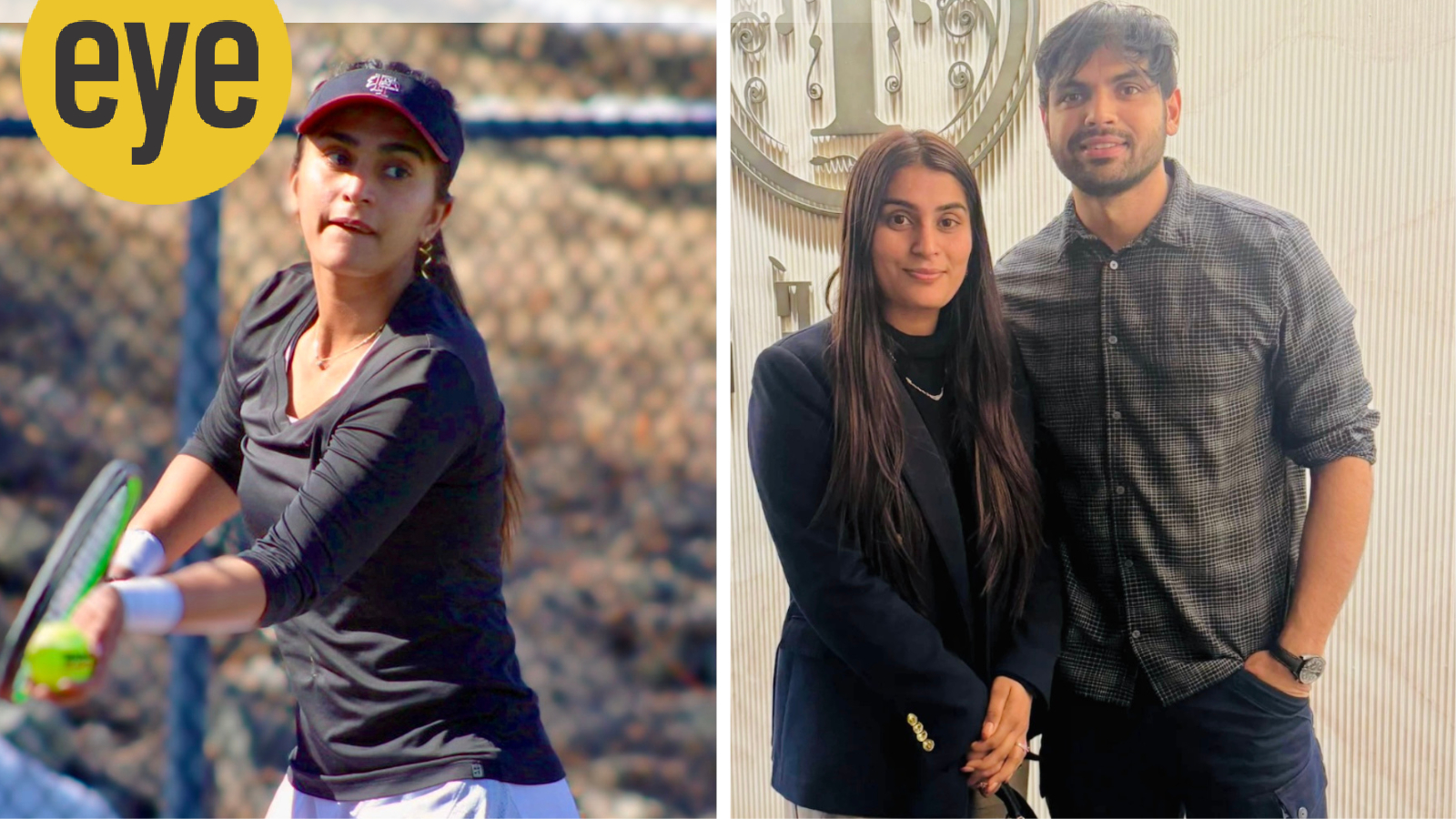
Neeraj Chopra’s arm throws a javelin ninety metres. On a tennis court, the same arm produces what his wife calls a speedy serve. Himani Mor should know. She represented India at the ITF World Juniors and was crowned All India University Champion, and when the two of them hit during his off season, she is the one standing on the other side of the net and by her own careful assessment, he comes across as a natural on court.
“We play tennis together during his off season. Last year, he could not because of injury,” Himani says, matter of fact rather than starry eyed. “Because he has a fast arm, his serve is really good. I jokingly told him to take up tennis once he retires. He has a good ball sense and hand-eye coordination.”
It is a small, private image, two elite athletes trading serves without trying to outdo each other. Whether it says anything about the marriage itself is not obvious yet. It gets clearer once you see how they run everything else.
****
Himani, 27, and Neeraj, 28, have been married for over a year-and-a-half. Himani is from Sonipat, Neeraj from Panipat, neighbouring districts in Haryana. Their families had known each other for years before the wedding and the friendship goes back further than the fame does.
“We have known each other since 2016, before he won the junior World Championship,” Himani says. “I used to train at the Sports Authority of India’s centre in Sonipat and so did he. My family is into sports. My cousins are wrestlers, boxers, and my parents were kabaddi players. My father was the Indian team captain at the first circle kabaddi world cup in Pakistan in 1983. There was a common interest. You talk to each other, get to know each other, and that’s how our relationship started. Our families were aware. That’s how we got married.”
She calls it a fusion of arranged and love. At a private ceremony in Solan in January last year, India’s most decorated track and field athlete took his marriage vows with a woman who had watched his career long before he became India’s Golden Boy.
****
In January this year, the partners in love became business partners too with a common interest. Neeraj founded Vel Sports Management. Himani became its managing director. Alongside it sits the Neeraj Chopra Foundation, another project close to the couple’s heart, and mentoring the next generation of athletes is one of its stated ambitions, something the two of them talk about together rather than strictly as colleagues.
Though Neeraj is still an active athlete, his dream is for the agency and the foundation to become legacy projects that outlast his playing career. A small team of trusted hands, Himani among them, runs the day-to-day work.
Vel Sports did not open by signing athletes. It opened by deciding how to create an athlete-first approach.
“We want to keep athletes and their priorities at the forefront,” Himani says. “We want to create an ecosystem that works around athletes’ schedules, allows them to balance their training while also maintaining their professional commitments. Being athletes ourselves, we understand what it takes to perform at the highest levels and what approach is best for an athlete. Because one missed session can cost them a lot. The focus is to create a balance where both sides can mutually benefit and work together to create meaningful campaigns,” Himani says.
Himani, 27, represented India at the ITF World Juniors and was crowned All India University Champion. (Special Arrangement)
In a video shot when Vel Sports was launched, Neeraj talks about a similar creed. “Athletes can work with brands when they are not training or competing. This way there is a mutual understanding (between an athlete and brand). An athlete’s career or performance should not be affected,” says Neeraj.
After gaining insights from his own career, Neeraj wants the next generation of athletes to be better prepared, on and off the field. “At the start of my career, I didn’t have enough knowledge on how to compete, how to plan. And I didn’t know enough on how to work with brands,” he says.
Active athletes building their own management companies is common enough elsewhere. Floyd Mayweather, Oscar De La Hoya, LeBron James, Lewis Hamilton and Coco Gauff have all done it and, in India, Sunil Gavaskar was doing it in the mid ’80s, co-founding Professional Management Group (PMG) during his playing days.
“Another reason for starting Vel Sports is because Neeraj wanted his own trusted team to take care of everything. He wants to focus on the sport,” Himani says. “He might have another six years as an athlete. At this stage, throwing ninety metres is just a number. But he wants to create a legacy. He is now looking at breaking records and not just about winning a gold. He wants the next generation to have the mindset that they can win at the highest levels of sport and stay at the top. Through his achievements, he wants to set an example for our next generation of champions… where they know that if our fellow athlete did it, we can do it too.”
****
The team he trusts is small: Himani, his manager Sudeep Kanodia, his physio Ishaan Marwaha, and Jai Chaudhary, the coach who introduced him to the javelin as a teenager and has since been brought back into the fold. Himani’s own role inside it is deliberately narrow but focused.
“It is crucial that he gets to know only the really important stuff on the athlete management side of things. I give direction to his vision,” she says. But she keeps her distance from Brand Neeraj Chopra specifically, and leaves that to Kanodia, whom she calls Sudeep. “If there is something we have to ask him, Sudeep is the one who does that. I don’t interfere in anything because I don’t really look at myself as his manager. We decided to keep it this way because we have the other relationship of husband and wife. We don’t want the business to get into our personal lives.”
The same principle holds inside team meetings, where business etiquette is followed just as strictly. “If something has to come through him, his manager is the one who asks him, or his international manager Lukas Wieland, even though I am right next to him at meetings or living with him,” says Himani.
The boundary is a decision, not an accident, and Himani states it plainly, with no interest in whether it sounds unusual. It is also close to a description of the marriage itself: two people who know what the other is capable of, working out how well they actually play together.
****
There is one subject on which the boundary disappears. India’s doping problem comes up often enough at their own dinner table that it has become, in effect, a shared project rather than a private opinion. Last month, the Neeraj Chopra Foundation and the Indian Olympic Association signed a memorandum to launch Clean Sport, a national anti-doping awareness campaign, and Neeraj will speak at its events.
“When we hear about the news (doping), we feel bad,” Himani says. “Because of Neeraj’s stature, he feels he has a responsibility to do something. Like telling fellow athletes, ‘I have been in the NADA (National Anti Doping Agency) testing pool for the past 10 years. I won the Olympics, World Championships, Diamond League, and I am a clean athlete.’ That’s the message he wants to give.”
****
Himani’s own path to that dinner table took longer, and cost more, than her husband’s. Supporting grassroots athletes is one of the foundation’s stated aims, and the plan resonated with her personally. Her family had limited resources. There was no full-time coach; her mother, a physical education teacher, doubled as one. She was fortunate that the then chairman of Little Angels School in Sonipat, Ashish Arya, impressed by how many matches she was winning, had two clay courts built for her.
“During my career in India, I never had a coach,” she says. “I wanted a sponsor for hiring a coach and fitness trainer. I wrote emails to academies abroad when I was 16-17 years old. Coaches were willing to train me, but I never got a response from a sponsor.”
A full scholarship offer arrived from Louisiana State University, US. She assumed it was fake and didn’t reply. A similar offer came later from Southeastern Louisiana University, US, and this time, she went. “I had never lived alone and always had my mother with me. But I moved because I would get a coach.”
A wrist injury ended any hope of turning professional. What was left was the degrees, an MBA in sports management and human resources, finished while playing and studying at once, and an MS in sports management from UMass Amherst, US, after her NCAA eligibility ran out.
“I went to the US in 2018 as a transfer student. In the US, undergrad is four years, in India, it is three. I did my undergrad from Miranda House in Delhi, but there, I had to complete the extra year. So I took seven courses to be done in one year. Usually you have five courses in one semester. I am used to managing multiple things.”
Days after the wedding, she flew back to New York to finish that degree. Neeraj went along and they spent 10 days together before he left for training and she returned to her books. They didn’t see each other again for six months. Now, based in Panipat, Himani is the one who travels to be with Neeraj rather than the other way round. The first time she watched him compete live as his wife was the Paris Diamond League in 2025, followed by Ostrava and the NC Classic in Bengaluru, three stadiums standing in for the six months they had just spent apart.
***
What she describes of him off the field reads like a different person from the one who competes. “He looks very aggressive on the field but he is completely opposite otherwise,” she says. “If we go somewhere and there is a kid, he will play with the kid. He has a pure soul, and that is why I admire him. He is not fake. I can’t stand fakeness. He is also fun loving. He opens up to very few people, so it is hard to get that side of him.”
She watched him hold that same evenness through the low point of the last year, an eighth-place finish at the World Championships he competed in while injured, followed by an extended break. “I won’t say he was frustrated. He reflects. He decided to participate because he wanted to win a medal for the country. But after that he realised he should not repeat the mistake, competing despite injuries. I never saw him frustrated, but sometimes he gets a little upset.”
His comeback came at the Doha Diamond League in June, a fourth-place finish after starting to throw again only in May, with the Commonwealth Games and Asian Games looming on the calendar. Himani has years of knowing him up close, and it shows in how she reads the result. “He is my husband, we have known each other for so many years. We are friends more than just partners. I am an athlete and I can feel what he feels,” she says. “He was not like, why am I fourth? He is a smart athlete. He was feeling like he could push more, but he was throwing after a long break. After Doha he was like, ‘I need to increase my training for the Commonwealth Games’.”
***
Outside of all of it, what they share is smaller and less strategic. Coffee, mostly. “We love coffee. When we go to a new city, we try to explore a new cafe, have a nice breakfast there,” Himani says. “Another thing we do together is nature walks. Whenever we are free we try to go to the mountains. Or we cook something and go to a beautiful spot and eat there. We cook whatever is available and try to spend some quality time together.”
There’s a bigger story here too, sponsorship deals, a foundation, a Commonwealth Games record still to chase and more Olympic medals. But on the tennis court neither of them takes it too seriously. One of the fastest arms in Indian sport does something almost childlike: serving to his wife, and waiting to see if she gets there in time. No prizes for guessing who has the better return of serve.
View original source — Indian Express ↗
Related stories

Indian Express
WorldJul 12, 2026 · 1 min
US, Iran trade strikes as Tehran shuts down Strait of Hormuz
Indian Express

Philippine Daily Inquirer
WorldJul 12, 2026 · 1 min
King Charles hosts Prince Harry and family for first time in years
Philippine Daily Inquirer

Stuff
WorldJul 12, 2026 · 1 min
Hipkins warns exporters to keep their ‘eyes wide open’ over differing India FTA interpretations
Stuff

Indian Express
WorldJul 12, 2026 · 1 min
7-year-old gangraped, killed; falls through shaft from 3rd floor to basement of upcoming mall in Ghaziabad
Indian Express