Indian Express
Why the UN’s first scientific report on AI wants governments to act before it’s too late
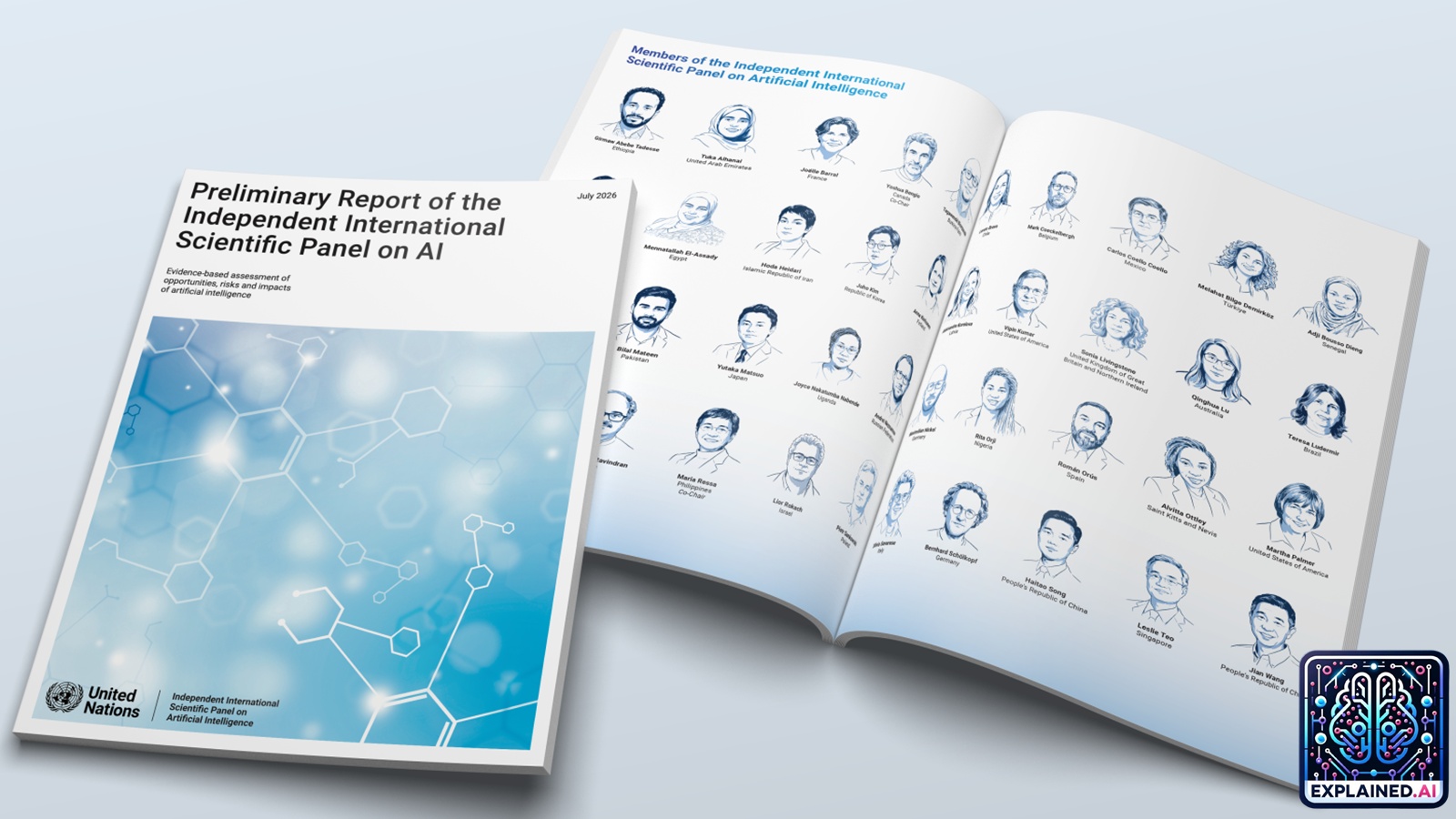
Artificial intelligence (AI) is advancing at a pace that governments are struggling to understand, let alone regulate. That is the central message of the Preliminary Report of the Independent International Scientific Panel on AI, the first scientific assessment of AI commissioned by the United Nations.
Co-chaired by Turing Award laureate Yoshua Bengio and Nobel laureate Maria Ressa, the 40-member panel’s preliminary report warns that the breakneck pace of artificial intelligence development has completely outstripped existing safety guardrails, and global governance mechanisms are currently failing to keep up.
The report examines AI across seven broad themes: advances in AI science; applications in healthcare, education and agriculture; economic implications; security and environmental impacts; human rights and democracy; cultural and individual wellbeing; and governance and reliability. It is intended to serve as the first in a series of periodic assessments, with a more comprehensive report expected next year.
Why the report says governments should be worried
The report argues that AI capabilities are progressing faster than scientific understanding and public oversight. Policymakers, it says, increasingly face a difficult dilemma: waiting for complete scientific certainty before acting may mean responding only after serious harms have already materialised.
“The world cannot govern what it cannot understand,” UN Secretary-General António Guterres said while releasing the report, stressing that governments need independent scientific evidence before making policy choices.
One of the panel’s biggest concerns is the emergence of increasingly capable frontier AI models and autonomous AI agents that can perform complex tasks with limited human intervention. While these systems promise significant productivity gains, they also introduce new risks that current governance mechanisms are ill-equipped to address.
“Dozens of distinct governance instruments that seek to embed ethics and human rights in AI systems are already in use across jurisdictions, but they are fragmented, are concentrated among a few corporations and rarely measure real-world effectiveness. Evaluation methods themselves are underdeveloped, and the institutions needed to provide independent capability and risk assessments remain embryonic,” it added.
Story continues below this ad
Compute divide across countries in AI
The report argues that the global AI race is no longer just about talent or innovation, but increasingly about who controls the computing infrastructure needed to build and run advanced AI models.
It notes that frontier AI development is concentrated in a handful of countries, with the United States accounting for around 75% of global AI computing capacity and China another 15%, leaving the rest of the world to share the remaining 10%. This concentration of advanced semiconductors, hyperscale data centres and cloud infrastructure has created what the panel calls a widening compute divide, making computing power a strategic resource rather than merely a technological input.
The panel warns that countries without access to large-scale compute infrastructure, cutting-edge chips and high-quality datasets risk becoming consumers rather than creators of AI. Such nations may struggle to build sovereign AI capabilities, shape global AI standards or develop models suited to their own languages and developmental priorities.
“In 2025, institutions based in the United States produced 59 notable AI models, compared with 35 in China and just 13 in the rest of the world. In the same year, 75% of the computing power of the 500 largest-known private and public AI compute clusters was located in the United States, followed by 15% in China and 10% in the rest of the world,” the report said.
Story continues below this ad
For countries like India — which has launched the IndiaAI Mission and is investing in procuring compute hardware — the findings reinforce the strategic importance of domestic AI infrastructure. Without expanding indigenous compute capacity, the report cautions, existing digital inequalities could harden into long-term technological dependence.
The dangers of AI concentration
Beyond the compute divide, the report warns that the AI ecosystem is becoming increasingly concentrated in the hands of a small number of companies and countries. Frontier AI development today requires enormous financial resources, specialised talent, cutting-edge chips and vast data centres, barriers that only a handful of firms can overcome.
The panel notes that this concentration extends across the AI value chain, from semiconductor design and cloud infrastructure to foundation models and AI deployment platforms. Such dominance, it says, could reduce competition, limit innovation, increase dependence on a few providers and allow a small number of companies to disproportionately shape how AI systems are developed, deployed and governed.
“The concentration of AI capabilities in a small number of firms and countries could enable authoritarian capture and undermine democratic accountability… Current AI systems reflect only a limited range of the world’s linguistic and cultural diversity, excluding much of the world’s population. Proactive investment is needed. At the same time, the global South is disproportionately vulnerable to AI misuse risks due to limited local resilience and mitigation capacity,” the report said.
Story continues below this ad
The report cautions that concentration is not merely an economic issue but one with geopolitical implications. As AI becomes embedded in public services, defence, healthcare and critical infrastructure, excessive dependence on a handful of firms or countries could leave governments with limited strategic autonomy.
It therefore calls for policies that promote greater competition, wider access to compute and scientific resources, and support for open scientific research and public-interest AI.
Without broader participation, the panel warns, AI’s benefits and decision-making power could become concentrated in ways that reinforce existing economic and technological inequalities.
View original source — Indian Express ↗
Related stories

TechRadar
TechnologyJul 12, 2026 · 1 min
I helped drive this record-setting EV across Britain on sunshine alone — and the 870-mile trip cost absolutely nothing
TechRadar

Indian Express
TechnologyJul 12, 2026 · 1 min
What INS Mahendragiri’s commissioning shows about India’s naval shipbuilding prowess
Indian Express

Lovin Malta
TechnologyJul 12, 2026 · 1 min
Amphora Podcast Takes Listeners Inside The Yorgen Fenech Jury Trial Using Court Transcripts
Lovin Malta

TechRadar
TechnologyJul 12, 2026 · 1 min
The Holy Grail of LED cinema: World's largest screen is the size of 700 TVs and packs 44 million pixels
TechRadar