Indian Express
UPSC Key: India-New Zealand relations, Akashvani, and India’s first hydrogen train
Preliminary Examination: Current events of national and international importance.
Mains Examination: General Studies-II: Bilateral, regional and global groupings and agreements involving India and/or affecting India’s interests.
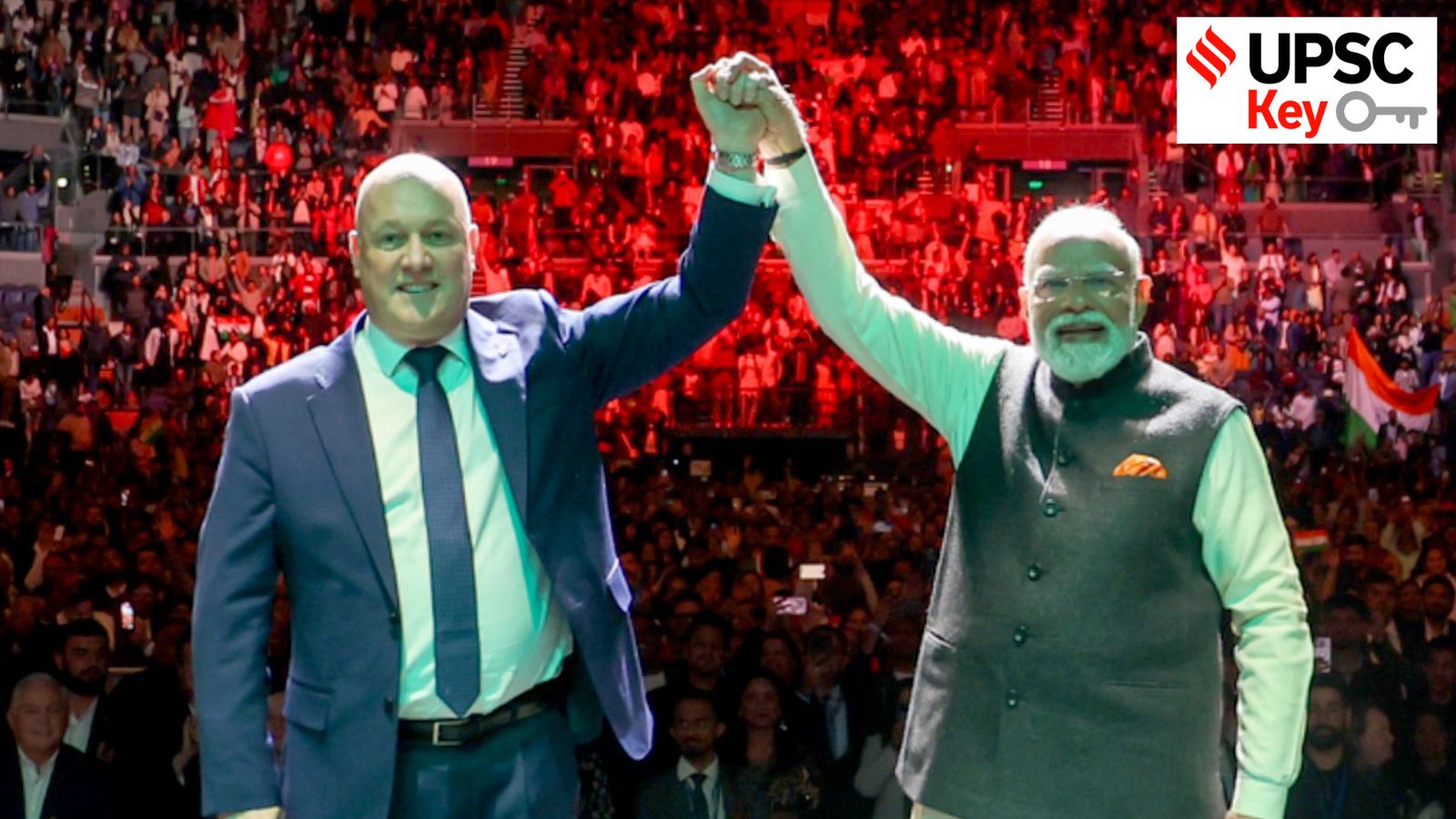
What’s the ongoing story: India and New Zealand pledged Saturday to elevate their bilateral relationship to a “strategic partnership” with Prime Minister Narendra Modi and his counterpart, Christopher Luxon, endorsing its framework and “roadmap to 2030.”
— Know about the history of India-New Zealand relationship.
— What is the significance of the India-New Zealand Free Trade Agreement (FTA)?
— What is the Five-Eyes intelligence alliance?
— What is Maori Haka?
— What do you understand to elevate a bilateral relationship to a ‘strategic partnership’?
— What are the efforts taken by India for Indo-Pacific outreach? Why is it important?
— Map work: Location of New Zealand and water bodies surrounding it
Key Takeaways:
— Both signed a range of pacts that included defence and maritime security, a target to double trade volume, a joint counter-terrorism panel to address pro-Khalistan concerns and a sports cooperation roadmap.
— After the bilateral talks in Auckland, Modi, the first Indian Prime Minister to visit the country in 40 years, said: “This marks the beginning of a new chapter in our relationship. Our shared, firm belief in democratic values creates a natural comfort for India and New Zealand to move forward together.”
— India and New Zealand agreed to double bilateral trade to NZ$7 billion or Rs 35,000 crore by 2030, in the context of the Free Trade agreement signed in April this year.
— Flagging the FTA signed in “record time” Modi said the trade deal “will open new doors for industries, farmers, and the youth of both nations.” Beyond trade, Modi underlined a “blueprint based on trust, technology, and talent,” that will power bilateral ties to “double our trade volume over the next five years.”
— The joint statement said that the Prime Ministers highlighted cooperation under Combined Task Force 150 (CTF-150) in 2025, with New Zealand in command and India as Deputy Commander, supporting efforts to deter narcotics smuggling, terrorism, and illicit maritime activity in the Middle East and the Western Indian Ocean.
— According to the Ministry of External Affairs, the two sides decided to establish a maritime security dialogue to strengthen cooperation, coordination and information exchange.
— The two leaders reiterated the importance of dialogue and diplomacy, and adherence to international law to achieve a peaceful and lasting solution to the West Asia conflict.
— The joint statement underscored stability in the Indo-Pacific and the importance of “transparent, and resilient supply chains.”
— On terrorism, both leaders condemned the terrorist attacks in Pahalgam in April 2025 and Red Fort in November 2025 and stressed that those responsible for the attacks should be held accountable.
— “The leaders welcomed…establishing a Joint Working Group (JWG) on Counter-Terrorism which will provide a framework for information and knowledge sharing,” the joint statement said, in the context of concerns from pro-Khalistan elements in New Zealand. This is significant since New Zealand is a Five-Eyes intelligence partner along with the US, UK, Canada and Australia.
— The two sides also signed a pact for enhanced cooperation in animal husbandry and dairying through technical collaboration, knowledge exchange, and best practices. They also decided to launch the ‘Kiwifruit Action Plan and Establishment of two Centres of Excellence for Kiwifruit in Nagaland and Uttarakhand’.
— The India-New Zealand Joint Action Plan on Sport will provide a framework for collaboration in sports, including high-performance sport, sports science, sports medicine and athlete development. The two countries also signed a pact on collaboration in Antarctic research.
— Modi, who wrapped up his three-nation trip in Auckland, also got a special Maori welcome. Luxon highlighted the deep cultural alignment and the unprecedented momentum injected into the bilateral relationship.
Do You Know:
— The haka, often associated with New Zealand’s All Blacks rugby team ( which has performed the haka before each match for nearly 120 years), is much more than a pre-game ritual; it is a cornerstone of Maori culture, embodying history, identity, and emotion.
— The haka traces its roots to the Maori people, the indigenous Polynesian inhabitants of New Zealand (Aotearoa). Traditionally, the haka was a ceremonial dance or challenge performed by warriors before battle. It was designed to intimidate opponents with synchronised movements, powerful chants, and piercing expressions.
— Beyond warfare, the haka also served as a means of storytelling, a way to express communal grievances, celebrate triumphs, or honour ancestors. The chants, or waiata, convey deep messages about Maori heritage, values, and connection to the land.
Other Important Articles Covering the same topic:
📍Modi first Indian PM to visit New Zealand in 40 years, trade and sports top agenda
📍Knowledge Nugget | Maori Haka explained: History, significance and India’s martial art forms
UPSC Prelims Practice Question Covering similar theme:
(1) With reference to the India-New Zealand relations, consider the following statements:
1. India and New Zealand decided to elevate their bilateral relationship to a ‘strategic partnership’.
2 India and New Zealand agreed to double bilateral trade by 2040.
3. India and New Zealand signed a pact on collaboration in Antarctic research.
4. India and New Zealand decided to launch the ‘Kiwifruit Action Plan’ and establish 2 Centres of Excellence for Kiwifruit in Gujarat and Sikkim.
How many of the statements given above are correct?
(a) Only one
(b) Only two
(c) Only three
(d) All four
EC changes Form 6 for new voters, inserts section asking them about parents in SIR
Syllabus:
Preliminary Examination: Indian Polity and Governance – Constitution, Political System, Panchayati Raj, Public Policy, Rights Issues.
Mains Examination: General Studies-II: Salient features of the Representation of People’s Act, Indian Constitution—significant provisions.
What’s the ongoing story: For the first time, the Election Commission’s online version of the electors’ registration form, known as Form 6, has a new section that seeks the status of the applicant’s parents vis-a vis the last Special Intensive Revision (SIR) of electoral rolls, even though the statutory form itself has not been amended, The Indian Express has learnt.
Key Points to Ponder:
— What is Form 6? What is its significance in the electoral registration process in India?
— Know about SIR and the reason for introducing it.
— What is the constitutional basis of voter registration in India?
— What is the legal backing for conducting SIR?
— How can Special Intensive Revision (SIR) affect vulnerable groups?
— Read about the Election Commission of India, its powers and functions.
— What are the constitutional and legal safeguards available to citizens against wrongful deletion from electoral rolls?
Key Takeaways:
— The EC’s ECINET portal, as accessed Saturday, showed an un-lettered “declaration form” inserted in between part “J” and “K” of Form 6 that asks for details of the applicant or their parents in the last SIR. But the copy of the Form 6 available for download on the same portal, ostensibly for filling and submitting physically, does not include this new declaration part.
— This part of the form was visible for applicants from all states and UTs where the SIR has concluded in 2025-2026 or is currently ongoing, except for Bihar, which was the first state to have the SIR in June last year, and Assam, where the EC has decided not to hold the SIR. While the new part has not been marked mandatory, the user cannot move forward toward the submission before completing it.
— It asks the applicant to pick from three options: “my name exists in Electoral Roll of last SIR; my parents name (Father, Mother, Grandfather, Grandmother) exists in the electoral roll of last SIR; neither my name nor my parents name exists in the electoral roll of last SIR”.
— While the EC sought the same details during the SIR in 12 states/UTs last year and also in the ongoing SIR in 19 states/UTs in its enumeration form for existing electors, Form 6 for new electors has not been amended since the EC started in SIR in June last year, a look at all gazette notifications by the Law Ministry since then shows.
— It is the Central government that has the power to notify rules under Section 28 of the Representation of the People Act, 1950 and Form 6 emanates from one such rule in the Registration of Electors Rules, 1960.
— The Act itself emanates from Article 326 of the Constitution, which guarantees the right to enrol as an elector to all adult citizens who are ordinarily resident in a particular constituency and have not been otherwise disqualified.
— “The Central Government may, after consulting the Election Commission, by notification in the Official Gazette, make rules for carrying out the purposes of this Act,” reads Section 28 of the RP Act, 1950.
— In the past, changes to Form 6 required an amendment to the Act itself by Parliament and/or an amendment and notification to the rules by the Law and Justice Ministry. Two senior former EC officials speaking on condition of anonymity said any change to the form would require at least an amendment and notification by the Law Ministry as the EC does not have the power to do so.
— “The EC cannot even add a comma to the form on its own,” one of the former officials said. For instance, after Parliament amended the Act in 2021 to allow the EC to collect Aadhaar numbers of electors, the Legislative Department of the Law Ministry issued a notification on June 17, 2022 making the necessary changes to the Registration of Electors Rules and Form 6.
— Form 6 is the statutory form for either those who have newly become eligible after turning 18 years of age or acquiring Indian citizenship or deleted voters who want to apply afresh.
— The existing Form 6, which is published in the Registration of Electors Rules, 1960, asks the applicant to provide the name and EPIC number of those family members with whom they currently reside.
From the Politics Page- UN Special Rapporteurs flag ‘discrimination’ in SIR exercise, seek govt’s response
— Three United Nations-appointed experts have written to the Centre expressing concerns over alleged discrimination towards minorities during the Election Commission’s Special Intensive Revision (SIR) of electoral rolls, particularly in West Bengal, and seeking information on the steps taken to ensure the process aligns with India’s obligations under international human rights law.
— The UN’s Special Rapporteurs on minority issues, on promotion and protection of the right to freedom of opinion and expression, and on freedom of religion or belief — Nicolas Levrat, Irene Khan and Nazila Ghanea respectively —wrote to the government on May 1.
Do You Know:
— The Part XV of the Constitution of India deals with Elections. It has the following articles (Articles 324-329) to empower the Election Commission and provide insight into the potential roles and functions of the commission.
— Article 324: The superintendence, direction and control of the preparation of the electoral rolls for, and the conduct of, all elections to Parliament and the Legislature of every state and of elections to the offices of President and Vice-President.
— Article 325: No individual to be excluded from electoral rolls on the basis of religion, race, caste, sex or any of them.
— Article 326: Adult suffrage shall be the basis for elections to the House of the People and to the Legislative Assemblies of States.
— Article 327: Parliament may, according to the provisions of this Constitution, from time to time enact laws with respect to all matters relating to elections to Parliament and Legislative Assemblies of States.
— Article 328: A state’s Legislature may from time to time by law make provision with respect to all matters relating to, or in connection with, the elections to the House or either House of the Legislature.
— Article 329: The article prohibits the courts from becoming involved in electoral matters.
— SIR, or Special Intensive Revision, is a large-scale verification exercise that the ECI undertakes when it believes the routine annual “Summary Revision” is not enough to clean the voter rolls. It involves house-to-house enumeration, pre-filled forms, online submissions, and fresh verification of old voter data.
Other Important Articles Covering the same topic:
📍Experts Explain | Can Election Commission decide who is an Indian citizen? What Supreme Court said in SIR verdict
📍What the Election Commission’s new online registration requirement means for voters
📍Special Intensive Revision (SIR): Why is it important? Why ECI is doing it now and what you need to do
Previous year UPSC Prelims Question Covering similar theme:
(2) Consider the following statements: (UPSC CSE 2017)
1. The Election Commission of India is a five-member body.
2. Union Ministry of Home Affairs decides the election schedule for the conduct of both general elections and bye-elections.
3. Election Commission resolves the disputes relating to splits/mergers of recognised political parties.
Which of the statements given above is/are correct?
(a) 1 and 2 only
(b) 2 only
(c) 2 and 3 only
(d) 3 only
Previous year UPSC Mains Question Covering similar theme:
To enhance the quality of democracy in India the Election Commission of India has proposed electoral reforms in 2016. What are the suggested reforms and how far are they significant to make democracy successful? (UPSC CSE 2017)
Govt panel raises UAPA spectre, ‘misuse’ by Pak
Syllabus:
Preliminary Examination: Indian Polity and Governance – Constitution, Political System, Panchayati Raj, Public Policy, Rights Issues.
Mains Examination: General Studies-II, III: Government policies and interventions, Role of external state and non-state actors in creating challenges to internal security.
What’s the ongoing story: In its order recommending the film “Satluj” remain blocked from public access, the government panel has raised the spectre of the Unlawful Activities (Prevention) Act by observing that “Khalistan-related propaganda, foreign-based separatist mobilisation, and hostile information operations are continuing concerns, with multiple pro-Khalistan organisations listed as terrorist organisations under the UAPA framework.”
Key Points to Ponder:
— Understand the controversy regarding the Sutluj movie?
— What is the difference between theatrical release and OTT release?
— How does India regulate theatrical releases and OTTs?
— What is Section 69A of the IT Act?
— What do you understand about “reasonable restrictions” on free speech under Article 19(2) of the Constitution?
— What are the key features of the UAPA Act? What is the objective of this act?
— What are the concerns related to the UAPA Act?
— What are the issues of regulating OTT material in India?
— What are the challenges to India’s internal security?
Key Takeaways:
— The film, directed by Honey Trehan, and starring Diljit Dosanjh is based on human rights activist Jaswant Singh Khalra and shows his death in police custody following his campaign to probe hundreds of disappearances during the militancy years in Punjab. It was pulled from the OTT platform ZEE5 for viewers in India two days after its release on July 3.
— The government’s Inter-Departmental Committee (IDC) rested its national security case on two grounds: pro-Khalistan organisations listed under UAPA, and the “misuse” of the film by Pakistan.
— Its July 9 order records that it “observed that the current security context of Punjab poses an immediate risk of the film becoming a tool for reviving separatist grievance among youth.”
— Besides voicing its concerns about Khalistan-based propaganda with multiple pro-Khalistan organisations listed as terrorist organisations under UAPA, the IDC said “the security situation in Punjab is sensitive due to Punjab’s border sensitivity, cross-border propaganda, and foreign-linked extremist ecosystems, thereby increasing the risk of hostile exploitation of emotionally charged content concerning the militancy period.”
— The Indian Express first reported on Saturday that the committee had recommended to the Information and Broadcasting Ministry that the film, starring Diljit Dosanjh and based on the life of human rights activist Jaswant Singh Khalra, remain blocked under Section 69A of the IT Act.
— The committee also observed that “the film can be used by hostile State/non-State actors to spread a misleading narrative of Sikh oppression by the Indian State, and such misuse by Pakistan has already begun with Pakistan-based actors using the film as evidence of Indian State brutality and oppression of Sikhs with the intent to spread separatist ideology in India.
— The order referred to Sikhs For Justice, a pro-Khalistan group that is declared an unlawful association under the UAPA.
— The order also underlined that the film “need not explicitly call for secession if it supplies the emotional and evidentiary building blocks of secessionist propaganda.”
Do You Know:
— Theatre releases are governed by the Cinematograph Act, 1952. Under Section 4 of the Act, any person wishing to exhibit a film publicly must apply to the CBFC, a statutory body under the Ministry of Information and Broadcasting. Screening uncertified films in a cinema is a criminal offence.
— The CBFC certifies films into categories: U (unrestricted); UA (unrestricted with parental guidance); A (adults only), and S (restricted to specialised audiences).
— The Cinematograph (Amendment) Act, 2023, further split the UA category into age-based sub-categories and made certificates perpetually valid, removing the earlier 10-year limit.
— The Act also empowers the board to refuse certifications or to grant them subject to excisions and modifications if a film is against the interests of the sovereignty and integrity of India… These are the “reasonable restrictions” on free speech under Article 19(2) of the Constitution.
— OTT content is regulated under part III of the Information Technology (Intermediary Guidelines and Digital Media Ethics Code) Rules, 2021, which prescribes a code of ethics requiring publishers to exercise caution over content that may fall under the grounds for “reasonable restrictions” mentioned above.
— In the 2023 Broadcasting Services (Regulation) Bill, which was subsequently withdrawn, the government attempted to define OTT platforms as a broadcasting service to bring them under its ambit.
— In the case of Satluj, however, the government has reportedly used its powers under Section 69A of the IT Act to take down the movie.
— Section 69A involves the power to issue orders to block content. These orders are issued under the Information Technology (Procedure and Safeguards for Blocking Access of Information by Public) Rules, 2009. The government must record the reasons for blocking in writing, and then a designated Review Committee examines these directions and can set aside orders if they do not comply with Section 69A.
Other Important Articles Covering the same topic:
📍Behind Satluj takedown, the parallel regimes for theatrical and OTT releases
UPSC Prelims Practice and Previous Year Question Covering similar theme:
(3) With reference to Section 69A of the IT Act, consider the following statements:
1. It allows the Centre to issue orders blocking any information generated, transmitted, received, stored or hosted in any computer resource.
2. For blocking content under Section 69A, the Centre must deem it “necessary”. This “necessity”, however, is only justifiable under grounds provided in Article 19(2) of the Constitution of India.
Which of the statements given above is/are not correct?
(a) 1 only
(b) 2 only
(c) Both 1 and 2
(d) Neither 1 nor 2
(4) According to the Constitution of India, which of the following are fundamental for the governance of the country? (UPSC CSE 2013)
(a) Fundamental Rights
(b) Fundamental Duties
(c) Directive Principles of State Policy
(d) Fundamental Rights and Fundamental Duties
Previous year UPSC Mains Question Covering similar theme:
Indian Government has recently strengthened the anti-terrorism laws by amending the unlawful Activities (Prevention) Act (UAPA), 1967 and the NIA act. Analyze the changes in the context of prevailing security environment while discussing the scope and reasons for opposing the UAPA by human rights organizations. (UPSC CSE 2019).
ECONOMY
PM to flag off India’s first hydrogen train: Why the technology is so challenging
Syllabus:
Preliminary Examination: Current events of national importance.
Mains Examination: General Studies- III: Science and Technology, Achievements of Indians in science & technology; indigenization of technology and developing new technology, Conservation, environmental pollution and degradation.
What’s the ongoing story: Prime Minister Narendra Modi will flag off India’s first hydrogen-powered train in Jind, Haryana on July 17. This will mark a major milestone for the Indian Railways in a green technology where few countries have ventured so far.
Key Points to Ponder:
— Read about hydrogen and its types.
— How does hydrogen fuel cell technology work?
— What are the advantages and challenges of hydrogen fuel cell technology in the transport sector?
— What are the major challenges related to hydrogen as a clean fuel?
— What is the significance of hydrogen trains for India?
— What is the National Hydrogen Energy Mission?
Key Takeaways:
— According to the Railways, this is one of the world’s longest (eight passenger cars and two driving power cars) and most powerful (2400 kilowatt) hydrogen trainsets.
— The train can carry at least 682 passengers on the 89-km Jind-Sonipat railway section at a maximum operational speed of 75 km/h. It will make two round trips a day, covering 356 km and consuming an estimated 300 kg of hydrogen. Notably, hydrogen is highly flammable and needs to be transported at very high pressure.
— French rolling stock giant Alstom presented the hydrogen train technology for the first time at a 2016 exhibition in Berlin. Its two-car trainset, the Coradia iLint, was launched in Germany two years later, becoming the world’s first hydrogen-powered passenger train.
— Later, countries such as Japan, China and the US also launched their own hydrogen-powered trains. The technology, however, is still evolving to cater to the mass transportation of passengers and freight. That is why few countries have hydrogen train services, and those that do use them mostly for relatively short trips.
— Normal electrical locomotives require overhead wires to draw the alternating current that powers their movement. Hydrogen trains don’t. They run on the simple formula of combining hydrogen with oxygen to produce the tractive electricity.
— In the Indian hydrogen train’s case, each of the two driving power cars will have four sets of integrated power packs, comprising hydrogen fuel cells and a lithium ferro phosphate battery.
— The hydrogen fuel cell will draw in the hydrogen stored on board (440 kg) at high pressure and oxygen from the outside air, then combine them to release electrical energy.
— Normal atmospheric pressure is measured as one “bar”. Hydrogen, however, has to be stored at 200-500 bar. This is the biggest challenge in using hydrogen as a clean fuel in trains. There are other issues too. Hydrogen production levels are low and transporting is difficult.
— To ensure the continuous supply of hydrogen for the trains, the railways has set up a 3000-kg-capacity fueling facility at Jind. A chiller plant has also been developed to keep the hydrogen at minus 15 degrees Celsius during dispensing — the low temperature will transform it into a liquid state and, thus, ensure its easy dispensing.
Do You Know:
— Decarbonisation of the railways is a significant step towards attaining the net-zero goal by 2070. Indian Railways under “Hydrogen for Heritage” envisages deploying 35 hydrogen-powered trains on heritage and hill routes across the country.
— Significance of hydrogen trains for India?
• Attaining net-zero target by 2070
• Reduce diesel dependence
• Support India’s effort to decarbinsation of Railways
• Promotes clean energy transition
Types of Hydrogen
Grey Hydrogen
It constitutes the bulk of India’s production. It is mainly produced through steam methane reforming (SMR), in which natural gas (methane) is used as the feedstock. The process relies on fossil fuels and releases carbon dioxide into the atmosphere
Blue Hydrogen
Production of hydrogen from coal/natural gas combined with Carbon Capture and Storage (CCS). CCS is a way to catch carbon and trap it beneath the earth. It is different from carbon dioxide removal (CDR) — where carbon is sucked out of the atmosphere. The byproducts, like carbon monoxide and carbon dioxide, are captured and stored.
Green Hydrogen
In this, hydrogen is produced from water electrolysis—splitting water into hydrogen and oxygen—by using renewable energy-powered electrolysers. It is considered a virtually emission-free pathway for hydrogen production.
Other Important Articles Covering the same topic:
📍Knowledge Nugget | India’s first hydrogen train: How does hydrogen fuel cell technology work?
📍Hydrogen trains for a truly green and sustainable form of transportation
UPSC Prelims Practice Question Covering similar theme:
(5) Which one of the following best describes the source of propulsion in a hydrogen fuel-cell train?
(a) Hydrogen is directly burned inside a diesel engine to produce mechanical energy.
(b) Electricity generated in a hydrogen fuel cell powers electric traction motors.
(c) Hydrogen is converted into steam, which drives a steam turbine.
(d) Hydrogen is used only for auxiliary systems, while diesel powers the engine.
OPINION
Akashvani: A voice from the sky, and an a meth at stuck
Syllabus:
Preliminary Examination: Current events of national importance.
Mains Examination: General Studies-II: Government policies and interventions.
What’s the ongoing story: Suanshu Khurana writes- “As Akashvani, the official radio broadcasting wing of Prasar Bharati under the Ministry of Information and Broadcasting, celebrates its 90 years, it should not be forgotten that it was born under a different name: All India Radio.”
Key Points to Ponder:
— How has public service broadcasting evolved in India since Independence?
— Read about Prasar Bharati and its functions.
— How has All India Radio (Akashvani) contributed to nation-building and cultural integration?
— What is the significance of public broadcasting?
— How do public service broadcasters differ from private broadcasters?
Key Takeaways:
— “Akashvani (meaning voice from the sky), the delightful term adapted from Rabindranath Tagore’s eponymous poem, entered the official vocabulary only two decades later, in 1956, and then coexisted with All India Radio. Until 2023. When an internal order severed ties with the original name and made it mandatory for the institution to be called only by the new official name, Akashvani.”
— “In a satellite message, a section of the Prasar Bharati Act, 1990 (which came into force in 1997), was enforced, defining Akashvani as “the offices, stations and other establishments by whatever name called, which immediately before the appointed day formed part of or were under the Director General, All India Radio of the Union Ministry of Information and Broadcasting.” It was described as implementing an existing statutory position rather than introducing a new policy. However, the execution strangely occurred more than two decades later.”
— “Celebrating 90 years of Akashvani, then, is technically inaccurate. The institution may have been called only Akashvani since 2023, but what has turned 90 is what generations of Indians have known as All India Radio.”
— “The 2023 change puzzled many because, for the nation, both names coexisted. While Akashvani was widely used in Indian-language broadcasts, in English bulletins and shows, one always heard, ‘This is All India Radio’. AIR has also been the institution’s global identity.”
— “One individual instrumental in bringing the name AIR and its identity to the fore was Lionel Fielden, the BBC producer recruited in 1935 as undivided India’s first Controller of Broadcasting, and who had the difficult task of coordinating broadcasting development in India. Unhappy with the long and clunky Indian State Broadcasting Service (ISBS), he wanted something simpler. For the change, he had to get past the then Viceroy, Lord Linlithgow.”
— “Fielden wrote in his book, The Natural Bent (1960), that he cornered Linlithgow after a State dinner, asking for his advice — an opening the man could not ignore. Complaining that the Indian State Broadcasting Service “was a clumsy title” and that “ ‘broadcasting’ was difficult for many Indians to pronounce,” Fielden requested the Viceroy’s help in suggesting a better alternative. “ ‘Indian State’, I said, was a term which, as he well knew, hardly fitted into the 1935 Act. It should be something general. He rose beautifully to the bait. ‘All India’? I expressed my astonishment and admiration… After some thought, he suggested ‘Radio’? Splendid, I said — and what beautiful initials. The Viceroy concluded that he had invented it, and there was no more trouble…Thus All India Radio (AIR) was born,” wrote Fielden.”
— “This was a landmark moment that gave a fledgling broadcasting network a distinct character, making it a cultural anchor of sorts, one that people in undivided British India identified with. The name went on to become synonymous with public broadcasting in the Subcontinent. After this, Delhi, Lahore and Dhaka, among others, had their All India Radio stations.”
— “Independence would come almost a decade later, in the wake of a bloody Partition and the station names in Pakistan and East Bengal (later East Pakistan) were altered. All India Radio, which would always open with Walter Kauffman’s signature tune on the violin played by Mehli Mehta (conductor Zubin Mehta’s father), carried official announcements, voices of leaders and film songs that became a soundtrack to our lives.”
Other Important Articles Covering the same topic:
📍All India Radio to only be referred to as Akashvani: A brief history of the Indian public broadcaster
ALSO IN NEWS
Premature life policy surrenders soar, overtake maturity payouts
— Blame it on financial stress or mis-selling by insurers — surrenders and withdrawals of life insurance policies before maturity have been increasing over the past five years.
— Payouts for surrenders and withdrawals increased from around 30% of total benefits paid to policyholders in FY2022 to 38.3% in FY2026, suggesting that a growing number of policyholders are exiting their policies before maturity.
— According to insurance experts, many families have surrendered traditional life insurance policies to meet immediate cash needs due to inflation, rising living costs and higher loan repayments in recent years.
— Some customers purchase policies expecting short-term investment or FD-like returns, but discontinue them after realizing later about the long lock-in period and surrender penalties. Further, higher interest rates on bank FDs, stock market and mutual fund investments have become more attractive, prompting many customers to move away from insurance policies that offered comparatively lower returns, they say.
Nightingale of South Indian cinema, who gave voice to over 40,000 songs, falls silent
— S Janaki, who recorded over 40,000 songs in multiple languages, including Tamil, Odiya, Bengali, Malayalam, Telugu, Kannada and Hindi among others, died at a private hospital in Mysuru on Saturday evening due to age-related issues. She was 88.
— In 2013, Janaki declined the Padma Bhushan, saying the recognition had come too late (she had been successfully singing for 55 years), and that she deserved nothing less than a Bharat Ratna, an honour that Mangeshkar was given in her lifetime.
India seeks review of US’ forced labour investigation
— India has sought the review of proposed US tariffs of 12.5% citing inconsistencies in its Section 301 investigation into forced labour concerns, as the deadline for fresh US tariffs scheduled to be imposed by July 24 nears. The US has currently imposed 10% global tariffs.
— Joint Secretary in the Department of Commerce Brij Mohan Mishra, during a public hearing, said that India takes the elimination of forced labour seriously as a Constitutional obligation, and as a matter of international law and principle.
— The USTR has not satisfied the relevant legal standards under Section 301(d) of the Trade Act. A mere absence of a forced labour import prohibition without evidentiary basis of other statutory requirements cannot be construed as unreasonable under Section 301, he added.
Gaming industry winning despite a real money ban
— Real-money gaming (RMG) may have been banned, but India’s gaming industry has not lost the game.
— From in-app purchases to premium passes, cosmetic spending to subscriptions and advertising-led monetisation, the industry is rapidly expanding its revenue streams to sustain growth momentum since the ban that became effective from May 1 this year.
PRELIMS ANSWER KEY
1. (b) 2. (d) 3. (c) 4. (c) 5. (b)
Subscribe to our UPSC newsletter. Stay updated with the latest UPSC articles by joining our Telegram channel – IndianExpress UPSC Hub, and follow us on Instagram and X.
🚨 Click Here to read the UPSC Essentials magazine for June 2026. Share your views and suggestions in the comment box or at [email protected]🚨
View original source — Indian Express ↗
Related stories

Hacker Noon
TechnologyJul 12, 2026 · 1 min
I Compiled 55 Days of Screen Activity Into Episodic Memory for My AI Agent
Hacker Noon
The Next Web
TechnologyJul 12, 2026 · 1 min
Ubisoft is in crisis, and a 13-year-old pirate game is part of the escape plan
The Next Web

Engadget
TechnologyJul 12, 2026 · 1 min
Why Xiaomi phones aren't banned, but are rarely sold in the US
Engadget
The Next Web
TechnologyJul 12, 2026 · 1 min
Netflix is reportedly considering always-on channels and bundles, which is to say, cable
The Next Web