The Guardian
Pollock, pace and potential offer glimpse of promised land for England
Next year Steve Borthwick would love to be where Thomas Tuchel is now. A World Cup semi-final in prospect, an entire nation transfixed and a team with another gear in it. Swap Atlanta for Sydney and Jude Bellingham for Henry Pollock and the same essentials will be required: big-match players, smart man management and the absolute belief that decades of disappointment can be overcome.
Tuchel and his staff even paid a visit to their rugby counterparts in March, albeit in the week the latter lost against Italy in the Six Nations for the first time. Borthwick has long been interested in how England-based coaches deal with the sheer weight of expectation and has spoken to a number of Premier League managers on the subject.
“I talk to them about how they manage it,” he said. “Consistency of preparation, consistency in reviews. If you win, yes praise them for what they did well, but make sure they understand what they can do better.”
Borthwick, accordingly, would have heartily approved of Tuchel’s post-match interview with Gabriel Clarke after England’s quarter-final win against Norway. Not for Tuchel a few bars of Wonderwall or beaming permission for England fans to get the party started. Uppermost in his mind was how his side can kick on further, regardless of how many damn lions there are on the shirt.
Which is essentially what Borthwick will be thinking heading into England’s final match between now and November. While the satisfaction of thrashing Fiji 73-8 was severely diluted by the opposition’s depressingly poor performance, it did offer a glimpse of the elusive promised land for which England supporters have long been yearning.
Borthwick being Borthwick he was reluctant to single out individuals but, equally, he will reflect on the backline that finished the game and feel something largely absent during England’s previous five-Test losing run. Namely a sense of quiet excitement that his Twickenham lab experiment has unearthed a couple of promising catalysts.
It remains to be seen which starting XV faces Argentina in Santiago del Estero on Saturday but, frankly, now is the moment to trust the evidence of his own eyes. If he starts Benhard van Rensburg and Henry Slade in midfield alongside Manny Feyi-Waboso and Tommy Freeman on the wings, with the precociously talented Noah Caluori lurking on the bench, he would have a balance of pace and potential any side would covet.
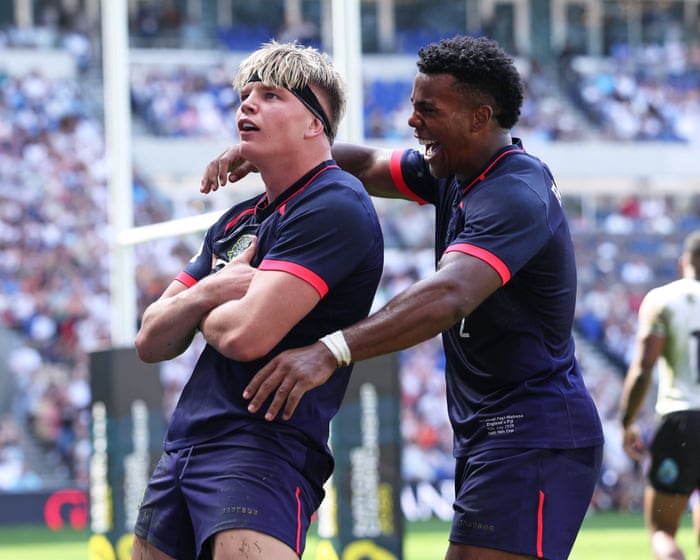
And because opportunities to experiment before the 2027 World Cup are running out, he should also bite the bullet and start Henry Pollock, whose hat-trick of second-half tries at Hill Dickinson Stadium was in the grand traditions of illustrious Everton sharpshooters such as Dixie Dean, Bob Latchford and Graeme Sharp.
Borthwick was studiously non-committal when asked about a possible start for Pollock this week – “He did a pretty good job coming off the bench, didn’t he?” – and preferred to spread the praise more widely. “I think Henry is an outstanding player but we’ve got many real top quality back row forwards there. I understand why you focus on individuals and I myself have also said we want superstars in our game. But’s its also quite right that I focus on the team that creates the opportunities for somebody to score those tries.”
True enough but, equally, England instantly look a more vibrant team with Pollock on the field if – and it is a crucial if – he has a licence to play his natural game. In that event why restrict his game time to 30-odd minutes rather than the full 80? The Pumas will be desperate to ambush England this Saturday but Pollock has the pace and self-confidence to transform the contest into something else entirely.
Borthwick should also consider repeating the experiment of employing Marcus Smith at scrum-half, where he ended up after Alex Mitchell’s latest untimely hamstring injury. Raffi Quirke has been drafted into the squad as Mitchell’s replacement but if Smith can become a feasible option at No 9, where he played a fair amount as a kid, it would allow his coaches to contemplate a 7-1 bench strategy à la South Africa.
In some ways England have no realistic choice other than to commit fully to playing attacking rugby. As Scotland showed in a humdinger of a contest against South Africa in Pretoria and France also demonstrated in Brisbane, slick execution with ball in hand is becoming de rigueur for the world’s top sides. If England can bolt on a half-decent offloading game like Northampton they could yet be similarly incisive.
Yes, this month’s travel demands are onerous. Yes, the weather conditions are fluctuating madly. Yes, it is the end of an achingly long season. But if Borthwick’s England really want to emulate Tuchel’s England they will need to venture even further outside their comfort zones. Going on the offensive in Santiago del Estero could yet pay off handsomely down the track.
View original source — The Guardian ↗
Related stories

ESPN
SportsJul 12, 2026 · 1 min
Free agent Diggs: No WR2 in NFL better than me
ESPN

Euronews
SportsJul 12, 2026 · 1 min
Haaland look-alike contest draws fans in Miami
Euronews
Sky Sports
SportsJul 12, 2026 · 1 min
Thesecretadversary adds Prix Jean Prat to Ascot gains
Sky Sports

ESPNcricinfo
SportsJul 12, 2026 · 1 min
MacDonald-Gay rocks Hampshire before Franklin seals Surrey stroll
ESPNcricinfo