Times of Israel
Beneath Beaufort’s strategic bulwark, a Hezbollah lair built to attack Israel is unearthed
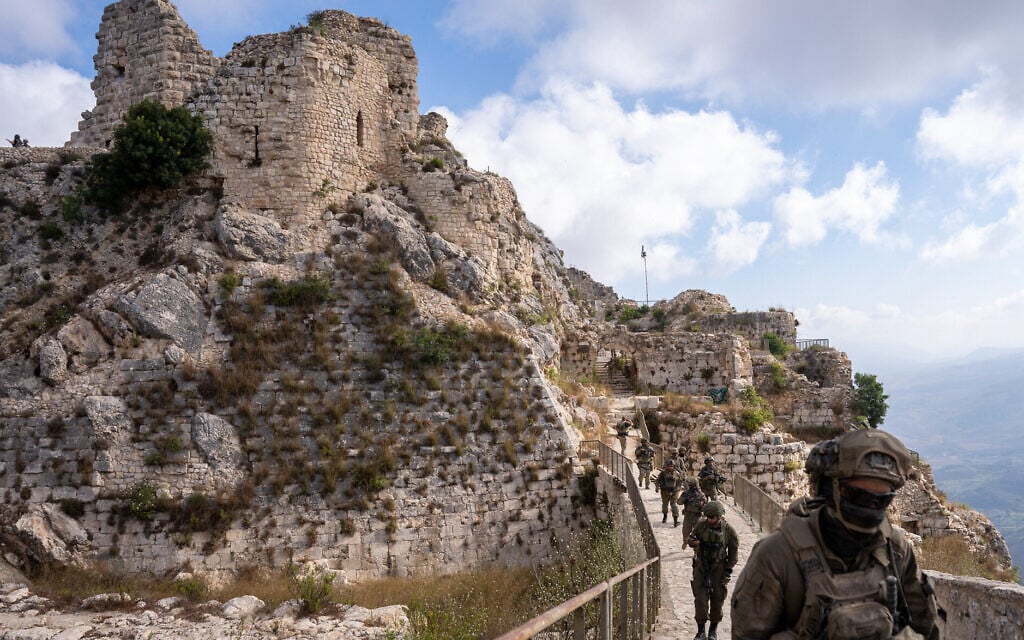
BEAUFORT RIDGE, Lebanon — With cool air rushing over the sweeping view from atop Beaufort Castle at dawn, it is easy to forget that just a few months ago, Hezbollah operatives launched hundreds of attacks at Israeli troops and northern Israel from this strategic escarpment.
In late May, Israel recaptured the historic Beaufort Castle and the surrounding ridge, 26 years after withdrawing from the site, as it pushed deeper into Lebanon during the fighting against Hezbollah.
Speaking to reporters during an organized media tour of the area last week, the commander of the 36th Division, Brig. Gen. Yiftah Norkin, said the capture of the Beaufort Ridge was “critical to the defense of the Galilee Panhandle, Metula, and the surrounding communities.”
Sitting atop a steep bluff some 680 meters (2,230 feet) above sea level, the site, known in Lebanon as Qalaat al-Shakif, commands sweeping views of the Galilee Panhandle in northern Israel, as well as the Nabatieh area in southern Lebanon, making it a strategically valuable position.
Home to a medieval fortress and castle that today lies mostly in ruins, Beaufort also holds symbolic importance as an emblem of Israel’s past military entanglements in Lebanon, particularly the 18-year occupation that ended in 2000.
According to the Israel Defense Forces, operations in the Beaufort Castle area are focused on capturing and demolishing major Hezbollah underground sites, as well as preventing the terror group from carrying out rocket attacks on Israel from the area.
Hezbollah launched over 400 rockets from the Beaufort Ridge toward northern Israel during the current round of fighting, mainly at the border community of Metula, the military says.
The fighting began in early March, when the Lebanese terror group began firing missiles and drones at Israel in support of its patron, Iran.
It also dispatched first-person view drones and fired anti-tank missiles at troops operating in southern Lebanon from the area.
About a kilometer (0.6 miles) south of the Crusader-built fortress, beneath the ridge, the military uncovered several major Hezbollah tunnels, which it said were constructed with direct Iranian assistance.
During Tuesday’s tour, reporters were taken into one of the tunnels, which stretches 1.3 kilometers (0.8 miles) from the cliff face into the mountain.
“The tunnels were intended for two purposes: first, to fire directly toward Israel. The moment you exit the tunnel, you can see Metula right in front of you,” said an officer in the elite Yahalom combat engineering unit.
“And its second purpose is to defend against an IDF ground maneuver to the Beaufort Ridge, in which, as you can see, we defeated them (Hezbollah),” he said.
Soldiers and officers were made available to comment on condition of anonymity, in line with military protocol.
Troops said they found “an exceptional quantity” of arms inside the Beaufort Ridge tunnels, including “unique and highly valuable” weapons, such as anti-aircraft systems and Iranian-made anti-helicopter mines.
The Yahalom officer said troops found Iranian weapons “that we had not previously gotten our hands on,” which were taken for examination in Israel.
The tunnel featured water and electricity infrastructure, and numerous rooms, including several living quarters complete with showers, toilets, kitchenettes, and what officers said was a fully equipped operating room for medical procedures.
“This operating room is at the highest level you can imagine, completely sterile, with machines and equipment — everything needed to perform a procedure right here inside this tunnel,” the Yahalom officer said.
According to officers, Hezbollah operatives could spend many months at a time in the tunnel.
The Yahalom officer said the tunnel likely took 10 to 15 years to construct and set up.
“Building such an underground system in the rocky terrain here in southern Lebanon is an undertaking that requires major investment and a great deal of time,” he said. “The process here involves drilling, blasting along the route, and then removing the excavated earth — all of this without being exposed to Israeli eyes.”
The army said it plans to demolish the facility.
During the tour, explosives placed by the Yahalom troops could already be seen in many of the rooms and passages. Reporters were warned not to light cigarettes inside the tunnel.
The IDF has uncovered several similar Hezbollah tunnels in southern Lebanon and says they were all built with direct Iranian assistance, planning, and funding.
Asked whether there had been fighting inside the underground facility when it was captured by the army, the officer said that “there were terrorists who were killed in the tunnel.”
Despite the castle being only about five kilometers (three miles) from the Israeli border, it took a convoy of army Humvees an hour and a half to reach the site, detouring around the sheer slope overlooking the Litani River to the fortress’s east and instead approaching the ridge from the less rugged western side.
On the way there, the convoy passed row after row of razed buildings in southern Lebanese villages near the Israeli border.
Israeli troops pushed into southern Lebanon in March after Hezbollah began firing rockets at Israel in support of Tehran days after the US and Israel started attacking Iran.
Soldiers are positioned up to 10 kilometers inside southern Lebanon in what Israeli officials have termed a “security zone” aimed at preventing Hezbollah from launching anti-tank guided missiles directly at Israeli border communities and reducing the terror group’s ability to launch rockets at the country.
On May 31, the IDF captured Beaufort Castle — located inside the buffer zone — as part of expanded ground operations against Hezbollah.
Fighting has tapered off for the last few months under a shaky ceasefire, though both sides continue to launch occasional attacks.
Just a few kilometers north of Beaufort Castle stands the Ali Taher ridge, on the outskirts of Nabatieh, where Israeli troops and Hezbollah operatives are in a tense holding pattern.
The Israeli military currently controls the ridge above ground, but beneath the hill, Hezbollah has another “strategic” underground facility. According to the IDF, that underground site is the “nerve center” of Hezbollah’s Badr regional division.
Dozens of Hezbollah operatives are believed to remain underground there, and the IDF, amid the ceasefire, has occasionally struck members of the terror group trying to escape or bring in reinforcements to the tunnel system, officers said.
However, because of the ceasefire agreement, the IDF is prevented from capturing the underground passages beneath the ridge.
Norkin, the division commander, said his forces were “currently in a defensive phase under the ceasefire,” but were prepared for any scenario and ready to return to offensive operations.
With fighting on hold, “Hezbollah is refreshing its forces, trying to remove weapons from the combat zone and improve some of its positions and capabilities,” he said.
“We are monitoring this,” Norkin added. “If we are required to return to fighting, we will be able to strike those forces, and we are prepared for any scenario in this regard.
View original source — Times of Israel ↗
Related stories

The Moscow Times
PoliticsJul 12, 2026 · 1 min
Nine Dead as Russia, Ukraine Exchange Strikes
The Moscow Times

Straits Times
PoliticsJul 12, 2026 · 1 min
Israel to hold Oct 27 elections in vote seen as referendum on Netanyahu
Straits Times
Deutsche Welle
PoliticsJul 12, 2026 · 1 min
Ukraine's Zelenskyy swaps out prime minister in reshuffle
Deutsche Welle

The Guardian
PoliticsJul 12, 2026 · 1 min
Reform would have held just 15% of last year’s donations under proposed £100,00 cap, analysis shows
The Guardian