The Guardian
Britain’s cars and SUVs are growing bigger – but there is a way to stop this deadly ‘carspreading’ | Christian Wolmar
We need an Ozempic for cars. They are growing at a phenomenal rate, wreaking havoc on the roads, squeezing out smaller vehicles in car parks and endangering pedestrians.
Like ever-hungry teenagers, cars in Europe are growing, on average, a centimetre wider every year, according to new research reported by the Guardian. And fewer than half of new cars in the UK can fit into a conventional parking space. As there is, remarkably, no width restriction for cars, no law can stop this growth until they reach the size of HGVs – that is, 2.55m wide – which are restricted.
SUVs now comprise a remarkable 30% of cars in England’s cities, compared with just 3% 20 years ago. But it’s not just SUVs that are responsible for what has become known as carspreading. Minis are no longer worthy of the name. They have expanded in all directions and become just a standard medium-sized car.
Carspreading is just the latest negative aspect of our century-long obsession with cars and our obeisance to every demand of the all-powerful motoring lobby. It is not only safety that has been adversely affected. By taking up more room in car parks, SUVs are reducing the number of spaces available. In Hove, the capacity of the Norton Road car park has been cut back from 290 to 180 to accommodate larger vehicles.
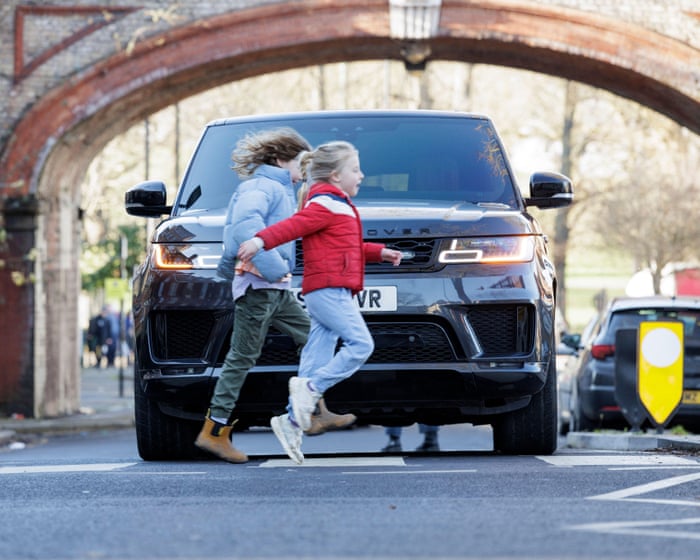
The phenomenon of ever-bigger cars has not come about accidentally. It has been sustained by an aggressive marketing campaign, as they are far more profitable for manufacturers than conventional-sized vehicles. They are sold on the basis that they are safer. Extra safety for your family is a key marketing strategy. But while Daddy drives Olivia and Rufus to school in perfect safety, other pupils are in greater peril. And that risk is growing as the cars get ever bigger.
In the 1990s, I wrote a series of articles in the Independent on Sunday about how bull bars were responsible for several child deaths since they were at precisely head height for many primary school pupils. Despite a campaign by manufacturers, bull bars were soon sent to the scrap yard as legislation limiting their use was passed.
But now that gain is being reversed. The increase in the height of car bonnets on SUVs and other luxury models means that this risk has returned. Research carried out for Clean Cities shows that a 10cm increase in bonnet height from 80cm to 90cm results in a 27% greater chance of death for pedestrians run over. For children, the risk of death is increased threefold if they are hit by an SUV rather than a conventional vehicle. They are also more likely to be hit since the driving position is often too high to observe what is in front of the vehicle.
Nevertheless, we should not despair. This carspreading process can be reversed. Bull bars and other successful campaigns show how it can be done. Petrol only became lead-free thanks to a brilliant campaign led by the illustrious Des Wilson; Ken Livingstone imposed a congestion charge on motorists in central London nearly a quarter of a century ago, and no one now questions its validity. Even Ulez is barely mentioned despite all the protests just a few years ago.
The car manufacturers are already on the defensive over the issue of carspreading since they cannot challenge the fact that these vehicles pose a greater risk to the general public. Instead, they tend to suggest that measures to deter purchases would restrict choice.
The government’s national road safety strategy published in January recognised the extra risk posed by SUVs but suggested no course of action except, as my fellow podcaster Mark Walker put it, that “We will have a chat with the industry about it.” There has been an equally tepid response from government over pavement parking. While pavement parking is essentially banned in London, the government’s policy, also announced in January, was that action on this issue had to be cautious.
With such a feeble approach from central government, it is at the local level where action to stop carspreading is most likely to be taken. Sadiq Khan, the mayor of London, is already on board. In the spring he announced he was looking at potential new levies and extra parking charges for large vehicles and as a personal gesture said he is hoping to dispense with his own huge armour-protected SUV.
In the absence of a weight-loss pill for cars, there are a host of other measures available. In Paris, the mayor has introduced weight-based parking surcharges, a logical move since these heavier vehicles cause greater damage to the roads. There are numerous other tax changes that could discourage the purchase and use of these cars. Oliver Lord, strategy director of Clean Cities, points out that: “The UK is a tax haven for these vehicles.” Research by the Transport and Environment Network shows that “buyers here pay up to 20 times less for the biggest models than in other European countries.” In France, tax of £66,000 is levied on a BMW X5 compared with just £3,200 in the UK.
One quick measure worth considering would be to restrict advertising of these dangerous vehicles, similarly to smoking. The car industry is rather at the stage where the tobacco manufacturers were a generation ago, with its head firmly in the sand, trying to resist what does appear to be an inevitable retreat. As more people are killed by these cars and the roads become ever more crowded, there will be a backlash. It is a shame that it will come after so much damage has already been done, while these cars are dominating urban environments ill-suited to accommodate them.
Christian Wolmar is a transport commentator and author of The Liberation Line, the story of the railwaymen who rebuilt the railways in Europe after D-day
View original source — The Guardian ↗
Related stories

ESPN
SportsJul 12, 2026 · 1 min
Yanks' Schlittler playing it safe, won't pitch in ...
ESPN

The Guardian
SportsJul 12, 2026 · 1 min
Tadej Pogacar urges radical overhaul of Tour de France amid stifling heatwave
The Guardian

Sky Sports
SportsJul 12, 2026 · 1 min
St Helens put to the sword by Toulouse in eight-try home thrashing
Sky Sports
ESPNcricinfo
SportsJul 12, 2026 · 1 min
Brendon McCullum successor could job-share with IPL
ESPNcricinfo