The Guardian
Former owner and chairman of Chelsea FC who bought the club for a pound and helped restore it to the top rank of…
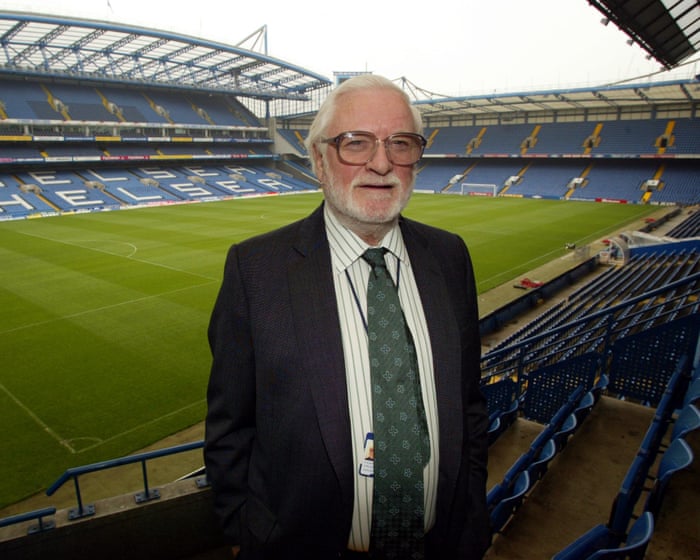
For more than 20 years, Ken Bates, who has died aged 94, was synonymous with Chelsea Football Club, which he bought in 1982 from the Mears family, who had lost control after rebuilding the west stand.
Haemorrhaging money, hugely in debt and about to sink into what was then Division Three, the London club cost him £1. Two feuding, financially hectic decades later, it was £97m in debt, but from its sale to the Russian oil tycoon Roman Abramovich Bates nevertheless took £17m for himself.
In 2004, on his departure, he made a cordial speech to the board over dinner. That night, his solicitors lodged a writ claiming a further £2m from them to compensate for alleged lost expenses and sundry benefits associated with his former position. The club disputed the claim.
Lent a deceptive air of geniality by his trademark grin and snowy beard, Bates gloried in his pugnacious reputation: “I’ve always said what I felt, and some people along the way haven’t liked it.” At Chelsea, he dispensed with managers as other men change shirts. Nine came and went during his chairmanship, many sacked in contentious circumstances.
He once banned two leading lights of the 1970s side, Ron Harris and Peter Osgood, for publicly criticising him, and used his matchday programme notes to attack various individuals and settle scores. At one stage, proposing to use it as a nursery club, he invested £100,000 in Partick Thistle, promptly forbidding its employees to wear anything on their feet but black shoes. Sir Alex Ferguson once compared him to Chairman Mao.
In 1985, without seeking council or FA permission, he erected a high fence around parts of the ground, topped with electric wiring to deter hooligans. The idea had come to him on one of his early-morning strolls around his Beaconsfield dairy farm, where a similar arrangement was used to keep the cows in. Permission had not been sought from the council and the FA, and the experiment was short-lived.
While all this was going on, he saved Stamford Bridge from being flattened by property developers, restored Chelsea to the top rank of English football, developed the ground with a hotel, apartment block, catering arm, travel business, megastore and radio and TV stations (ideas long since embraced by other clubs) and, as a League chairman, pushed for a fairer distribution of Premiership TV revenues and the principle of parachute payments to relegated clubs.
Born in Ealing, west London, and raised on a council estate, Bates was 16 when he learned that the couple whom he knew as mum and dad were, in fact, his grandparents. His mother, Elizabeth (nee Philpot), had died when he was 18 months old, leaving him in the care of a father, Thomas Bates, who rapidly bailed out. His sister, looked after by another couple, was an adult by the time he met her. Nevertheless, he regarded his adoptive parents warmly.
Born with a club foot, Ken endured four unsuccessful operations as a child before, in 1938, “dad” scraped together £20 for a fifth. This one worked out. At his primary school, Cuckoo school in Hanwell, he played as a burly centre-forward and dreamed of a career in professional football.
He proudly defined himself as the kind of player that was called a dog: “Hard-working, someone who never gave the ball up. I didn’t like letting people past or getting the better of me.” Later, he had a successful trial for Chase of Chertsey, then famous as an Arsenal feeder club – “Not bad for someone who was born a cripple,” Bates said, “but at that level, with the bad foot I have, the imperfections of the breed showed up.”
His grandfather was not a proponent of women working, so “mum” got a cleaning job in secret to earn enough to fund Bates through Ealing county grammar school. At 15, he was offered a job on the ground staff at Brentford FC, but was discouraged from leaving school by his headteacher, who saw Bates had the potential to go further in life.
At 18, he took a job in the booking office at Paddington station. Bored after nine weeks, he went into the City to train as an accountant and spent two years there, learning. Then he threw himself into work and making money; he had seen his grandparents struggle and vowed never to be like that. “I’ve had to fight for everything I’ve got. When you start with nothing, you’re driven by insecurity. In life, nothing is easy.”
At 23, he bought his first Bentley and by his early 30s was rich enough to retire, making his fortune out of a ready-mix concrete business that he sold after four years for more than half a million. He tolerated the inactivity of retirement for less than a year, building up a second fortune with, among other interests, a Buckinghamshire dairy farm which, he claimed, made the best ice-cream in England.
In the 1960s, he was briefly chairman of Oldham Athletic as well as buying control of Wigan Athletic in 1981. A year later came the opportunity to get hold of Chelsea. The next 10 years were spent battling the property developers Marler Estates, which owned a substantial part of the Stamford Bridge freehold. Emerging victorious in 1992, Bates formed Chelsea Village Ltd and launched the transformation of ground and club, appointing as manager Glenn Hoddle, who took the team to the 1994 FA Cup final.
Things might have been going well enough on the pitch but the club existed in a continuing atmosphere of financial crisis. In 1994, in an attempt to swell the coffers, the businessman Matthew Harding was appointed to the board after Bates had called for new investors. Bates soon embroiled himself in a feud with his new colleague and potential replacement, in due course banning him from the directors’ box. Harding’s death in a helicopter crash in 1996 barely ended the stand-off - Bates described him posthumously as “an evil man”.
Often the object of fierce criticism in the print media, Bates relished the attention. As a grammar school boy who sent both his sons to Eton and loved flaunting his wealth, his trademark farewell to sports hacks after a match was, “I’m off to my 300-acre farm. You lot can bugger off back to your council houses.”
His reputation as a limelight-seeking tyrant and brashly imperious speculator was offset in private by generosity and fierce loyalty to chosen friends. But football, he said, was always his love. In 1998, he claimed: “I am still playing, really. I kick every ball, head every clearance away and score every goal. The players in their blue shirts … how I wish I was one of them.”
After leaving Chelsea in 2004, he moved to Monaco where, once again, he was “bored stupid” by the purposelessness of retirement. A year later, he bought a 50% stake in Leeds United, another financially chaotic club that after Premier League glory had sunk into the lower tiers owing to debts racked up by Bates’s predecessors.
He was soon claiming that Chelsea had poached two of his Elland Road starlets. The Chelsea directors, he claimed, were “a bunch of shysters from Siberia”. Chelsea’s response was to file a complaint with the FA against him and Leeds for alleged racism and for bringing the game into disrepute. “I haven’t laughed so much since Ma caught her tits in the mangle,” Bates retorted.
After becoming sole owner of Leeds in 2011, Bates sold it to the private equity group GFH Capital the following year, stepping down to become club president. He was swiftly stripped of the role, claiming it was after a dispute over payment for his private jet, and returned to retirement in Monaco. “It’s easy to sit on your backside and moan that nothing happens to you,” he once said. “Make it happen. And then fight for it. Fight for what is yours.”
Bates is survived by his third wife, Suzannah (nee Dwyer), and by three daughters and two sons from his first marriage.
View original source — The Guardian ↗
Related stories

ESPN
SportsJul 12, 2026 · 1 min
Pebley out as Sparks GM, assistants to share role
ESPN

ESPN
SportsJul 12, 2026 · 1 min
What's next: Why Max Holloway and Paddy Pimblett c...
ESPN

ESPN
SportsJul 12, 2026 · 1 min
Yanks' Schlittler playing it safe, won't pitch in ...
ESPN
BBC Sport
SportsJul 12, 2026 · 1 min
England facing defeat in Knight & Beaumont's farewell
BBC Sport