Times of Israel
In memo before October 7, Sinwar predicted Israel might respond with nuclear strike
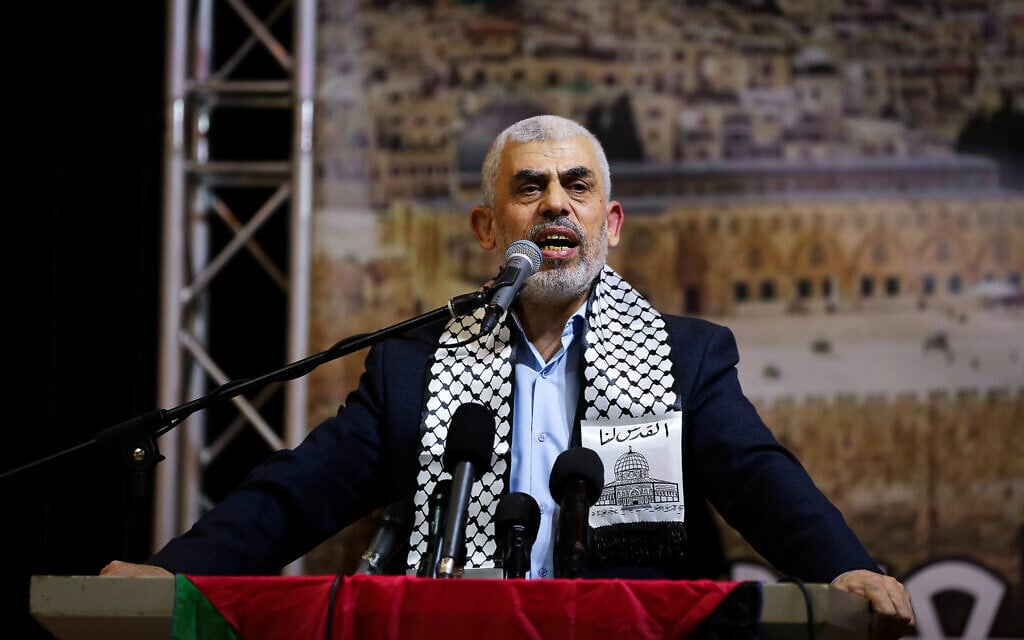
Yahya Sinwar, the late Hamas leader who masterminded the terror group’s October 7, 2023, massacre, assessed ahead of the onslaught that Israel might respond with a nuclear strike on the Gaza Strip, but chose to carry out the invasion anyway, according to a newly revealed document written in the terror chief’s own hand.
The memo, written in August 2022, was obtained by the Meir Amit Intelligence and Terrorism Information Center, and excerpts from it were published by Channel 12 on Sunday. A similar document was revealed last fall, though several details were not present in previous reporting.
According to Channel 12, Sinwar laid out specific operational plans, including numbers of fighters to be deployed to particular junctions, envisioning 25 simultaneous breaches of the Israel-Gaza border fence, to take control of 25 different junctions. He envisioned “well-trained squads” carrying out each of these infiltrations, with each squad numbering 100 fighters.
Sinwar also planned for a further 2,210 fighters to attack 221 small communities in the south, and a further 1,600 for eight larger ones. He wrote that 1,200 fighters would be deployed to attack Israeli cities, and 2,000 to attack army bases. The total fighting force he imagined would have numbered some 10,000 terrorists, none of whom would have been privy to the entire scope of the plan.
The figures are significantly higher than the number of Palestinians who actually invaded from Gaza on October 7, which the Israel Defense Forces estimates at around 5,600, of whom about 3,500 were Hamas fighters, along with some 580 fighters from the Palestinian Islamic Jihad group, and about 1,400 other Gazans.
Get The Times of Israel's Daily Edition
by email and never miss our top stories
By signing up, you agree to the terms
“The goal is to expel the settlers with their vehicles,” the terror chief wrote in the memo, referring to the residents of Israel’s south. He wrote that “priority” should be given to children and women, while ordering that “the men aged 17-50 are to be taken hostage” and that “all phones must be taken, along with any additional documents they are carrying on their person.”
The Channel 12 report emphasized Sinwar’s awareness of the likely costs of the attack, noting that he did not profess certainty that Iran, which backs Hamas, or the Islamic Republic’s other regional proxies such as Hezbollah, would join in the onslaught, as the terror group is widely believed to have hoped they would.
Moreover, the terror chief estimated that Israel would “not hesitate to use all means and weapons at its disposal,” adding: “They may even use an atomic bomb, no less.”
“But first, it will be surprised by the attack and enter into chaos,” he wrote, describing the assault as “a campaign of life or death,” and calling for “a popular operation of returning to the villages and recapturing them symbolically.”
Israel is widely believed to possess nuclear weapons, but has never publicly confirmed having them; it is not a party to the Nuclear Non-Proliferation Treaty.
The newly published excerpts come after the Meir Amit Intelligence and Terrorism Information Center released a similar Hamas document in October 2025 that had been written by Sinwar and described plans to deliberately create “horrifying images” during the October 7, 2023, massacre and broadcast the atrocities live.
Thousands of Hamas-led terrorists participated in the invasion and massacres on October 7, 2023, slaughtering some 1,200 people in southern Israel, mostly civilians, and abducting 251 people, including women, children, and the elderly. The terrorists carried out widely documented atrocities, including systematic sexual assault, and overtly targeted civilians in their homes and at an outdoor music festival.
A day after Hamas launched its assault, the Hezbollah terror group in Lebanon also attacked Israel using rockets and drones. Other Iran-backed groups in Yemen, Iraq, and Syria later attacked Israel as well, and the fighting prompted the first of several direct confrontations with the Islamic Republic.
Fighting in Gaza mostly stopped in October 2025, with a US-brokered ceasefire deal that secured the release of all remaining hostages, while Israel released almost 2,000 Palestinian security prisoners. However, smaller-scale clashes have continued, and Israel still conducts airstrikes against some Hamas targets in Gaza.
Sinwar served as the leader of Hamas in the Strip from 2017 until he was killed by Israeli troops in southern Gaza’s Rafah in October 2024.
View original source — Times of Israel ↗
Related stories
South China Morning Post
PoliticsJul 12, 2026 · 1 min
How Hong Kong can draw line under the 2019-20 protests and move forward
South China Morning Post

Al Jazeera
PoliticsJul 12, 2026 · 1 min
Israel to hold national elections on October 27, parliament says
Al Jazeera

Al Jazeera
PoliticsJul 12, 2026 · 1 min
Protest on London’s Tower Bridge demands release of Dr Hussam Abu Safia
Al Jazeera

Philippine Daily Inquirer
PoliticsJul 12, 2026 · 1 min
A very strange impeachment (1)
Philippine Daily Inquirer