The Guardian
Fleeting window slammed shut as Zverev gets lost in the Sinner Zone | Jonathan Liew
Shortly before 7pm, a full 162 minutes into this match, Alexander Zverev got his first break point on the Jannik Sinner serve. With the score still one set apiece and tied like a knot, this felt like a kind of hinge point. A humongous chance in a match preciously short on them. Sinner faulted. A priceless second serve for Zverev to look at.
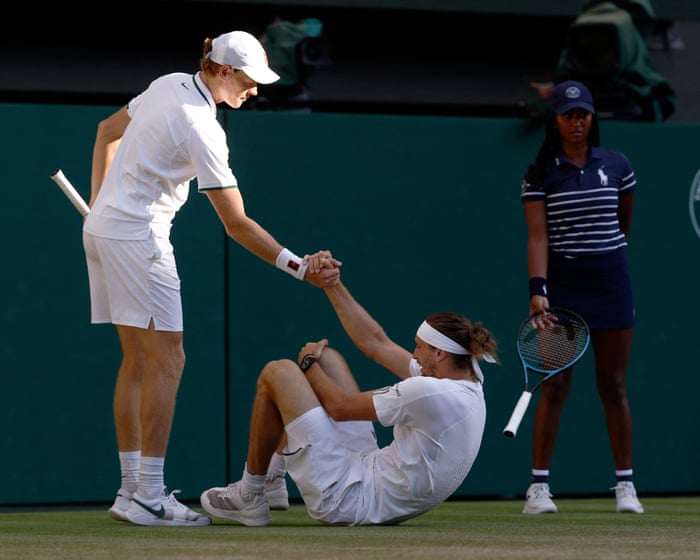
The serve was a little safer than usual and Zverev returned it with interest. After a little exploratory baseline flirting, with no breakthrough in sight, Sinner simply flicked the switch: a perfect backhand on to the sideline, followed by a perfect drop shot, sending Zverev sprawling to the turf holding his knee. And in hindsight, those few seconds – right there – was the window.
Perhaps this was the moment that encapsulated the sheer futility of Zverev’s task, the way in which the world No 1 can take your hope, your graft, your optimistic energy and hurl it back in your face. Not long after, Zverev was broken for the first time in the match, flinging his racket in the process. By 7.07pm he was two sets to one down; by 7.56pm it was handshakes and phone cameras all round. Zverev probably played his best match of the tournament, and perhaps the kindest thing you can say is that he came close to coming close: a man who had unwisely entered the dispiriting, disfiguring place known as the Sinner Zone.
Ever since Sinner’s implosion in Paris there had been a lot of talk about his big weakness being heat and humidity, which while true is also faintly damning of his competition. What it means, in essence, is that in a tour of about 200 other guys trying to knock him off his pedestal, your best shot is basically a weather forecast.
In the event, even this fell in his favour. A surprisingly stiff breeze blew into Centre Court as the championships reached their conclusion, the shadows darkening, the dramatic possibilities winnowing away. It was a match that for two sets followed a rigid – almost military – structure, before loosening just enough to let the humanity in. And played above all in the shadow of those two monster-truck serves, a battle of the bombs that was always going to come down to the handful of minuscule errors that define greatness at this level.
Let’s do the maths on this for a second. Across the match, Zverev sent down 60 unreturned serves over the course of 21 service games and a couple of tie-breaks. That’s around three per game. Which means that arguably the best returner in men’s tennis was effectively starting every other game 40-0 down before he could even put a ball back in play.
Certainly as Zverev nicked the first set tie-break with only his second backhand winner of the match, other futures briefly presented themselves. The No 2 seed had come into this match in the form of his life, suspecting that his French Open triumph may have unlocked something feral and surgical in him. Until this year’s run he hadn’t beaten a top-10 player on grass in a decade. He’d never been past the fourth round here before. He hadn’t beaten Sinner in nine attempts. As he stomped to his chair, perhaps he sensed that this time might be different.
By any measure, this has not been a vintage Sinner fortnight. His game has been uncharacteristically wasteful at times, his demeanour a little edgy. And yet the fundamentals remain unchanged: the ability to find four perfect serves at 0-30 down, to snuff out the chance before it ever really existed. The problem‑solving mind. The athleticism and sense of showmanship required to nail a no‑look angled backhand glider when you’re serving for the Wimbledon title.
By the same token, this has not really been a vintage Wimbledon. In a sense this was a tournament that existed in the gaps around the football, a fortnight filled with all the usual drama and daring, new folk heroes like Arthur Fery and Linda Noskova, old ones in Serena Williams and Stan Wawrinka, but which felt more than ever like a walled-off garden party, a drop in the cultural ocean.
And until Carlos Alcaraz returns from injury, men’s tennis finds itself in a similar kind of lacuna: rich in talent and intrigue, poor on genuine crossover stars. Sinner is a brilliant player, already an all-time great, but also served a three-month anti-doping suspension last year and is not an athlete truly beloved beyond his home country. Zverev has twice been accused of domestic violence by former partners, which he stringently denies. There is plenty of promise in the younger generation – your João Fonsecas, your Jakub Mensiks, your Learner Tiens, your Rafael Jódars. But they kind of have to win something first.
Of course none of this will perturb Sinner, a player whose grand slam title drought comes to an end at a laughable three. There was none of the wild weeping that greeted his first title here 12 months ago; one of the curses of repeated greatness is the increasingly forlorn search for new feelings. Instead, as he clutched the trophy close, he looked immensely satisfied: like a man who had made, and kept, a solemn promise to himself.
View original source — The Guardian ↗
Related stories

ESPN
SportsJul 12, 2026 · 1 min
Orioles' Alexander hit by pitch, has fractured han...
ESPN

Sky Sports
SportsJul 12, 2026 · 1 min
Papers: Arsenal turn to Alvarez with Barcola unavailable
Sky Sports
Sky Sports
SportsJul 12, 2026 · 1 min
Ratajski beats Wattimena to lift European Darts Open title
Sky Sports
Sky Sports
SportsJul 12, 2026 · 1 min
Tuchel and Bellingham’s ‘battle of wills’ is healthy for England
Sky Sports