Times of Israel
Knesset committee approves bill to gut attorney general’s powers for final readings
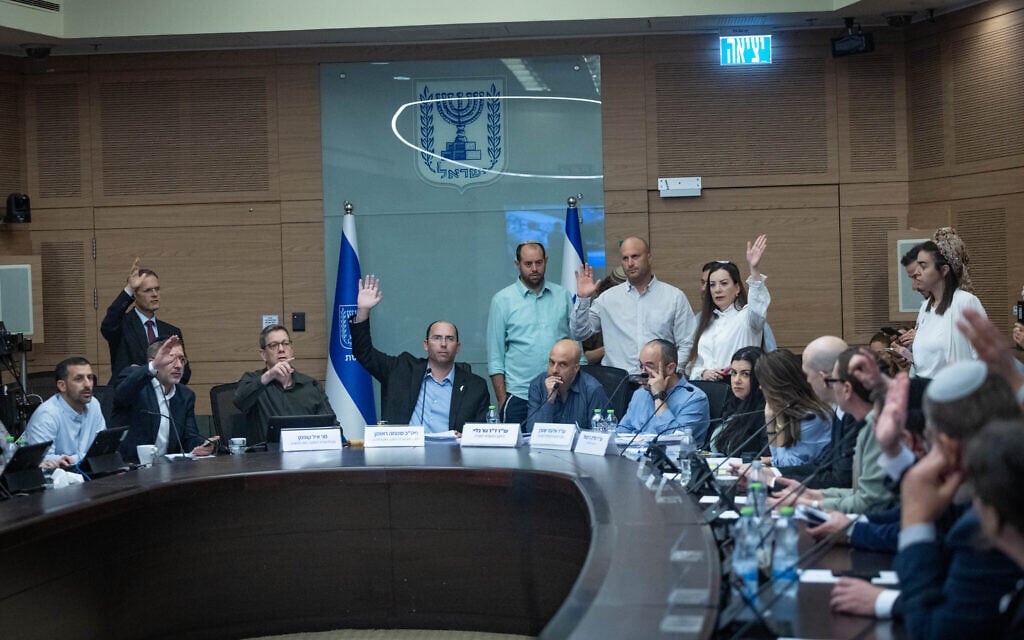
The Knesset Constitution, Law and Justice Committee on Sunday approved for its final readings a highly controversial bill that will drastically weaken the attorney general’s authority and ability to act as a check on government power. The coalition is aiming to pass the law later this week.
The legislation, if passed, will enable the government to reject the attorney general’s legal opinion on a given issue by deeming it inconsistent with the existing law, unlike the current situation, whereby the attorney general’s legal positions are binding on the government.
The override mechanism will enable the government to decide for itself if a specific action or decision is legal, sparking alarm from critics including Attorney General Gali Baharav-Miara herself, who warned the legislation will violate the rule of law.
Advancing the legislation was the latest step taken by the ruling coalition to diminish Baharav-Miara’s authority amid repeated power struggles between her and various members of Prime Minister Benjamin Netanyahu’s right-wing government, chiefly over its efforts to assert control over Israel’s judiciary.
The coalition voted to oust Baharav-Miara from her position in August 2025, but the High Court of Justice annulled the decision to fire her on procedural grounds in a decision handed down at the end of the year. The new bill will enable a process by which the government can fire the attorney general.
Get The Times of Israel's Daily Edition
by email and never miss our top stories
By signing up, you agree to the terms
With all its far-reaching consequences, this bill will not allow the government to throw out the attorney general’s decisions on criminal matters, as head of the state prosecution. The coalition intends to pass further legislation gutting the powers of the attorney general if its wins reelection in October.
In addition to letting the government ignore the attorney general’s legal positions, the bill would also allow it to decide on the attorney general’s behalf what position to take in legal proceedings in court involving arms of the government.
At present, the attorney general can decide for themselves what position to adopt, which has recently led to several run-ins with between Baharav-Miara and coalition lawmakers embroiled in lawsuits and criminal cases.
“This is a good and important law, and many others have proposed arrangements in its spirit during different governments,” said Knesset Constitution, Law, and Justice Committee Chairman MK Simcha Rothman, a member of the Religious Zionism party and a key architect of the government’s judicial overhaul plans.
Opposition MK Gilad Kariv, of The Democrats party, denounced the legislation as part of what he called the government’s campaign to remove checks on its authority.
“This law places the government above the law and exposes citizens to arbitrary government action. It is part of a broader effort to remove constraints and checks on the government,” said Kariv, and vowed to petition the High Court of Justice against the bill.
Yesh Atid MK Karine Elharrar said the attorney general’s current power “protects citizens against the tyranny of the majority,” and added that the legislation will be canceled by a future government led by the current opposition.
The bill, which the architects of the government’s judicial overhaul program have long sought to pass, can now be brought for its second and third readings in the Knesset later this week.
The draft of the legislation had been watered down slightly after passing its first reading in June and being sent back to its committee for revisions.
Coalition lawmakers sought to use the legislation to divide the attorney general’s role into two separate offices — an attorney general and a prosecutor general — but later dropped that provision, in order to expedite the process of passing the bill into law before the Knesset term ends on July 17 ahead of the October 27 elections.
View original source — Times of Israel ↗
Related stories

Philippine Daily Inquirer
PoliticsJul 12, 2026 · 1 min
De Lima: No healing without closure in Sara Duterte impeachment
Philippine Daily Inquirer

Philippine Daily Inquirer
PoliticsJul 12, 2026 · 1 min
Diokno: Sara Duterte’s ‘kill threat’ video authentic
Philippine Daily Inquirer

Japan Times
PoliticsJul 12, 2026 · 1 min
U.S., Iran trade wave of strikes while disputing status of Hormuz
Japan Times

The Hill
PoliticsJul 12, 2026 · 1 min
McConnell says he ‘won’t be able to return to the Senate floor to vote quite yet’
The Hill