The Guardian
Christopher Nolan says people ‘disdain’ AI and the idea it will replace humans is ‘nonsense’
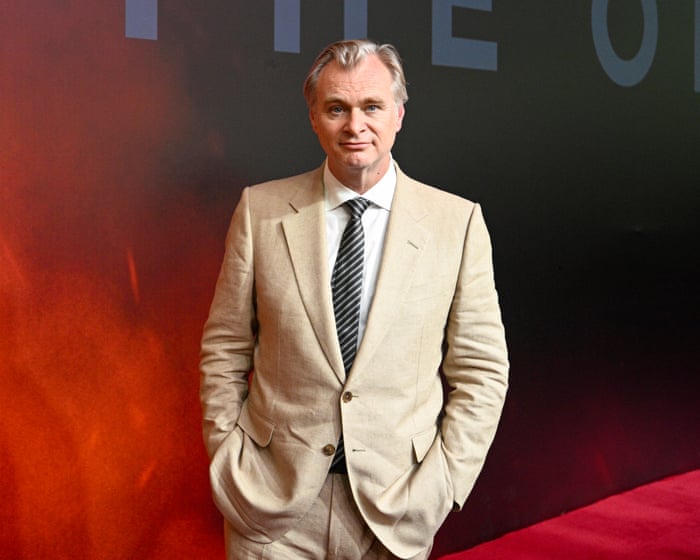
The Oscar-winning director Christopher Nolan believes the kind of movies he makes – big-budget action films shot mostly on location – would survive the spread of artificial intelligence, a technology he says many people “disdain”.
The Oppenheimer and The Dark Knight director is promoting his latest blockbuster, an adaptation of the Greek epic The Odyssey, which will be released in cinemas this week.
“The interesting thing with AI is I’ve never seen a technology that’s been so successfully adopted by Wall Street and by investors and by tech companies that the public has so thoroughly rejected,” he told AFP in Paris.
“It’s just sort of an odd thing. Young people in particular, they coined this term ‘AI slop’,” he added. “There’s a sort of disdain for things AI.”
AI has been infused into business applications and online search services, and chatbots such as ChatGPT have been widely adopted, but the technology faces major pushback in the creative industries such as music, cinema and art.
“AI slop” refers to the flood of AI-generated text, video and audio content that has inundated social media in recent years.
Nolan, who once again makes use of spectacular special effects in The Odyssey, added that he expected AI to result in some useful “imaging tools”.
“But I think the idea that it replaces human beings wholesale and human creativity, to me it’s a nonsense,” the British-American director said.
Around the release of his previous film Oppenheimer, Nolan told the Guardian in 2023 that there were “very strong parallels” between the renowned physicist’s calls for nuclear restraint and AI experts who were calling for the technology to be reined in, such as Dr Geoffrey Hinton, the British “godfather of AI”, who quit Google to speak more openly about the “existential risk” posed by advanced AI.
“I do think [AI] is going to be a powerful tool in the future. What I’ve tried to put into the debate, and keep voicing, is the notion of responsibility and employer responsibility. The one thing we can’t do is let management, employers and the producers use AI to sidestep responsibility for their actions,” Nolan said at the time.
“[AI] leaves me with a lot of troubling questions. And quite often those become fuel for what I do next,” he added.
The AI industry has touted the potential of the technology to replace actors, writers and camera operators – claims that have spread panic in movie-making circles, though also plenty of scepticism.
It was one of the issues behind a huge strike in Hollywood in 2023 that shuttered productions and cost studios billions of dollars.
The Odyssey is an Ancient Greek poem that is considered a cornerstone of western literature. It recounts the hero Odysseus’s 10-year quest to return home after the Trojan war and includes some of the most famous scenes from Ancient Greek mythology, including the one-eyed monster Cyclops and the Sirens.
Nolan’s The Odyssey has a reported budget of $250m, which enabled the director to travel to locations throughout the Mediterranean with a stellar cast that includes Matt Damon in the lead role as Odysseus, supported by Zendaya, Tom Holland, Robert Pattinson and Anne Hathaway.
Nolan has been attacked by Elon Musk and other rightwing figures for casting the black actor Lupita Nyong’o as Helen of Troy, a mythological figure considered the most beautiful woman in the world. Nyong’o herself has dismissed the commentary, saying: “Our cast is representative of the world. I’m not spending my time thinking of a defense. The criticism will exist whether I engage with it or not.”
In a separate interview with the UK’s Telegraph on the weekend, Nolan said the backlash “comes with the territory”, saying: “These conversations that happen before people see the film — they’re always irrelevant, because no one having them knows what the film actually is yet.”
“Remember, I spent 10 years of my life dealing with Batman,” he said. “When I came on [Batman] Begins, writers and artists had been working on this beloved character for almost 65 years, and a lot of freighted thoughts were out there about what he represents. And what I learnt over my time on that trilogy is you can’t worry about any of that at all. What you have to do is honour the original text by interpreting it in the strongest way you personally can.”
Agence France-Presse contributed to this report.
View original source — The Guardian ↗
Related stories

TechRadar
TechnologyJul 13, 2026 · 1 min
Missed EOFY sales? Prime Day has you covered with up to 38% off top-rated office chairs
TechRadar

Times of Israel
TechnologyJul 13, 2026 · 1 min
UK pledges £250 million over 3 years to boost protection of Jewish communities
Times of Israel

Indian Express
TechnologyJul 13, 2026 · 1 min
1,856 trees fell, 3 died in 11 days: Why India’s richest civic body can’t predict the next collapse
Indian Express
Indian Express
TechnologyJul 13, 2026 · 1 min
38% dropped: Maharashtra removes 92 lakh Ladki Bahin beneficiaries after verification
Indian Express