Indian Express
Delhi’s ‘expiry date’ racket: How relabelled food products may have reached consumers through e-commerce apps
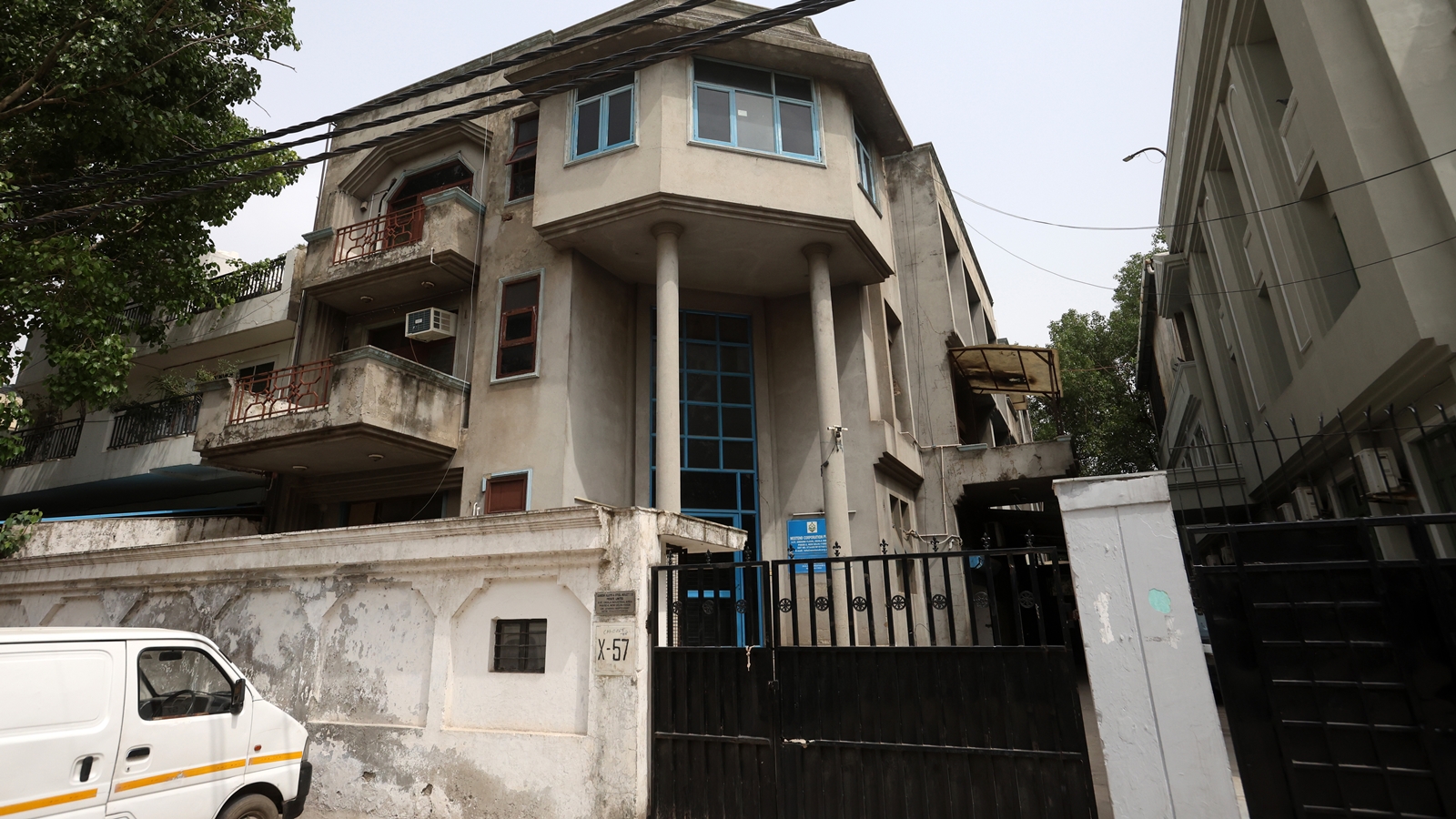
Behind a tall black iron gate on plot X-57 in southeast Delhi’s Okhla Industrial Area stands a seemingly ordinary three-storey commercial building. The basement houses a curtain warehouse, while the first floor is occupied by a women’s garment stitching and embroidery unit run by the building owner. The second floor remains vacant.
But for four years, trucks laden with cartons of chips, soft drinks and fruit juices arrived almost daily at the ground-floor unit. Workers at neighbouring factories watched the consignments come and go, but few knew what happened once they were taken inside.
“They never allowed us inside,” said a worker at a nearby factory who had known many of the unit’s employees for years. “They would only say it was packaging work and that the goods were being sent abroad — to countries like the United States, Canada, Australia and New Zealand.”
The unit operated from the ground floor. It was sealed after a raid on June 12. (Express Photo by Gajendra Yadav)
But on July 2, at around 1.30 pm, the mystery surrounding the unit began to unravel.
Acting on a tip-off about suspected child labour, a 12-member joint team comprising Delhi Police personnel, officials from the office of the Sub-Divisional Magistrate (Badarpur), the FSSAI and the NHRC raided the premises.
What investigators say they found was a different serious offence altogether. According to the police, the unit had allegedly been removing the original manufacturing and expiry dates from expired food and beverage products and replacing them with fresh labels before putting them back on the market.
“The products included popular names such as Thums Up, Fanta, Bournvita, Horlicks, Maggi noodles and Paper Boat beverages, as well as ghee products,” a senior police official said.
“We suspect some of the relabelled products were supplied to warehouses operated by e-commerce platforms and may have reached consumers. We have alerted the companies as we probe the scale of the operation,” the official said.
Police arrested seven people, including the alleged owner of the unit, Darshan Singh Sachdeva, 70, a resident of Greater Kailash.
The repacking unit ran from a three-storey commercial building in Southeast Delhi’s Okhla Industrial Area stands. (Express Photo by Gajendra Yadav)
How the operation worked
According to the police, the accused followed a deceptively simple method to carry out the alleged fraud.
“They would first use thinner, applied to paper or cotton, to remove the original manufacturing and expiry dates printed on the packaging,” an officer said.
The workers would then use handheld printing machines to stamp fresh expiry dates, allegedly extending the shelf life of the products by five to six months, depending on the item, the officer said.
If the original date could not be completely erased, workers allegedly pasted similarly sized stickers carrying newly printed dates over the existing labels to conceal them, the officer added.
The investigation has also shed light on the supply network that allegedly sustained the operation.
During questioning, the accused told investigators that they sourced near-expiry food products from 60 to 70 suppliers across several states, including Punjab, Haryana, Bihar and Uttar Pradesh, police said.
The repacking unit ran from a three-storey commercial building in Southeast Delhi’s Okhla Industrial Area stands. (Express Photo by Gajendra Yadav)
“Most of the suppliers were wholesalers. The accused purchased goods from wherever they could secure the steepest discounts,” an officer said.
Investigators are now trying to identify all the suppliers linked to the operation and determine the scale at which the relabelled products may have entered the market.
According to the police, the alleged operation was run by Sachdeva, who had been operating from the Okhla godown under the name Westend Corporation Private Limited for more than three years. “We are also examining the nature of his business before he shifted to the current premises,” an officer said.
Besides Sachdeva, police arrested six employees, including the unit’s manager, accountant, operator, warehouse keeper and two supervisors. All seven have been booked under sections of the Bharatiya Nyaya Sanhita related to the sale of noxious food or drink, cheating, forgery and criminal conspiracy.
Police said several other workers were allegedly engaged in tampering with and repackaging the products. “The workers employed at the unit were paid around Rs 12,000 a month and typically worked eight to ten hours a day,” the officer said.
Inside the sealed unit
According to local sources, the building is owned by a Kalkaji resident who had rented out the basement and the ground floor for more than Rs 1 lakh a month each.
The front portion of the ground floor functioned as the office of the alleged repackaging unit, while the godown operated from the rear.
When The Indian Express visited the premises, the ground-floor hall and the godown had been sealed, with some of the seized material still visible inside. At the rear of the godown, several soft drink bottles and cartons of Paper Boat beverages lay in the open.
One neighbouring worker said police had sought his help in counting, sorting and collecting the seized products while sealing the premises. “It was the first time that I had gone so far inside the godown. We were all shocked to see the fraud they were carrying out,” the worker said.
Police said the seized products were mostly genuine branded food and beverage items that had crossed their expiry dates and were allegedly being relabelled for resale. “We recovered products worth more than Rs 20 lakh. We also recovered counterfeit labels and stickers, forged nutrition-value labels, fake barcodes and batch labels,” the officer said.
E-commerce platforms alerted
According to the police, one of the most troubling aspects of the case is the possibility that the relabelled products may have entered mainstream supply chains and reached consumers through e-commerce platforms.
“The products were supplied to warehouses linked to e-commerce sellers in the National Capital Region, from where they may have been distributed to consumers across the country,” an officer said.
Investigators are now trying to determine the scale of the alleged distribution network and whether the entities involved were aware that the products had been repackaged.
“We are investigating how these transactions were carried out and whether those dealing in these products knew that the items had been relabelled,” another officer said.
“We are also seeking details of the suppliers and the customers to whom these products were sold.”
Deputy Commissioner of Police (Southeast) Hemant Tiwari said the investigation is being led by Inspector Anil Malik under the supervision of Assistant Commissioner of Police (Sarita Vihar) Anil Sharma.
View original source — Indian Express ↗
Related stories

RNZ
WorldJul 13, 2026 · 1 min
Fiji's rising handball stars ready to take on the world
RNZ

RNZ
WorldJul 13, 2026 · 1 min
Ōamaru residents urged to conserve water for several more days
RNZ

Indian Express
WorldJul 13, 2026 · 1 min
Daily Briefing: US-Iran conflict deepens, Delhi’s expiry-date racket exposed, Railways battles massive linen theft
Indian Express

Japan Times
WorldJul 13, 2026 · 1 min
Typhoon Bavi weakens as heavy rain spreads across China
Japan Times