Philippine Daily Inquirer
Cebu City audit: DEPW constraints delayed 41 projects
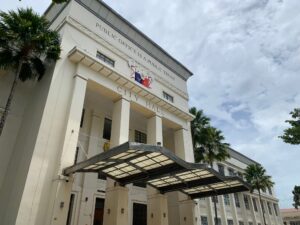
CEBU CITY, Philippines — Capacity constraints within Cebu City’s Department of Engineering and Public Works (DEPW) contributed to delays in the implementation of dozens of priority infrastructure projects that left billions of pesos in development funds largely unused in 2025.
This has prompted the Commission on Audit (COA) to call for reforms to strengthen the city’s project implementation system.
In its 2025 Annual Audit Report, COA found that Cebu City utilized only P344.45 million, or 7.98 percent, of the P4.32 billion available under its 20 percent Development Fund last year after 41 priority infrastructure projects worth P2.11 billion failed to move forward as scheduled.
READ: Cebu City hospital: COA flags ₱1.13B spent on delayed CCMC project
Auditors attributed the delays to procurement and implementation readiness issues, deficiencies in project realignment and execution, and the DEPW’s limited capacity to keep pace with the volume of infrastructure projects.
The commission warned that the delays significantly constrained the city’s ability to deliver planned socio-economic programs and public infrastructure, falling short of the objectives set under the Department of Budget and Management (DBM), Department of Finance (DOF), and Department of the Interior and Local Government (DILG) Joint Memorandum Circular No. 2020-1.
READ: Cebu City audit: COA flags P11.18B in ‘questionable’ spending
The findings also reinforce concerns over the city’s infrastructure management following COA’s separate audit observations on the long-delayed Cebu City Medical Center (CCMC), where auditors likewise cited engineering deficiencies and implementation lapses.
Only 8% of funds utilized
According to COA, Cebu City spent only P344,448,073.94 of the P4,316,851,122.65 appropriated under the 20 percent Development Fund in calendar year 2025.
READ: Installment salary deductions eyed as COA disallowance notice looms
The remaining funds largely went unused because 41 priority infrastructure projects worth P2,112,913,514.58 encountered delays or failed to proceed altogether.
COA said the low utilization stemmed primarily from procurement delays, inadequate implementation readiness, and weaknesses in project execution and budget realignment.
The commission noted that these setbacks prevented the city government from delivering planned infrastructure projects and achieving its intended development outcomes.
DEPW capacity constraints
Among its recommendations, COA urged Cebu City to address manpower and workload limitations within the DEPW.
Government auditors specifically recommended that the city consider outsourcing the preparation of Programs of Work and Estimates (POWE), in accordance with Republic Act No. 9184 or the Government Procurement Reform Act, for infrastructure projects that have already exceeded the engineering department’s in-house capacity.
COA said this would allow the DEPW to catch up on its work backlog and facilitate the immediate implementation of delayed projects.
The POWE serves as the technical foundation of government infrastructure projects. It outlines the scope of work, engineering specifications, quantities, cost estimates, and implementation schedule required before procurement and construction can begin.
Strengthen planning, monitoring
Beyond addressing the DEPW’s capacity, COA recommended several measures to improve Cebu City’s infrastructure delivery.
The commission urged the city government, the DEPW, and the City Planning and Development Office to strengthen the review and screening process so that only projects ready for procurement and implementation receive funding.
It also recommended conducting additional validation measures, including ocular inspections whenever feasible, to identify constraints before projects move into procurement.
To improve coordination among implementing offices, COA proposed establishing a unified monitoring mechanism involving the DEPW, planning office, and the Bids and Awards Committees for infrastructure and goods.
The system would provide real-time updates covering project planning, procurement, and implementation.
Auditors also called for stronger validation and reporting controls to ensure that only projects with verified implementation status qualify for budget realignment.
They likewise urged city officials to justify the inclusion of projects already under implementation or already completed in future realignment proposals.
Finally, COA reminded the city to ensure that project billboards contain accurate information to promote transparency and avoid misleading the public.
Infrastructure delays
The audit findings add to a list of observations involving Cebu City’s infrastructure projects.
In another section of the 2025 Annual Audit Report, COA flagged the implementation of the CCMC reconstruction project after finding that the city had already spent P1.13 billion despite major engineering deficiencies, documentation gaps, prolonged construction suspensions, and contract management issues that prevented auditors from completing a full technical evaluation.
COA also noted that the DEPW failed to submit several technical documents required for the audit, including records needed to evaluate multiple construction phases of the hospital project.
The commission directed city engineers to explain prolonged work suspensions, account for questioned quantities and non-functional systems, submit complete POWE, and strengthen detailed engineering activities before future infrastructure projects proceed.
The findings echo concerns recently raised by the Archival administration over the city’s flagship hospital project.
Last week, Mayor Nestor Archival said he supports hiring an independent project management consultant to oversee the remaining CCMC works, acknowledging that the project has become increasingly difficult to manage after passing through several contractors over more than a decade.
Archival also disclosed that recent inspections uncovered portions of previous construction that may not meet technical standards, particularly involving the building’s mechanical, electrical, plumbing, and fire protection systems, which still require extensive testing before the hospital can move toward completion.
Your subscription could not be saved. Please try again.
Your subscription has been successful.
Read Next
View original source — Philippine Daily Inquirer ↗
Related stories

Philippine Daily Inquirer
WorldJul 13, 2026 · 1 min
'Jurassic Park' star Sam Neill dies aged 78
Philippine Daily Inquirer

Indian Express
WorldJul 13, 2026 · 1 min
AI engineer kills woman colleague, then dies by suicide on rail tracks: police
Indian Express
Indian Express
WorldJul 13, 2026 · 1 min
‘Car giving 12-13 km per litre is now giving 9-10’: Delhi mechanics on E20 fuel impact
Indian Express

South China Morning Post
WorldJul 13, 2026 · 1 min
What Labubu fatigue? Billionaire investor doubles down on Pop Mart stake
South China Morning Post