Indian Express
‘Drone at St Petersburg airport changed our plan’: How wars are reshaping Indian travel
The ongoing geopolitical conflicts in the Middle East and parts of Europe are creating ripple effects across the global travel ecosystem, prompting Indian travellers to rethink how, when, and where they travel. The industry is witnessing a significant shift in traveller behaviour, characterised by higher sensitivity to costs, a growing preference for flexibility, longer decision-making cycles, and renewed interest in domestic destinations.
Interestingly, industry stakeholders across airlines, online travel platforms, hospitality, and tourism bodies share with indianexpress.com that Indians have not stopped travelling. Instead, they are becoming “strategic travellers”.
One of the most immediate consequences of the conflict involving Iran and wider tensions in West Asia has been airspace disruption. Airlines flying between India and Europe have been forced to reroute flights, resulting in longer flying times, higher fuel consumption, and increased operating costs.
Travel buff Priyanka Sharangpani Joshi says the ongoing conflicts in Europe and the Middle East made planning her family vacation to the UK and Russia far more unpredictable than previous overseas trips.
“We built in a buffer for unexpected expenses, closely tracked airline updates and travel advisories, and prepared backup plans, especially since we were travelling with our six-year-old daughter. A drone-related disruption at St Petersburg airport even forced us to consider changing our travel plans. The experience made us realise that travel today is less about finding the perfect itinerary and more about being prepared for unexpected changes,” she says.
Marketing professional Akshat Chadha encountered similar challenges while planning a holiday to Thailand. “The biggest challenge I faced while booking my trip was that Delhi-Phuket airfares had increased by around 25-35 per cent. There were also fewer flight options available, making it more difficult to find convenient schedules at reasonable prices.”
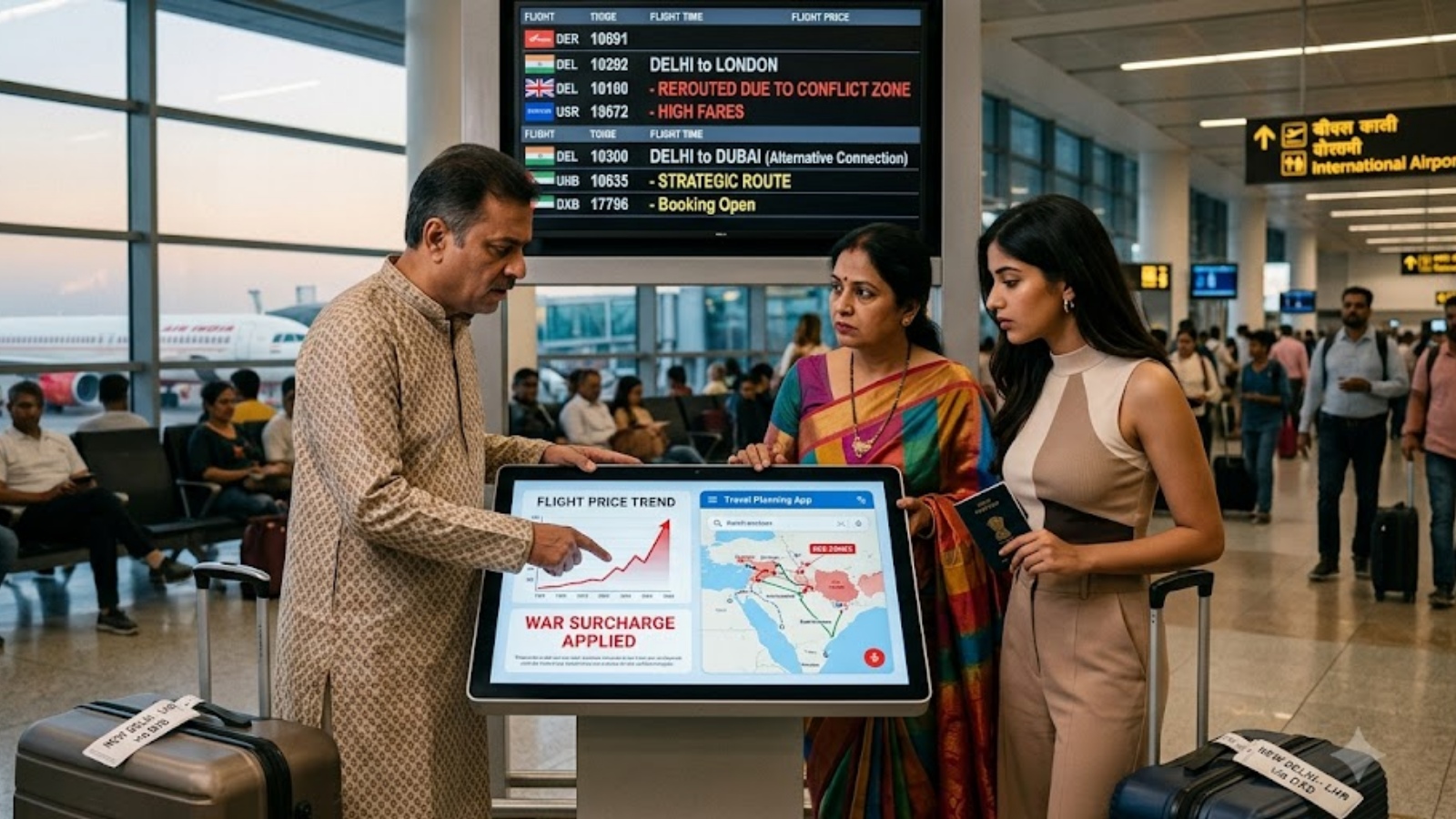
The ongoing wars have prompted Indians to become ‘strategic travellers’ (Photo: Magnific)
According to Ravi Gosain, President, Indian Association of Tour Operators (IATO), these disruptions are directly impacting consumer budgets.
Story continues below this ad
“There is evidence that travellers are making the gradual transition from travelling internationally to travelling domestically,” says Gosain. He notes that flight times to several international destinations have increased significantly due to airspace restrictions, while rising fuel prices and unfavourable currency exchange rates have pushed international travel costs much higher than in previous years.
The impact is especially visible among budget-conscious families and first-time international travellers, for whom airfare often represents the largest portion of travel expenditure. Srijit Nair, General Manager, India at Rail Europe, says travellers are spending more time comparing options and calculating the total cost of a trip before making bookings.
“The conflict in Iran, rising fuel prices, and growing concerns around travel costs have added a new layer of uncertainty to travel decisions,” Nair says. “Airfares, exchange rates, and booking flexibility now play a much greater role in destination selection than they did a few years ago.”
Adventure traveller and paragliding instructor Gurpreet Dhindsa also experienced the ripple effects of the geopolitical situation during his trip to Afghanistan.
Story continues below this ad
“For my trip to Kabul, I had to choose Kam Air because Air India has limited international routing options on that sector. With fewer airlines operating, ticket prices have gone up considerably. Commercial carriers are also having to avoid unstable airspace, including parts of Iran and restricted zones along the India-Pakistan border. This has significantly affected route planning,” he says.
International travel remains consistent
Despite geopolitical tensions, Indian outbound travel demand remains strong. According to Bernard Corraya, General Manager, Wego, travellers are not cancelling trips en masse. Instead, they are becoming more deliberate about how they book.
“International travel demand among Indian travellers remains resilient,” says Corraya. “Rather than seeing widespread cancellations, travellers are spending more time comparing fares, evaluating flight schedules, and assessing their options before making a booking decision.”
Even for Riddhi Garg, who will attend the International Immersion Programme at IÉSEG School of Management in Paris and Berlin from July 11 to July 27, 2026, the ongoing geopolitical tensions have not been a concern.
Story continues below this ad
“My Schengen visa was processed without any delay. The entire process has been extremely smooth, and I haven’t faced any disruption so far,” she says.
While travellers are spending more time evaluating costs, flight routes, and booking flexibility, their preferred destinations have largely remained unchanged. According to Wego, Thailand, Singapore, Malaysia, Vietnam, Japan, Bali, and Sri Lanka continue to witness robust demand, thanks to their proximity to India, strong air connectivity, and appeal across a range of travel budgets.
The rise of the value-conscious traveller
Perhaps the most significant change emerging from the current crisis is the rise of the value-conscious traveller. Corraya notes that flexibility has become an important component of travel planning.
“Travellers are looking beyond the lowest fare and paying closer attention to schedule convenience, booking flexibility and overall confidence in their travel plans,” he says.
Story continues below this ad
Nair acknowledges this change, observing that travellers increasingly want reassurance that they can modify plans if circumstances change. “Value, flexibility, and confidence are becoming just as important as the destination itself,” he says.
This behavioural shift is driving demand for refundable tickets, flexible hotel reservations, comprehensive travel insurance, and itineraries that minimise uncertainty. Travel companies like Wego report that many travellers are delaying bookings until closer to departure dates, allowing them to monitor geopolitical developments and secure better clarity on travel conditions.
Europe remains attractive
Europe continues to rank among the most aspirational destinations for Indian travellers despite the broader geopolitical environment. However, the way Indians are planning European holidays is changing significantly.
According to Rail Europe, travellers are increasingly opting for slower, more manageable itineraries instead of attempting multi-country whirlwind tours.
Story continues below this ad
Nair says many travellers are focusing on experiences that offer better value and greater flexibility. As airfares consume a larger share of travel budgets, travellers are paying closer attention to how they move around within Europe after arrival. One notable trend is the growing appeal of rail travel within Europe. Rather than booking multiple short-haul flights between cities, travellers are increasingly considering rail networks as a cost-effective and flexible alternative.
Domestic tourism grows
While outbound travel remains robust, domestic tourism is undoubtedly one of the biggest beneficiaries of the current geopolitical climate.
According to IATO, destinations offering a mix of recreation, spirituality, nature, and convenience are witnessing increased demand. States such as Himachal Pradesh, Uttarakhand, Goa, Rajasthan, Kerala, and Uttar Pradesh are among the major gainers.
Spiritual tourism is proving particularly resilient. Destinations such as Ayodhya, Varanasi, Prayagraj, and Rishikesh continue to attract large volumes of travellers. Gosain points out that India’s domestic tourism market remains the largest segment of the country’s tourism industry, with an estimated 303 crore domestic trips recorded in 2025.
Story continues below this ad
Besides, India welcomed more than 20 million international tourists, including Non-Resident Indians, in the same year. The country also recorded over one million international visitor arrivals in January 2026 alone. However, Gosain cautions that prolonged geopolitical instability could eventually affect inbound demand. Some international travellers may postpone trips while monitoring developments in the region.
Gosain says families increasingly prefer shorter domestic holidays that provide safety, predictability, and better value for money. Destination weddings and family gatherings are also driving demand in states such as Rajasthan, Goa, Kerala, and Uttarakhand. The trend aligns closely with the government’s ongoing push to encourage Indians to “Explore India” and celebrate important life events within the country.
The ongoing wars have prompted Indians to become ‘strategic travellers’ (Photo: Magnific)
Hotel industry sees measurable gains
The shift is already visible across the hospitality industry. According to Nikhil Sharma, Managing Director and Chief Operating Officer, South Asia, Radisson Hotel Group, the geopolitical developments in West Asia have redirected a portion of international travel demand towards domestic destinations.
“Travellers continue to prioritise meaningful, high-quality experiences closer to home,” he says. The trend is reflected in Radisson’s performance. Overall occupancy across its India portfolio has increased by 5 per cent compared with the same period last year, while average occupancy at leisure destinations is nearing 75 per cent.”
Story continues below this ad
Budget travel platform Zostel is seeing a similar pattern. According to CEO Aviral Gupta, domestic tourism has remained constant despite global uncertainty. “Domestic tourism has held steady through this period as booking numbers across Zostel properties have shown no significant impact, and demand for backpacker and budget travel within India continues to grow.” Interestingly, many travellers who had planned international holidays either shifted to Southeast Asian destinations or opted for domestic travel instead.
“What has changed is lead time. Travellers are booking much closer to their travel dates rather than planning weeks in advance. Our data shows close to 48 per cent of bookings now coming in within three days of travel, with most remaining bookings made seven to 10 days in advance,” Gupta adds.
“Travellers are choosing properties and platforms that offer easy rebooking or modification options, a marginal shift from booking behaviour even a year ago. Queries around real-time safety updates and travel advisories have also increased before bookings are confirmed, pointing to a traveller who is more informed and more cautious, but still travelling.”
Industry body Hotel Association of India (HAI) believes India’s strong domestic tourism base has cushioned the sector against global uncertainties.
“Recent travel disruptions have impacted international travel sentiment and demand, although the impact varies across business segments, source markets, and destinations,” says K B Kachru, President, Hotel Association of India (HAI). “Some hotels witnessed a near-term drop in bookings, especially from overseas markets and business travellers.”
“To sustain demand, hotels are widening their source markets while introducing dynamic pricing, flexible cancellation and rescheduling policies, staycation packages, experiential travel offerings, and stronger digital engagement,” says Kachru.
Echoing this sentiment, Chander K Baljee, Chairman and Managing Director, Royal Orchid Hotels Limited, says travel disruptions typically create short-term fluctuations in occupancy and booking patterns, particularly in destinations that rely heavily on air connectivity. “However, the Indian hospitality sector has demonstrated remarkable growth due to domestic travel demand for leisure, business, weddings, and MICE (Meetings, Incentives, Conferences, and Exhibitions) travel.”
Baljee adds that travellers are increasingly making decisions much closer to their departure dates. To encourage bookings despite continued uncertainty, Royal Orchid Hotels is focusing on “dynamic pricing, targeted promotions, loyalty-driven offers, direct booking incentives, and curated guest experiences.”
View original source — Indian Express ↗
Related stories

Variety
EntertainmentJul 13, 2026 · 1 min
Natalia Solórzano Vásquez’s ‘Spells to Revive a Witch,’ About Mythical Fortune Teller Soralla de Persia, Gets Backing…
Variety

South China Morning Post
EntertainmentJul 13, 2026 · 1 min
Sam Neill, known for roles in Jurassic Park and The Piano, dead at 78
South China Morning Post

Variety
EntertainmentJul 13, 2026 · 1 min
China Box Office: ‘Kung Fu Soccer’ Scores Massive $73.6 Million Opening
Variety

Rolling Stone
EntertainmentJul 13, 2026 · 1 min
Sam Neill, Star of ‘Jurassic Park,’ Dead at 78
Rolling Stone