The Guardian
‘We should be dead’: Perth’s Indigenous community felt ignored after alleged Invasion Day bombing attempt, inquiry told
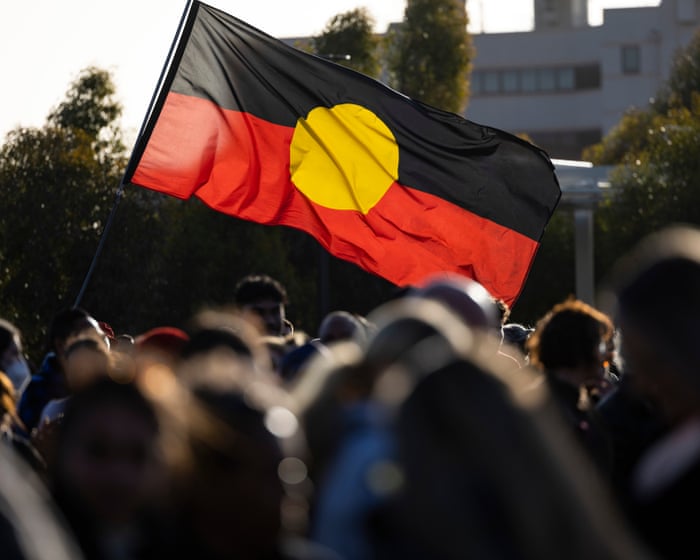
Indigenous community members who witnessed the alleged attempted terror attack at the Invasion Day rally in Perth have told a federal inquiry into racism and hate directed at First Nations people that they felt dismissed and ignored by authorities.
Western Australia police declared the incident was being investigated as a terror attack nine days after an alleged homemade bomb, filled with ball bearings, screws and other projectiles, was thrown into the crowd of 2,000 people at Forrest Place on 26 January. Perth man Liam Alexander Hall has been charged with terrorism offences and is in custody, and his lawyers have indicated he intends to plead not guilty by way of insanity.
In a hearing in Perth on Monday, the Curtin University academic Renae Isaacs‑Guthridge told the inquiry that she saw the device land in front of her after it was thrown into the crowd.
“I shouldn’t be sitting here and talking to you today. I and my girls, and mum and my sister, we should be dead because it landed right in front of us,” she said.
The Noongar‑Yamatji woman said many in the community felt ignored and dismissed in the days and weeks after the attack, which left the community shaken and traumatised.
“I believe because we were an Aboriginal and Torres Strait Islander crowd, there is an underlying hate against us, and so we’re not taken as seriously,” Isaacs-Guthridge said.
She said the attack was not treated with the same sense of urgency or understanding as the Bondi massacre one month earlier, in which 15 people died and 40 were injured.
“There needs to be consistency – no matter what happens in any situation where there’s a terrorist attack or there’s harm. And to me, that consistency was not applied,” she said.
She said condemnation from politicians and other non-Indigenous leaders was lacking. “Silence. Nothing … There was obviously a distinct pattern of people who said absolutely nothing.”
The Invasion Day rally organiser Fabian Yarran told the inquiry they had been warned far‑right individuals may be planning to target the event.
“We had a tipoff from community members that the Nazi party was going to come and hurt us on that day,” Yarran said. He told the inquiry that they informed the police and several state MPs that there was an unspecified threat, but that the police did not meet organisers prior to the day.
The square where the rally was held was evacuated after a woman in the crowd picked up the device, which had allegedly been lobbed from a balcony, and gave it to a police officer. Yarran said police did not tell rally organisers why the crowd was being moved on. “The police didn’t tell us about the actual bomb. They didn’t communicate, it was very frightening, very terrifying,” he said.
“[It was] especially disappointing that they didn’t come out and say that it was just a terrorist attack straight away.”
The former Indigenous affairs minister Ken Wyatt also gave evidence, telling the inquiry that the defeat of the referendum on a constitutional voice to parliament in 2023 – which was campaigned against by his own party – normalised racism and online hate. He said while many who voted no supported First Nations people, the result “emboldened” some racist commentary.
“It opened the doors to the trolls and the racists to legitimise their comments, both on social media and certainly in some of the behaviours and actions that they’re doing,” Wyatt told the committee. “Councils are no longer doing, [or] no longer wanting to do Welcome to Country or have Aboriginal flags flown.
Wyatt, a Yamatji man and the first Indigenous person elected to a lower house federal seat, said he hoped the inquiry would recommend action, and receive funding to match.
“I suspect at the royal commission into antisemitism that there will be money allocated,” he said. “What I’d like to see, if that occurs, is for the Indigenous parallel to be equally funded and supported, so it is rolled out across the nation.”
View original source — The Guardian ↗
Related stories

The Punch
PoliticsJul 13, 2026 · 1 min
Shettima, El-Rufai mourn HCD adviser Sagir Balarabe
The Punch

Euronews
PoliticsJul 13, 2026 · 1 min
Shocking footage: Ex-deputy minister in Poland's former ruling party shown helping Russian soldiers
Euronews

Philippine Daily Inquirer
PoliticsJul 13, 2026 · 1 min
Marcos to study request to open VP Sara's tax records
Philippine Daily Inquirer

TASS
PoliticsJul 13, 2026 · 1 min
Perekop training ship reaches Northern Fleet's main base from Baltiysk
TASS