CNA
‘Extraordinary confluence’: What China’s latest military moves reveal about its broader strategy
BEIJING: In a span of barely two weeks, China has sent bombers with Russia near Japan, kept coast guard vessels active east of Taiwan, launched joint naval drills with Moscow and test-fired a missile from a nuclear-powered submarine into the Pacific.
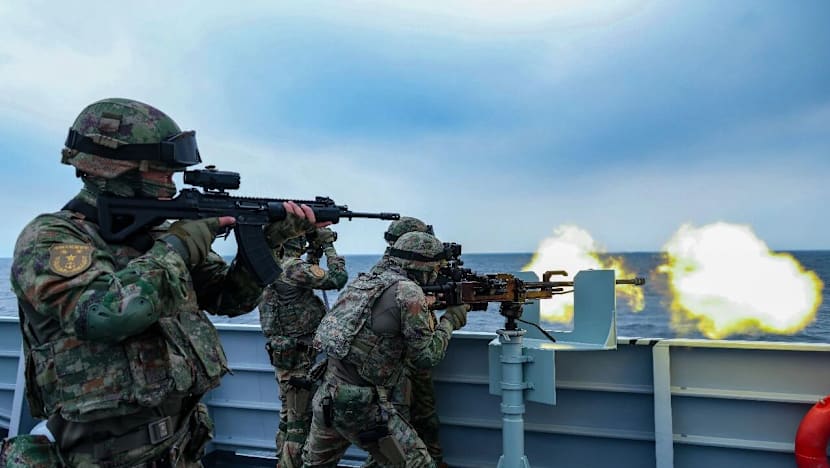
Analysts say the recent activities reflect a broader effort by Beijing to make a wider range of operations across multiple domains increasingly routine.
China also wants to signal to the United States and its allies that its growing ability to operate across the region is becoming an increasingly permanent feature of the security environment, they add.
“The objective is normalisation, not crisis. Beijing wants its presence in these waters to become unremarkable, so the cost of challenging it rises over time,” said Ben Brand, founder and lead analyst at Iron Command, an independent defence intelligence channel and advisory practice.
Yet the moves should not be viewed as actions in a single coordinated campaign, experts cautioned. They were driven by different services, agencies and planning cycles, and there is no public evidence that they were deliberately synchronised.
The significance, analysts said, lies instead in how separate strands of Chinese activity can converge to reinforce a broader message about Beijing’s strategic trajectory.
“COHERENT STRATEGIC DIRECTION”
On Jun 27, China and Russia conducted a joint bomber aircraft patrol over the Sea of Japan, the East China Sea and the western Pacific, including through the Miyako Strait.
Days later, Chinese and Russian naval forces gathered in Qingdao for Joint Sea-2026, the latest edition of a long-running annual exercise. The drills concluded on Jul 11, Chinese state media reported, adding that some participating forces would proceed to the Pacific for a joint maritime patrol.
In the same period, Chinese coast guard vessels continued patrols in waters east of Taiwan, while Japan reported repeated movements by Chinese naval ships through key waterways around its southwest islands.
Then on Jul 6, China carried out a rare missile test in the Pacific. Carrying a simulated warhead, the long-range ballistic missile was launched from a nuclear-powered submarine and travelled about 7,300km before landing in international waters in the South Pacific.
The recent cluster of activity amounts to an “extraordinary confluence of public shows of China’s military might”, Isaac Kardon, an adjunct professor at Johns Hopkins University's School of Advanced International Studies, told CNA.
The timing and intensity of the recent activity likely reflected Beijing’s intent to react forcefully to regional developments it sees as adverse, including deepening security coordination among US allies and partners, he added.
The developments have also unfolded as the US-led Rim of the Pacific (RIMPAC) exercise, the world's largest multinational naval drill, is taking place in and around Hawaii, bringing together dozens of countries for maritime and joint-force training.
While there is no public evidence the activities are centrally coordinated by China, their effects still “converge and mutually amplify”, said Hao Nan, a Nuclear Futures fellow with Ploughshares Fund and Horizon 2045, which support research on nuclear security and strategic risk.
“The best assessment is therefore a coherent strategic direction without demonstrated operational integration,” Hao told CNA.
Brand from Iron Command put it another way: Beijing was using “an already busy annual exercise window to pack a lot of signalling into one news cycle”.
MAKING CHINESE PRESENCE ROUTINE
Analysts said the recent activity builds on a longer-running effort by China to make its military operations in and beyond its immediate waters appear increasingly routine.
Brand described it as the “normalisation of activity in waters that used to be exceptional”.
This normalisation push is unfolding on two tracks, he said - one around and just beyond the First Island Chain aimed principally at Japan, Taiwan and the US, and another reaching into the South Pacific aimed at Australia, New Zealand and Pacific Island states.
The First Island Chain refers to the string of islands stretching from Japan through Taiwan to the Philippines that sits between China's coastline and the wider Pacific.
Alongside the China-Russia bomber patrol and Joint Sea-2026 naval exercise, the China Coast Guard (CCG) has maintained operations east of Taiwan while the People’s Liberation Army (PLA) Navy has continued moving through strategic straits around Japan.
Beijing has portrayed the recent activities as routine.
China's defence ministry has described Joint Sea-2026 and the subsequent Pacific patrol with Russia as part of the two militaries' annual cooperation plan to jointly respond to security challenges and maintain regional peace and stability.
Routine or not, the manoeuvres retain strategic significance, analysts said.
While the China-Russia exercises are fixtures on the calendar and their timing should not be overinterpreted, the other activities are “certainly worth considering as deliberate strategic signalling”, said Kardon, who is also a former assistant professor at the US Naval War College.
The missile test was primarily an effort to demonstrate the credibility of China’s sea-based nuclear deterrent, he said.
Activity through the straits off Japan also serves both operational and political purposes, allowing the PLA to train for Western Pacific contingencies while shaping regional perceptions of China's ability to project military power around Japan and Taiwan, he said.
Since late June, the China Coast Guard has maintained what it describes as regular law enforcement patrols in waters east of Taiwan, which face the wider Pacific. Rather than primarily serving as operational training, those patrols signal Beijing’s intention to control maritime space east of Taiwan, Kardon said.
China views Taiwan as part of its territory and has not ruled out the use of force to bring the island under its control.
The CCG patrols east of Taiwan were building "a jurisdictional record on the Pacific side" that would matter in any potential future blockade, said Brand from Iron Command.
At the same time, China's growing blue-water naval operations beyond the First Island Chain signalled to Washington that access to the western Pacific was "no longer uncontested", he said.
Hao from Ploughshares Fund and Horizon 2045 said Beijing was simultaneously seeking to make its military and coast guard presence beyond the First Island Chain more credible, raise the perceived cost of intervention and prevent the US-led security network from acquiring what he described as uncontested regional advantage.
While the recent activities overlap in timing, analysts said they should not be treated as carrying a single message.
Instead, Beijing appears to be tailoring different instruments to different audiences.
Hao from Ploughshares Fund and Horizon 2045 said the submarine-launched missile test spoke chiefly to the US and other nuclear powers, while operations through the First Island Chain were directed more immediately at Japan and the Philippines.
Activity around Taiwan, meanwhile, primarily addressed Taipei, while China-Russia patrols signalled to Washington and Tokyo that coordinated pressure could emerge across several directions.
For Japan, the signalling comes clearest through both military activity and geography, analysts said.
Brand said bomber patrols and repeated transits through nearby waterways - maritime and aerial actions - kept "a two-front problem in front of Japan", adding another layer to the pressure Tokyo would have to account for in any regional crisis.
Beyond those immediate audiences, Hao said, the wider region receives a dual message - that China is demonstrating resolve in the security sphere, while maintaining engagement through trade, diplomacy and regional mechanisms.
FROM SIGNALS TO A SUSTAINED POSTURE
The coming months may offer a better indication of whether the recent activity marks the beginning of a more enduring pattern, said analysts.
For Johns Hopkins University’s Kardon, one of the clearest indicators will be whether China can sustain coast guard operations east of Taiwan.
"If there is a CCG task group on station continuously in the coming months, this will be a good indication of more assertive law enforcement actions to come in those sensitive waters, which may precipitate a crisis with Taiwan, Japan, or the Philippines," he said.
Further submarine-launched ballistic missile tests into the Pacific, or other conspicuous submarine and missile activity, would also be closely watched, Kardon added.
Such developments "should be interpreted in Washington as a signal of Beijing's willingness to escalate beyond the region in the event of American intervention in a Taiwan contingency", he said.
Highlighting similar indicators, Brand said the key question was whether the current pattern hardened into doctrine or faded with the summer exercise season.
"One test is a signal. A cadence is a doctrine,” he said.
At the same time, the evolution of China's military presence may not only be measured on the surface.
Verineia Codrean, chief strategy and partnerships officer at Euroatlas, a defence technology company focused on underwater intelligence and surveillance, told CNA the broader pattern pointed to "more sustained naval and undersea activity further from China's coastline", suggesting an ambition to operate over greater distances.
Codrean said governments should pay close attention to how the undersea domain evolves, including the deployment of autonomous underwater vehicles, the expansion of persistent sensor networks and efforts to better protect critical underwater infrastructure.
"Future maritime competition will increasingly depend not only on who has the most capable submarines, but on who can maintain continuous awareness beneath the surface," she said.
Even as military competition intensifies, Hao said the region's longer-term trajectory would also depend on whether existing regional institutions could continue to moderate strategic rivalry.
China is responding to a more networked US alliance system by strengthening its own layered deterrence and selective coordination with Russia, Hao said.
But Beijing has also continued to engage through Association of Southeast Asian Nations (ASEAN)-centred mechanisms, trade and diplomacy, Hao said - suggesting it still wants strategic competition to remain bounded.
Whether the region remains stable, he said, will depend in part on whether those institutions can continue to prevent growing rivalry between the US and China from becoming a self-reinforcing cycle.
Source: CNA/lg(ws)
Related stories

The Punch
WorldJul 13, 2026 · 1 min
Enugu bus driver, conductor snatch police AK-47, knock down officer
The Punch
The Punch
WorldJul 13, 2026 · 1 min
Anambra arraigns blogger over fake reports on Soludo, son
The Punch
The Punch
WorldJul 13, 2026 · 1 min
ICPC arraigns ex-minister Nnaji, court grants N20m bail
The Punch
The Punch
WorldJul 13, 2026 · 1 min
Resurfaced 2024 video shows Davido revealing his biggest fear in music
The Punch