Indian Express
How the shrinking Caspian Sea intensifies ecological stress
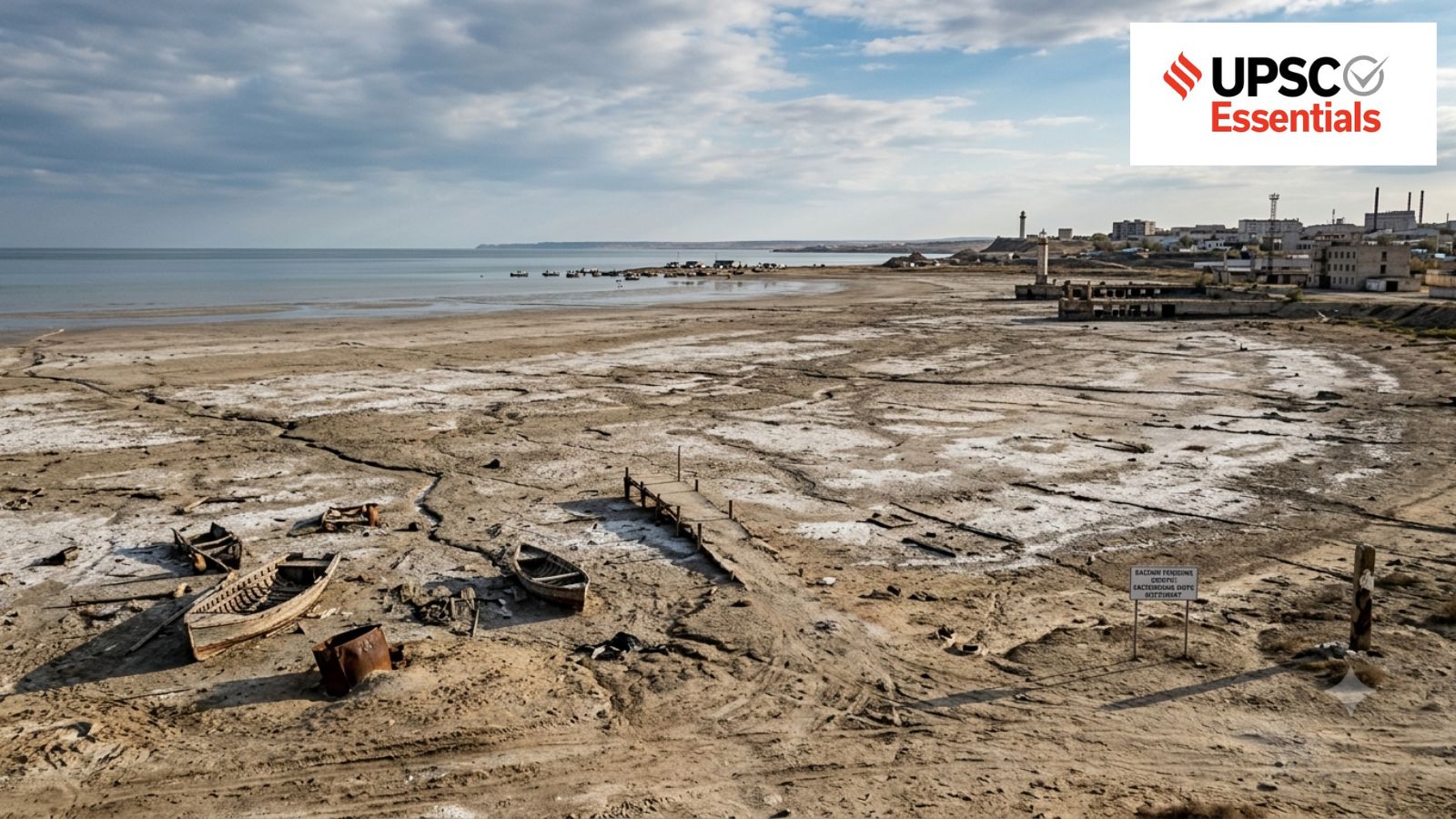
The shrinking of the Caspian Sea offers a stark example of how climate change and anthropogenic interventions are affecting the world’s inland water systems. The Earth’s largest landlocked water body is shrinking at a pace that raises far-reaching ecological concerns.
A study published in June 2026 identifies the decline in river inflow, largely driven by damming, river diversion, and excessive water withdrawal, and increased evaporation due to climate change as the main reasons behind the Caspian’s shrinkage.
The findings also highlight how rising global temperatures – with average sea surface temperature increasing by roughly 1°C since the mid-20th century – are causing physical and ecological changes in the marine and inland water systems.
But what makes the Caspian Sea one of the world’s most ecologically significant inland ecosystems, and what could be the long-term consequences of its continued shrinkage?
The Caspian Sea Is Shrinking — Here's Why It Matters
The shrinking sea Why it's shrinking Species at risk Warning signs
SCALE OF THE DECLINE
A landlocked giant is losing ground
Since the mid-1990s, the Caspian Sea — the world's largest inland water body — has lost about 5.5% of its surface area. That's equivalent to 630 cubic kilometres of water, according to a June 2026 study.
5.5%
Surface area lost since mid-1990s
630 km³
Volume of water lost
TWIN DRIVERS
Human activity and climate change, combined
A 2026 study identifies two main causes behind the decline.
◆
Declining freshwater inflow
Dams, reservoirs and irrigation diversion upstream — mainly on the Volga River, which supplies nearly 80% of the sea's inflow — have reduced the water reaching the Caspian.
●
Rising evaporation
Local surface air temperature rose about 1°C between 1979 and 2015, alongside changing wind patterns, driving evaporation rates that now outpace incoming river water.
80%
Of the Caspian's aquatic life is found nowhere else on Earth
90%
Of world's black caviar historically came from the Caspian
◆
Beluga sturgeon
Migrates up freshwater rivers to spawn. Falling water levels and pollution are disrupting its reproductive cycle, pushing the endangered species toward extinction.
●
Caspian seal
Also endangered, and losing habitat as shallow coastal breeding areas disappear along with the receding shoreline.
WATER QUALITY
Algal bloom risk is rising
Scientists have recorded a rise in chlorophyll-a concentration in the northern Caspian — an indicator of algal growth linked to warmer, nutrient-enriched waters. This raises the risk of harmful algal blooms and declining water quality, with knock-on effects for the fisheries that coastal communities depend on for food security and livelihoods.
Sources: The Shrinking Caspian Sea: Eco-Hydrological Responses to Human and Climate Pressures (2026) · The Indian Express
Caspian Sea and its significance
Though called a sea, the Caspian is technically a landlocked water body and is often regarded as the largest lake on Earth. Rivers feed freshwater into the Caspian Sea, as it is not connected to any ocean. Located on the borders of Europe and Asia, it spans approximately 371000 sq km and has a coastline of 6,819 km. Its coastline is shared by Azerbaijan, Iran, Russia, Turkmenistan, and Kazakhstan.
Story continues below this ad
(Wikimedia Commons)
The Caspian Sea receives water flow from around 130 rivers, but the Volga River in Russia accounts for nearly 80 per cent of its inflow. As an enclosed inland ecosystem, the sea is ecologically significant and supports a high rate of endemism. Endemism refers to species that are exclusively found in a specific geographic area.
Around 80 per cent of its aquatic life is entirely unique to the region. It includes the Caspian Seal and several species of sturgeon that together produce the vast majority of the world’s caviar (the eggs, or roe, of sturgeon preserved with salt).
Q1. With reference to the Caspian Sea, consider the following statements:
1. It is the world’s largest inland water body by surface area.
Story continues below this ad
2. It is directly connected to the world’s oceans through natural waterways.
3. It receives freshwater inflow primarily through rivers.
Which of the statements given above are correct?
(a) 1 and 2 only
(b) 1 and 3 only
(c) 2 and 3 only
(d) 1, 2 and 3
The shallow northern Caspian, in particular, functions as a critical breeding and spawning ground, supporting fisheries, wetlands and migratory bird routes linking Europe, Asia and Africa. As an enclosed inland sea lacking a natural outflow except through evaporation, the Caspian plays a major role in regional moisture and temperature regulation.
Economically and strategically, the sea underwrites regional energy and trade. It has vast oil and gas reserves, and hosts an extensive network of offshore oil and gas infrastructure. Its ports and shipping lanes are integral to transport corridors connecting Russia, Central Asia, and Iran, including routes that feed into China’s Belt and Road Initiative and India’s International North-South Transport Corridor (INSTC) ambitions. However, the ecological stability of the sea is under growing stress.
Why is the sea shrinking?
Since the mid-1990s, the Caspian Sea has lost about 5.5 per cent of its surface area, which is equivalent to 630 cubic kilometres of water. The research points to a combination of factors. The shrinking of the Caspian is the result of climatic and anthropogenic factors, including:
Story continues below this ad
Decline in freshwater inflow – According to a recent research titled, The Shrinking Caspian Sea: Eco-Hydrological Responses to Human and Climate Pressures (2026), one of the primary reasons is the decline in freshwater inflow, particularly from the Volga River. The main reasons behind this decline in inflow are human activities upstream like dams, reservoirs, and the diversion of water for irrigation purposes.
Increased evaporation – The other driver is the increased evaporation caused by climate change. Unlike open oceans that rise with global warming, the Caspian Sea is experiencing the exact opposite effect due to its closed geography. Between 1979 and 2015, local surface air temperature rose by approximately 1 degree Celsius alongside changing wind patterns, which have triggered extreme evaporation rates that vastly outpace incoming river water.
Q2. Which of the following are likely consequences of a significant decline in the Caspian Sea’s water level?
1. Loss of breeding habitats for endemic species.
2. Increased risk of harmful algal blooms.
3. Reduced navigability of shipping routes.
4. Expansion of mangrove forests along the coastline.
Select the correct answer using the code below:
(a) 1 and 2 only
(b) 1, 2 and 3 only
(c) 2, 3 and 4 only
(d) 1, 2, 3 and 4
Consequences of the shrinkage
The decline in water level carries serious consequences. The most immediate impact is on the biodiversity that the sea supports. For example, the endangered beluga sturgeon migrates up freshwater rivers to spawn. Notably, the Caspian Sea produced about 90% of the world’s total harvest of black caviar.
Story continues below this ad
Falling water levels and pollution affect their reproductive cycles, pushing them to the brink of extinction. Similarly, the endangered Caspian seal is also facing habitat loss due to the disappearance of shallow coastal areas.
Scientists have also recorded the rise in chlorophyll-a concentration in the northern Caspian, an indicator of algal growth linked to warmer and nutrient-enriched waters, increasing the risk of harmful algal blooms and declining water quality.
This is also directly impacting the coastal communities that depend upon the fisheries for food security and traditional livelihoods in the region. Declining water levels may also cause serious geographical implications. A 5-metre drop is estimated to turn about a fifth of the sea into land, and the exposed sea bed may become a health hazard, giving off toxic salt and dust storms.
The disappearing sea will also have trade and economic implications. Falling water levels will make navigation difficult, and the shipping route connecting Europe and Asia will become less efficient. These challenges will disrupt regional trade and affect the movement of energy resources across the region.
Story continues below this ad
The Tehran Convention: A regional response
Recognising the ecological significance of the Caspian Sea, the five littoral states adopted the Framework Convention for the Protection of the Marine Environment of the Caspian Sea, also known as the Tehran Convention, in 2003. The convention is backed by the United Nations and is the only legally binding regional agreement to protect the Caspian Sea’s marine environment and provide a framework for co-operation among the five countries.
It is based on principles such as the precautionary principle, the polluter pays principle, and the principle of access to and exchange of information. The main focus of the convention is on preventing, reducing, and controlling pollution as well as on the protection, preservation, and restoration of the marine environment. Under the convention, four protocols were also established:
* The Aktau Protocol on oil pollution.
* The Moscow Protocol on land-based pollution.
* The Ashgabat Protocol on biodiversity conservation.
* The protocol on Environmental Impact Assessment.
However, the convention was negotiated at a time when pollution was viewed as the principal environmental challenge.
In recent times, when climate change has emerged as the main factor behind declining water levels, the five littoral states adopted the Declaration on Strengthening Cooperation to Address the Caspian Sea Water Level Decline at COP29 in 2024. The declaration calls for enhanced scientific research, coordinated monitoring and the establishment of a regional working group to examine the causes and impact of sea-level decline.
Story continues below this ad
Q3. With reference to the Tehran Convention, consider the following statements:
1. It is a legally binding regional agreement for the protection of the Caspian Sea’s marine environment.
2. It provides a framework for cooperation among all the littoral states of the Caspian Sea.
3. It was adopted under the auspices of the United Nations in 2003.
Which of the statements given above are correct?
Story continues below this ad
(a) 1 and 2 only
(b) 2 and 3 only
(c) 1 and 3 only
(d) 1, 2 and 3
The Caspian crisis offers an important lesson
While these initiatives mark an important step towards regional cooperation, addressing the decline of the Caspian Sea requires strengthening both climate action and regional environmental governance.
The coastal states should enhance their co-operation under the Tehran Convention by establishing a strong monitoring system, undertaking joint scientific research, and sharing data. Also, there is a need for coordination in managing the Volga River and its tributaries to ensure proper water flow into the sea.
The construction of dams and excessive water withdrawal will also need to be addressed in order to restore damaged habitats, preserve endangered species and promote sustainable fishing practices.
In the context of the declaration on the Caspian Sea adopted at COP29, there is increasing awareness of the need for co-operation. However, it will fructify only when commitment is translated into some concrete action.
The Caspian Crisis also offers an important lesson for the management of shared water resources. Protecting transboundary ecosystems demands collective responsibility and long-term legal and scientific co-operation.
Post read questions
1. The shrinking of the Caspian Sea is a manifestation of the combined effects of climate change and unsustainable water management. Discuss the factors responsible for its decline and examine its ecological and socio-economic consequences.
2. Climate change has amplified the vulnerability of endorheic (closed-basin) water bodies across the world. Discuss with reference to the Caspian Sea.
3. Assess the implications of the shrinking Caspian Sea for India’s economic and strategic interests in Eurasia.
4. Regional cooperation is indispensable for the conservation of transboundary ecosystems. Discuss with reference to the Tehran Convention and the Caspian Sea.
5. The decline of the Caspian Sea underscores the need to strengthen international environmental governance in the era of climate change. Discuss.
(Renuka is a Doctoral researcher at Himachal Pradesh National Law University, Shimla.)
Share your thoughts and ideas on UPSC Special articles with [email protected].
Click Here to read the UPSC Essentials magazine for June 2026. Subscribe to our UPSC newsletter and stay updated with the news cues from the past week.
Stay updated with the latest UPSC articles by joining our Telegram channel – IndianExpress UPSC Hub, and follow us on Instagram and X.
View original source — Indian Express ↗
Related stories

South China Morning Post
TechnologyJul 13, 2026 · 1 min
1 killed in ICE-involved shooting in US
South China Morning Post

TechRadar
TechnologyJul 13, 2026 · 1 min
Tom Cruise's new movie Digger just got an absolutely unhinged first full trailer
TechRadar

The New York Times
TechnologyJul 13, 2026 · 1 min
Europe Will Defend Itself ‘With Blood, if Necessary,’ Macron Says
The New York Times

TechRadar
TechnologyJul 13, 2026 · 1 min
Vibe coded threats shift again — hackers are using AI chatbots to write malware using natural language
TechRadar