Indian Express
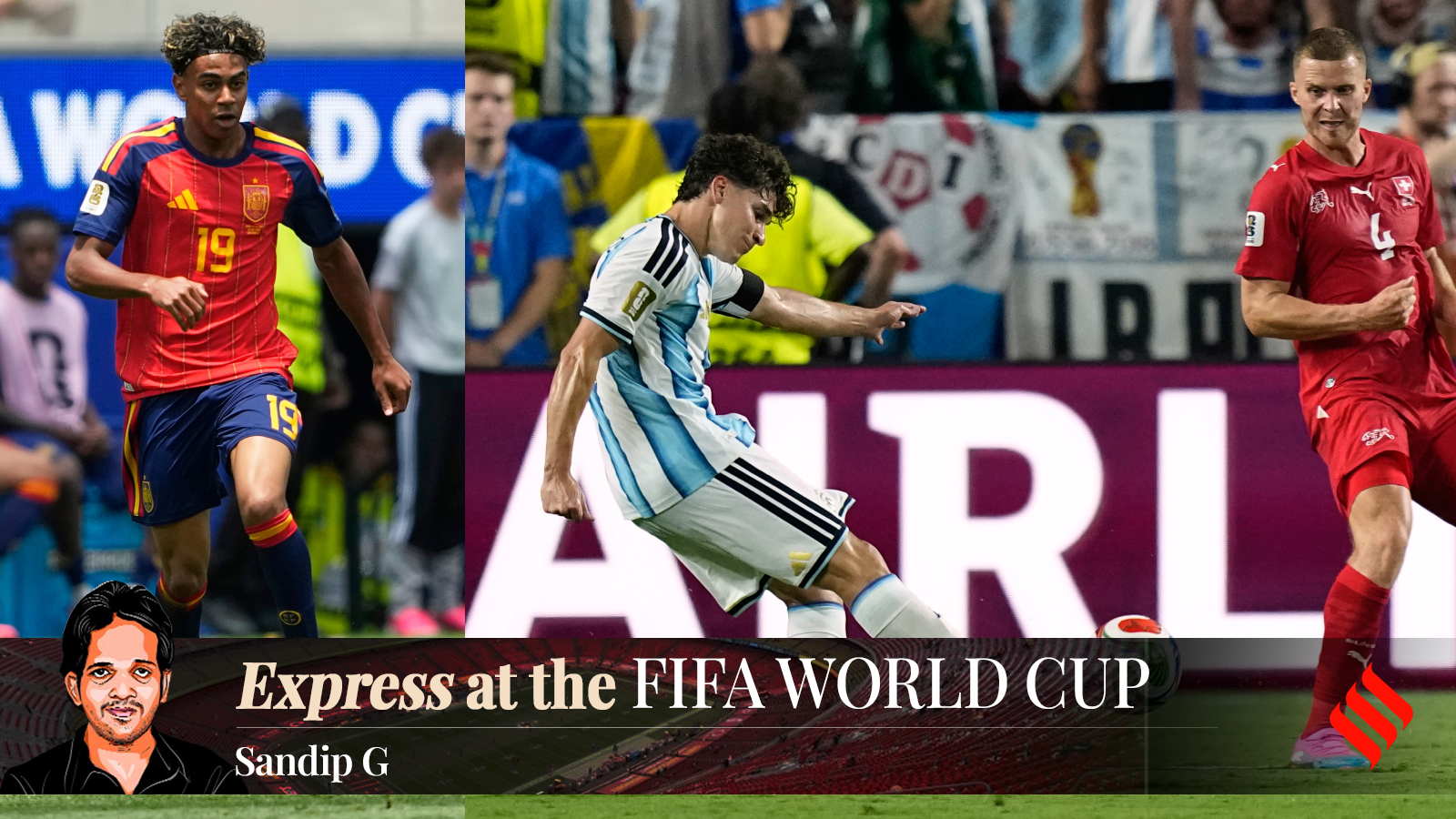
Yamal, Alvarez and why the long-range goal is back at this FIFA World Cup
Lamine Yamal’s words are like his goals. The strikes open up unseen angles, unthought spaces, and unforeseen dimensions. The words slit open old wounds. With one sentence after the Belgium victory, “If anyone should be afraid it should be them, we knocked them out of the Euros,” he slashed open a night France wanted to forget. Everything: the score, the scar, the star, the goal, the flaw.
It was the night that built the legend of Yamal. The goal that advertised his infinite potential and announced the postcode of his town Rocafonda to the world. He has yet to set the World Cup stage on fire, but the memory clings on. Thirty yards from goal, he careened inside and ferried the ball to the top corner off the far post, leaving the audience, teammates and the French in equal parts shocked and marvelling.
The pattern could recur with semifinal-defining consequences. Yamal’s recovery from injury has been so staggered that he has not hit the high notes of the Euros, but France’s left side remains his hunting ground, their sinister vulnerability, their historical undoing.
Lucas Digne, who replaced Theo Hernandez at left-back, is susceptible to lapses, prone to abandoning his post for attacking pastures, and slow to retreat when play turns quickly. The midfielder behind him would have nightmares recalling the goal’s buildup, when Yamal left his marker grasping vapour with a nudge of the outside of his boot. France simply wilted thereafter.
Such a goal would be a fitting tribute to a World Cup semifinal where strikes from outside the box, cutting inwards, curling away, have become vogue again. Both Messi and Mbappe have pummelled two apiece; Morocco’s Ismael Saibari, Egypt’s Emam Ashour, Cape Verde’s Sidny Lopes Cabral have all beaten goalkeepers with long-rangers. Thirty-eight goals have been wrought from outside the area; the corresponding number in Qatar was twelve. There were all sorts, curlers, dippers, flat and ferocious thunderbolts. And then there is the Julian Alvarez clanger: a wickedly unstoppable blend of power, curl and drop that foxed the Swiss backline and goalkeeper Gregor Kobel with divine mastery.
From the moment the ball left Alvarez’s right instep, Kobel knew its design, that it would arc into the top corner. He could only pray it missed the target, that it bent more than it should, or didn’t curve at all, or plunged straight into him. There were so many variables, so little he could do, but watch the ball pierce the narrow space between his palms and the post. Alvarez joked afterwards that he was plainly fortunate. But he has composed such goals before, with frightening aerial theatrics and the air of a man who expects them to go in.
Long-rangers are sometimes brushed off as gambles, the goal as freak occurrence. But to shoot from distance and hit the intended target requires its own mastery. It is a moving ball, unlike a free kick, defenders are not chained to a white line, bodies are shifting all around, and through that chaos the striker must conceive not the perfect path but the most workable route, in two seconds or less. Alvarez struck his with inevitability. Watch the perfection of his follow-through, which ended with his right foot and left arm perpendicular to the rest of his body. Few goals are struck with such beautiful technique.
Story continues below this ad
It may be a direct response to low blocks and packed penalty areas. One-touch passing inside the box becomes fruitless against eleven men behind the ball; tap-ins and nudges improbable avenues in a crowded goalmouth. Outside the box there is relatively more space, more time to sketch a destination. Arsenal manager Mikel Arteta made the point last season, when open-play conversion rates from distance climbed to 4.9 per cent from a low of three per cent in 2019. “The more density there is inside the box, the more difficult it is to score in open play, so you have to find other ways.” He reached for a parallel with basketball’s rediscovered love of the three-pointer. “It happened in basketball, going from twos to threes,” he said.
Julian alvarez first goal 🤑
Let’s go baby alien 🤑@FootbalIhub @TotalFootball @WorldCupEra pic.twitter.com/KOHeCNUbnp
— james rule💫 (@jamesrule900) July 13, 2026
VAR’s intense scrutiny of penalty-box contact has played its part too. And there are those who implicate the ball itself, Trionda. “It arrives faster and swerves more than expected,” former England goalkeeper Joe Hart has said. But it is strictly not for imposters. For that reason it remains an outlier, and an elusive art.
The semifinal’s fate could hinge on it. Both sides carry distance-shooting threats in abundance, Mbappe and Ousmane Dembele for France; Baena, Cubarsi and Yamal for Spain. But the French full-backs, Jules Kounde and Lucas Digne, look weathered against their Spanish counterparts Marc Cucurella and Pedro Porro, who are quicker and more aggressive in the press. The angles are there for the taking.
None of them, though, not even Mbappe, carry the particular thrill of Yamal pedalling the rubbery sphere to the top corner. France would remember. And if they had forgotten, Yamal’s words have reopened the wound. Whether it fuels them or finishes them, the semifinal will answer.
View original source — Indian Express ↗
Related stories

ESPN
SportsJul 13, 2026 · 1 min
McGregor to have surgery, plans to fight again
ESPN

ESPN
SportsJul 13, 2026 · 1 min
Ex-delivery driver in UK wins final Open spot
ESPN

ESPN
SportsJul 13, 2026 · 1 min
Ex-Kansas player charged with attempted murder
ESPN

ESPN
SportsJul 13, 2026 · 1 min
Updated ranking of the top 100 players in the coll...
ESPN