The Guardian
Taking down the Nicky Winmar statue points to a troubling double standard in our public spaces | Paul Daley
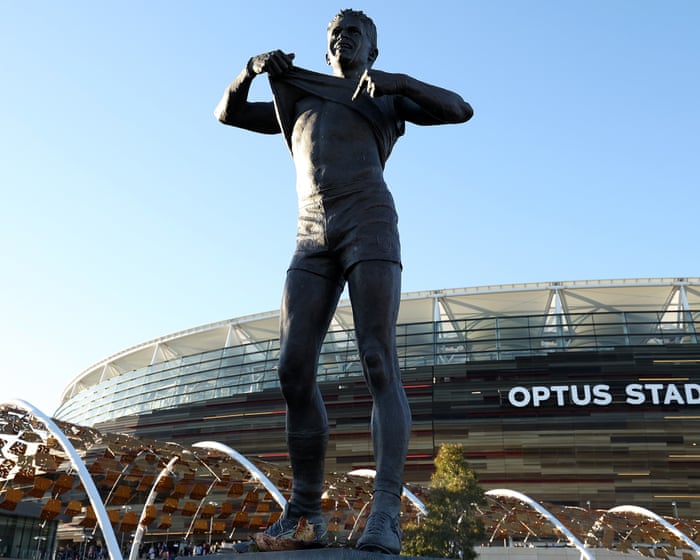
Divided opinion about the Western Australian government’s swift, unilateral removal of a statue honouring the former AFL player Nicky Winmar’s stand against racism in light of his domestic violence conviction highlights the potentially fraught nature of memorialising the living.
What should happen to the statue or the plaque, the street name or building honouring a living person should they transgress after its dedication? Should the memorial, no matter what form it takes, be amended to document the transgression? Or simply removed, as was the case with the Perth Stadium statue depicting the former St Kilda player and Noongar man famously lifting his jersey and pointing at his skin in response to terrible racial abuse by Collingwood spectators in 1993?
These are at once highly vexed practical and moral questions to which the official answers – from governments and other institutions – seem largely arbitrary.
I’ve argued previously that public statues and monuments are not of themselves histories – although they can be portals into them, fostering constructive discussion about the past and present, about changing values, and social and political mores.
The removal of the Winmar statue effectively symbolises the state’s wilful cancellation of him due to his egregious crime.
This is not the first time a governing institution has de-memorialised a public figure. In 2014 WA’s Bassendean council, where convicted sex offender and paedophile Rolf Harris grew up, removed all public mention – including a plaque – that once celebrated the entertainer.
Critics of the decision to remove the Winmar statue will, however, continue to argue that the action should not annul remembering the courageous stand he took against racism in 1993 and his ongoing activism against it.
Some also point to a “double standard”, given that the public spaces of our major cities are replete with statues, monuments and nomenclature honouring the killers and oppressors of Aboriginal people.
The difference, of course, between statues dedicated to the living and the old monuments honouring long-dead prominent colonisers, is that the crimes of the latter were usually extremely well-known and documented at the time of their memorialisation.
Perth is, perhaps, the best case in point, as the celebrated WA historian Chris Owen has long pointed out.
Until recently a statue of the former WA governor James Stirling who led the 1834 Pinjarra massacre stood in Foundation Park. It was recently moved into storage amid renewed public debate about Stirling’s appalling legacy (although it remains unclear if that was the reason why) even though his crimes had been well established and documented long before the statue’s dedication in 1979.
And then there are the Forrest brothers – John, the first premier of WA and his pastoralist and MP brother Alexander, who advocated in parliament for the killing of Aboriginal people.
As Owen writes in his remarkable history of WA policing, Every Mother’s Son Is Guilty, “John Forrest had significant personal experience in coming into contact with Aboriginal groups hostile to his group’s presence during his three expeditions between 1869 and 1874.
“In June 1874 at Weld Springs Forrest had shot Aboriginal people himself when about ‘forty to sixty natives came’ running towards the camp, all plumed up and armed with shields and spears. These experiences would inform Forrest’s later judgments.”
And yet the brothers still stand proudly in statuary (Alexander on the corner of Barrack Street and St George’s Terrace, John in Kings Park), in the city. They are in company with statues, plaques and public spaces dedicated to other celebrated white settlers – among them the Duracks and Alfred Canning – who “opened” the WA pastoral frontier well into the 20th century, a euphemism up there with “dispersal” when it came to dispossessing the Indigenous people of that state.
The statue of Alexander Forrest features him with a slung rifle – something of a defiant nod, perhaps, to the state’s brutal pastoral history of murder and violent dispossession.
Other states have illustrated that it is possible to reflect progressive evolution in attitudes through the removal of various statues and monuments. In Melbourne, for example, a colonial-era statue of Burke and Wills, commemorating the 1860 fiasco of their (celebrated failure of an) expedition, remains in storage. It will likely be replaced where it last stood in Melbourne’s City Square by a new, Indigenous-themed monument.
This was Victoria’s oldest public monument. It’s now a reminder, perhaps, that statues are inanimate and represent moments in time. They can be removed and forgotten about.
And sometimes their very dedication is profoundly mistaken.
The best example of this, to my mind, is the statue of Lachlan Macquarie in central Sydney. He is the most unworthily celebrated and eulogised of the colonial governors of New South Wales.
Macquarie orchestrated the Appin Massacre of 1816 (the tactic of “terror” – his own terminology – was central to this shameful early colonial episode) and the subsequent abduction of Aboriginal children.
All of this was very well established when the statue was dedicated in 2013, along with the ridiculous bronze epithet that declared the murdering Macquarie to be a “perfect gentleman”.
That statue remains.
Paul Daley is a Guardian Australia columnist
View original source — The Guardian ↗
Related stories

The Punch
WorldJul 13, 2026 · 1 min
Adeleke demands visa ban for APC chieftains, party faults gov
The Punch
The Punch
WorldJul 13, 2026 · 1 min
Anambra agency cracks down on illegal street trading, shanties in markets
The Punch
The Punch
WorldJul 13, 2026 · 1 min
Oluremi Tinubu assures World Bank of robust school feeding programme
The Punch
The Punch
WorldJul 13, 2026 · 1 min
Abducted Oyo farmer regains freedom
The Punch