Times of India
Can Messi stop England? Will France vanquish Spain? A guide to WC semifinalists
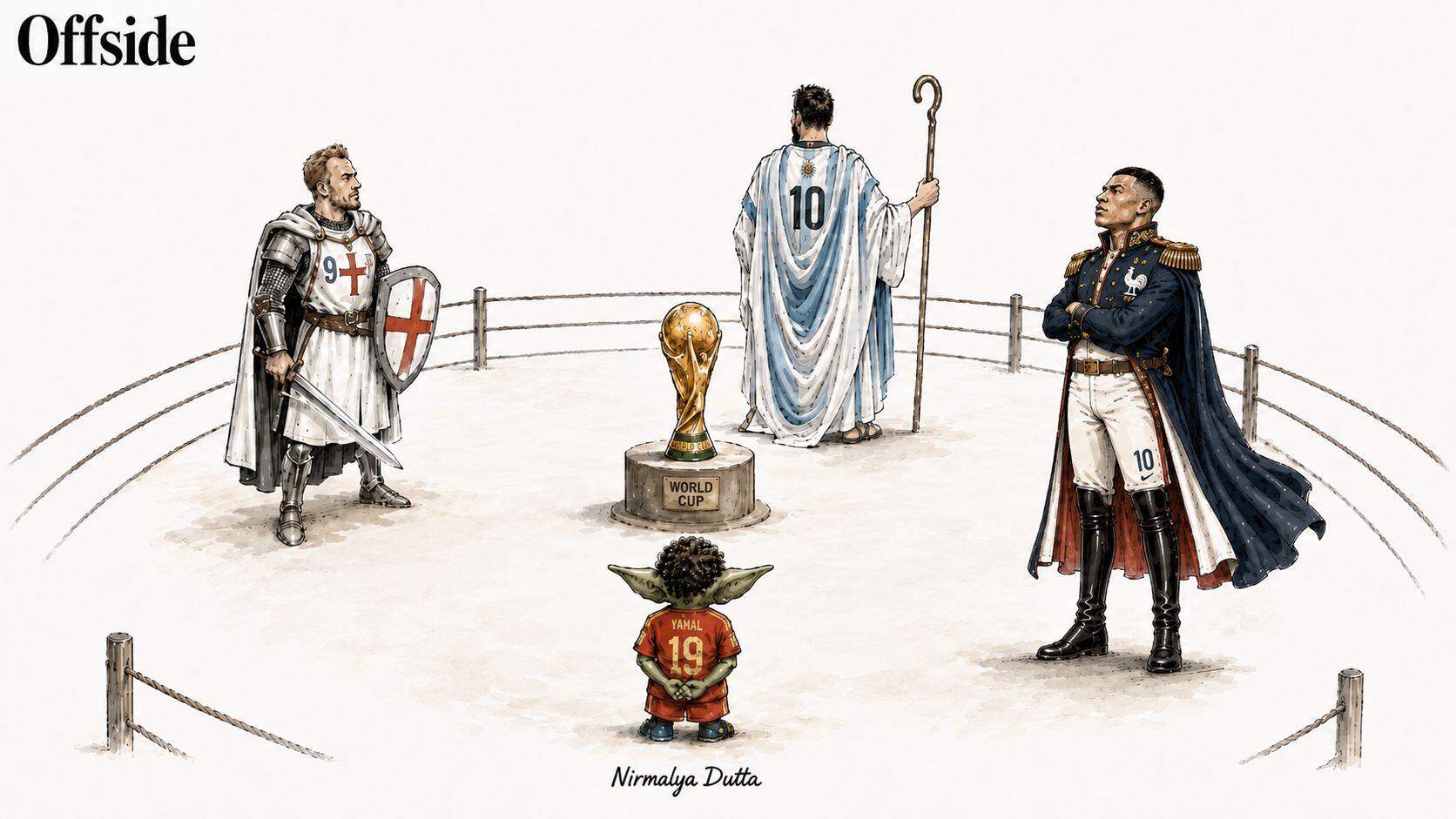
Hello and welcome to another edition of Offside. Now, there’s a phrase on OSINT Twitter: “monitoring the situation”. It refers to the lives of those individuals who are really into bird-watching, except their birds are usually military planes and other assorted objects of mass destruction.Football fans, too, have been monitoring the situation for the last month, figuring out where Cabo Verde is located or doing more maths than they did in high school while calculating which third-placed teams will qualify. We’ve gone through FIFA’s rulebooks to explain why VAR isn’t favouring Messi and borne the brunt of Ronaldo fans for pointing out that he has simply become too old to lead the attack of a nation like Portugal. Now, after a month, we are at the business end of the tournament. We are down to four and, for the first time since the FIFA rankings were introduced, the semi-finalists are the world’s top four ranked teams: France (1), Argentina (2), Spain (3) and England (4).France play Spain in the first semi-final, while Argentina take on their old enemies England, in two mouth-watering clashes. Now, if you haven’t followed what’s going on, here’s a not-so-brief executive summary of each of the teams left.
FRANCE (Rank 1)
One of the oft-quoted Voltaire quotes that he never said was: “I don’t agree with what you are saying, but I will defend to the death your right to say it.” Much like Tagore’s Where the Mind Is Without Fear, it has been used ad nauseam to the point that anything a person says after that quote can be roundly ignored. But at this World Cup, there’s one thing we can all agree on: the French team led by ‘Dictator’ Mbappé looks terrifying to all comers.
Every idea — good (breadless diets and beheadings) or bad (fraternity, equality and secularism) — came from the French, and that is why they have to constantly update their Republic. They are in its fifth iteration now, and French football’s Charles de Gaulle has constructed its footballing equivalent: centralised, powerful, stable and designed to survive every crisis. Earlier versions were conservative security states.
In his final tournament, the old pragmatist has unexpectedly liberalised the attack, placing Mbappé, Dembélé, Olise and Barcola or Doué together while retaining the institutional machinery underneath.While all the talk has been about the attack, their defence has been equally terrifying and, in the knockout rounds, all their opponents have recorded xG figures significantly lower than 1.And to top it off, France play their match on Bastille Day, but it is the Spanish defence that will be worried about being stormed.Road to Semi-FinalFrance are chasing a third consecutive World Cup final and look as dominant as Brazil did between 1994 and 2002. Their first real challenge was Paraguay in the Round of 16, which was more an MMA bout than a football match, and even then France, to borrow a line from Mbappé, “put their hands in the s****” to win. Against Morocco, despite Mbappé having a penalty saved, France easily swept aside a talented Moroccan team and, while Spain have looked rock solid, they will be wary of what the French can do.Beginner’s GuideFrance are playing with four attackers — seldom seen in world football these days — with Mbappé through the middle and drifting left, Dembélé on the right but cutting inside or outside at will, Barcola offering speed on the left and the silken-touched Olise playing in the hole. This is the third version of Deschamps’ French team: the 2018 one absorbed pressure and attacked, the 2022 one depended on Mbappé changing matches, but the 2026 one is firing on all cylinders.
They can slow the game, press high, retreat into a compact block and do it all with the élan of a Frenchman in a cravat, eating a baguette and sipping a glass of champagne while wondering what all the fuss is about.It’s the kind of football that France’s most famous football fan and part-time philosopher, Albert Camus, would call simply absurd.The Main Man
France's Kylian Mbappe (10) reacts after the World Cup round of 16 soccer match between Paraguay and France in Philadelphia, Saturday, July 4, 2026. (AP Photo/Matt Rourke)
Now, all eyes will be on Kylian ‘Dictator’ Mbappé, who has embraced his social media meme persona and is treating all French opponents with disdain, on and off the pitch.
He has scored in five of France’s six games and has eight goals and three assists in this edition. He is also on 20 World Cup goals, one behind Messi, and the smart money is on him finishing this tournament as the highest-scoring World Cup player of all time.Playing StyleThis French squad can play in different ways. They can be physical when needed, patient against low blocks, dominate possession when required, counterattack at will and defend compactly.
They also have what product managers call “institutional memory”, with 14 years of Deschamps making them a team accustomed to the zeniths and nadirs of tournament football. If there are any downsides, they are that France have often been wasteful in attack, while Spain have a particularly miserly defence.
Their four-attacker gamble could also backfire against Spain’s ability to control possession.
ARGENTINA (Rank 2)
In a World Cup being held in MAGAland, somehow supporting Argentina has become the most politically charged thing at this World Cup. Progressives of a certain persuasion, now buoyed by Ronaldo fans, are convinced that — and it’s ridiculous when you write it — a ‘pro-Zionist’ FIFA, led by Gianni Infantino, is working to ensure that Argentina win the World Cup.
This has apparently included VAR support, allowing Messi to disrespect officials and even injecting Álvarez’s left foot so that he can score worldies whenever the plot requires it.
Argentine short-story writer Jorge Luis Borges had a lifelong fascination with labyrinths, and that makes him the perfect patron because this campaign has been about the defending champions building elaborate mazes before asking Messi to locate the exit.Coach Lionel Scaloni says suffering is part of Argentina’s DNA, and his players appear determined to prove the diagnosis correct, though their semi-final opponents England have their fair share of experience when it comes to suffering.Road to Semi-FinalBefore Maradona and his successor, Messi, the most famous Argentine export — even if folks never realised it — was a young man named Ernesto ‘Che’ Guevara, whose Cuban military beret has always been socialism’s biggest advertisement.Argentina’s route in this tournament has been as colourful as The Motorcycle Diaries, Che’s road trip that made him a socialist.Argentina started the tournament with a bang — much like the motorcycle in that book — with Messi scoring a hat-trick against Algeria and a brace against Austria. Their knockout rounds, though, have all been revolutionary, with Cabo Verde pushing them all the way in a 3-2 victory, Egypt leading 2-0 until the 79th minute and Switzerland pushing them into extra time before Álvarez and Lautaro Martínez secured a 3-1 victory.
Argentina are attempting to become the first nation since Brazil in 1962 to retain the World Cup, but they have looked less likely to do so with each knockout round.Beginner’s GuideArgentina’s system is designed around giving Messi the freedom to walk, watch and wait. The other ten players provide the running required to turn his stillness into catastrophe for the opposition.Scaloni can shift between a 4-3-3 and variations of a 4-4-2, but the basic idea remains unchanged.
Messi drifts into central and right-sided areas, receives between the opposition’s midfield and defence, and waits for defenders to move towards him. Julián Álvarez runs beyond the defence and presses on Messi’s behalf, while Alexis Mac Allister, Enzo Fernández and Rodrigo De Paul provide control, physical effort and runners from midfield.Argentina move the ball securely through short combinations before suddenly accelerating through the centre or switching play towards the full-backs.
Messi remains the heart of the team, but the build-up is organised to create the spaces and passing angles that allow him to choose the decisive moment.At 39, Messi can no longer dominate every minute of every match. Argentina arrange the game so that he can dominate the two minutes that matter.The Main Man
Argentina's Lionel Messi (10) looks on during the World Cup quarterfinal soccer match between Argentina and Switzerland in Kansas City, Mo., Saturday, July 11, 2026. (AP Photo/Ed Zurga)
Messi has eight goals at this World Cup and remains level with Kylian Mbappé in the Golden Boot race. His scoring streak ended against Switzerland, but his influence did not.
He recorded the assist for Álvarez’s extra-time goal and repeatedly created openings while surrounded by Swiss defenders. He has also looked oddly mortal at this World Cup, missing two penalties and channelling his inner Mourinho to demand respect from a referee.Playing StyleArgentina are playing slowly but deliberately, circulating possession and waiting for Messi either to occupy the space between the lines or for the midfield runners to accelerate.
They are also masters of seizing moments and changing the emotional temperature of a match when required.The obvious weakness is their defence. Argentina conceded only once during the group stage but have allowed five goals across their three knockout matches. Cabo Verde, Egypt and Switzerland all found spaces around Argentina’s aggressive defenders, while Messi’s limited defensive involvement places additional responsibility on the midfield.The quarter-final provided Scaloni with his most encouraging development. Messi did not score and Argentina still advanced through goals from Mac Allister, Álvarez and Lautaro. The supporting cast finally proved it could complete the miracle without asking Moses to part every sea personally. England, on the other hand, have their own miracle man.
SPAIN (Rank 3)
It’s fitting that Don Quixote, Spain’s most famous literary hero, was so committed to his worldview that, when he mistook windmills for giants, he chased them.
For Spain, the windmills became possession and the misguided belief that completing a thousand passes was the same as scoring a goal.Now, one can’t blame them.Spain won three major tournaments in a row with Xavi, Iniesta and Busquets, who passed the ball with such élan that opponents became transfixed like bulls hypnotised by a matador’s flag. Yet that Spain side did not merely carry the flag of possession; it also had forwards who could put the bull to the sword, such as Fernando Torres and David Villa.
Spain’s current boss, Luis de la Fuente, has found a way to combine Spain’s love of the ball with the ability to pass, press and dominate. He has wingers who can stretch games, midfielders like Rodri who can control them and, in 18-year-old Lamine Yamal, the most talented wunderkind, who already looks like he is one with the Force.Road to Semi-FinalSpain began the tournament with an uncomfortable throwback to their recent flaccid past, being held 0-0 by Cabo Verde before dismantling Saudi Arabia 4-0 and Uruguay 1-0 to finish top of their group. They dismissed Austria 3-0 and then handed Ronaldo and Portugal a reality check with a Mikel Merino winner. Belgium, too, ran Spain close before Merino again came off the bench to send Belgium’s Golden Generation home without a ticket.
This is Spain’s first World Cup semi-final since 2010, and they have conceded only once in six matches and are unbeaten in 37 games.Beginner’s GuideSpain play a 4-3-3, with Rodri providing security at the base, Pedri and Fabián Ruiz moving into spaces and Yamal providing a bit of magic dust by stretching defences. When Spain lose the ball, they counterpress as their first form of defence. The idea is to recover the ball before the opposition can figure out what’s happening.
It has worked so far, but then they haven’t faced Mbappé and Co yet.The Main Man
Yamal is the face of Spain’s restoration. De la Fuente has compared his creativity to that of Salvador Dalí and Michelangelo, an impressive amount of pressure for someone who can’t buy alcohol in the US but can probably buy a rifle or marry. He can receive the ball out wide, cut infield and bamboozle defenders with Cruyff turns. He has already warned France that Spain will play sin ningún miedo — without any fear.And, of course, there’s always Merino, who, after breaking a bone in his foot earlier in the season, is experiencing his own redemption arc, stepping up to score whenever Spain need him.Playing StyleSpain’s greatest weapon is ensuring that their opponents don’t have the ball because, as the old adage goes, if you don’t have the ball, you can’t score. They are defensively astute rather than tackling like bulls in a china shop.They are also a team accustomed to playing different tunes, from flamenco to heavy metal.
Yamal can accelerate at will, but the weakness is contained within the same system. Spain’s full-backs and advanced midfielders leave space behind. No team has properly exploited that yet, but Mbappé and Dembélé will love attacking them during defensive transitions.France will treat that the same way the guillotine treated Marie Antoinette. Don Quixote eventually learned that the world didn’t conform to his fantasies, but the inheritors of Voltaire’s legacy will love to puncture Spain’s Panglossian optimism and show them the proper way to tend a garden.
In the Indian imagination, Spain is the destination of the rich man’s road-trip movie Zindagi Na Milegi Dobara, and if La Roja fail to score against France, they might just realise: Chance Na Milegi Dobara.
Not against Mbappé and Co.
ENGLAND (Rank 4)
Etched above the players’ entrance to Centre Court at Wimbledon are Rudyard Kipling’s words: “If you can meet with Triumph and Disaster and treat those two impostors just the same.” Except for England, there has historically been more disaster than triumph, as the rest of the world takes great pleasure in mocking Albion for failing to win at yet another sport it invented.
Jude Bellingham, left, and Harry Kane celebrates England's victory over Norway in a World Cup quarterfinal soccer match in Miami Gardens, Fla., Saturday, July 11, 2026. (AP Photo/Julio Cortez)
Perhaps England have finally found the solution that also worked for their monarchy, which avoided the revolutions that swept through the rest of Europe: put a German in charge.Tuchel’s England have spent the World Cup meeting triumph and disaster with roughly the same expression of intense dissatisfaction. They have been brilliant, they have been bad, they have conceded first, survived with ten men and even benefited from a spidercam controversy.
Through all this, they have finally discovered the ancient English stoicism that allowed a tiny island to become the most powerful empire in the world.Road to Semi-FinalEngland began with a 4-2 victory over Croatia, then drew terribly against Ghana, led by England’s auld enemy, Sir Alex Ferguson’s former assistant Carlos Queiroz. Against a stubborn Panama, Bellingham and Kane combined to lead them to a 2-0 victory before it appeared that they were going to lose against DR Congo. Except Harry Kane suddenly remembered why Scorpions wrote a song about him, scoring twice in 15 minutes, including a shot so powerful that Ralph Waldo Emerson could have written a poem about it.In a raucous Azteca, they exorcised recent tournament horrors by playing for 30 minutes with ten men, which saw Jude Bellingham score twice, Kane score a penalty and Jordan Pickford put in a goalkeeping performance reminiscent of a bouncer keeping drunks out of a pub. Finally, in the match billed as the Battle of Apex Predators, Haaland and Kane, it was Jude Bellingham who dragged England towards the semi-final with a little help from the spidercam cables.Beginner’s GuideTuchel’s side read as a 4-2-3-1 on paper, with Rice supposed to protect the defence, Kane supposed to be the centre-forward and Bellingham attacking the space behind him.
Except it has been far more chaotic. Bellingham is playing as a proper box-to-box midfielder, and everyone is putting in a proper shift, including Jordan Henderson, who managed to break his wrist while celebrating.England like to press, but they can retreat when needed, as they did against Mexico. Another unlikely hero has been Dan Burn, the defender who was the Mountain to Haaland’s Hound, coming on when England needed height and aggression.
Burn is one of the few defenders who has troubled Haaland, and so it proved against Norway, as he kept the Vikings out.The Main Man
England's Jude Bellingham (10) celebrates scoring their first goal during the World Cup quarterfinal soccer match between Norway and England in Miami Gardens, Fla., Saturday, July 11, 2026. (AP Photo/George Walker IV)
England technically have two main men, but Jude Bellingham has become the protagonist in the last two knockout games, becoming the first Englishman since Gary Lineker to score six non-penalty goals at a World Cup. And he is a midfielder, though that’s a misnomer given that he is covering every blade of grass in a way that would have Roy Keane’s approval, even more so after he directed some criticism at his own manager.When Tuchel said he was “disappointed” with England’s performance against Norway, Bellingham hit back, suggesting that the German probably couldn't do it on a hot day in Miami against Haaland and Co. Tuchel later agreed with his own enfant terrible because there is no logic in a coach cutting off his nose to spite the team.Ask any Englishman to name the best performance at a World Cup and they would say Gazza in 1990, but the way Bellingham is playing, by the end of it all, he could be the lad who brings football home after all.Playing StyleOne of the reasons this World Cup is so enjoyable is that none of the teams look overcoached, like club sides that have had their joy sucked out by Big Data and gegenpressing. England are a delightful epitome of that chaos, playing haram ball at times, attacking through crosses and set-pieces or slowing the game down to defend a lead. They are powerful, have players who can decide matches and can also defend as if their lives depend on it.Their main problem is fluency. England’s build-up can become slow, with Kane dropping deep, Bellingham pushing forward and Rice left trying to connect two halves of a team that appear to be operating in different time zones. Their dependence on Kane and Bellingham is alarming, with the pair having scored 12 of England’s 13 goals.They can also appear defensively vulnerable, and that makes the match against Argentina so delightful. Against Argentina, they come up against intergenerational trauma, from the Hand of God in 1986 to Beckham’s red card in 1998. But in Bellingham, they finally have a man who can perhaps avenge all those losses.
After all, the last player to score braces in consecutive World Cup knockout matches? Diego Maradona in 1986, with the first of those braces including the Hand of God.
View original source — Times of India ↗
Related stories

ESPN
SportsJul 13, 2026 · 1 min
Mock draft: 12-team league can shift your quarterb...
ESPN

The Punch
SportsJul 13, 2026 · 1 min
If anyone can beat France, it’s Spain — Yamal
The Punch
BBC Sport
SportsJul 13, 2026 · 1 min
England to make late call on Rice for World Cup semi-final
BBC Sport

Philippine Daily Inquirer
SportsJul 13, 2026 · 1 min
The Eala effect: Diasporic identity
Philippine Daily Inquirer