Indian Express
Amrit Bharat Station Scheme: Railways upgrades 10 stations at Rs 424 crore cost
Launched in 2022, the Amrit Bharat Station Scheme (ABSS) aims at development and upgradation of stations over the IR network. The ABSS has a long-term vision that involves creating master plans, promoting multimodal connectivity, better station accessibility for passengers, etc.
A look at these 10 railway stations that have been modernised under the Amrit Bharat Station Scheme:
The 110-year-old Punjab’s Jalandhar Cantt Railway Station has been redeveloped at a cost of Rs 125 crore. The modernised station now features a double-height air concourse, heavy steel platform roofing, slip-resistant flooring, energy-efficient LED lighting, improved connectivity through entry points from both sides of the city, and two new Foot Over Bridges (FOBs) with widths of 6 metres and 9 metres.
The redeveloped station also includes a 40-metre-wide trough roof covering 200 metres of platform length, spread across 8,720 sq. metres, along with a 36-metre-wide air concourse spanning 1,770 sq. metres. Other key facilities include a newly developed second entry with a 300 sq. metre station building and a 4,855 sq. metre parking area to enhance passenger convenience.
Last week, Union Minister Ravneet Singh Bittu inspected Jalandhar Cantt railway station (Image: Northern Railway)
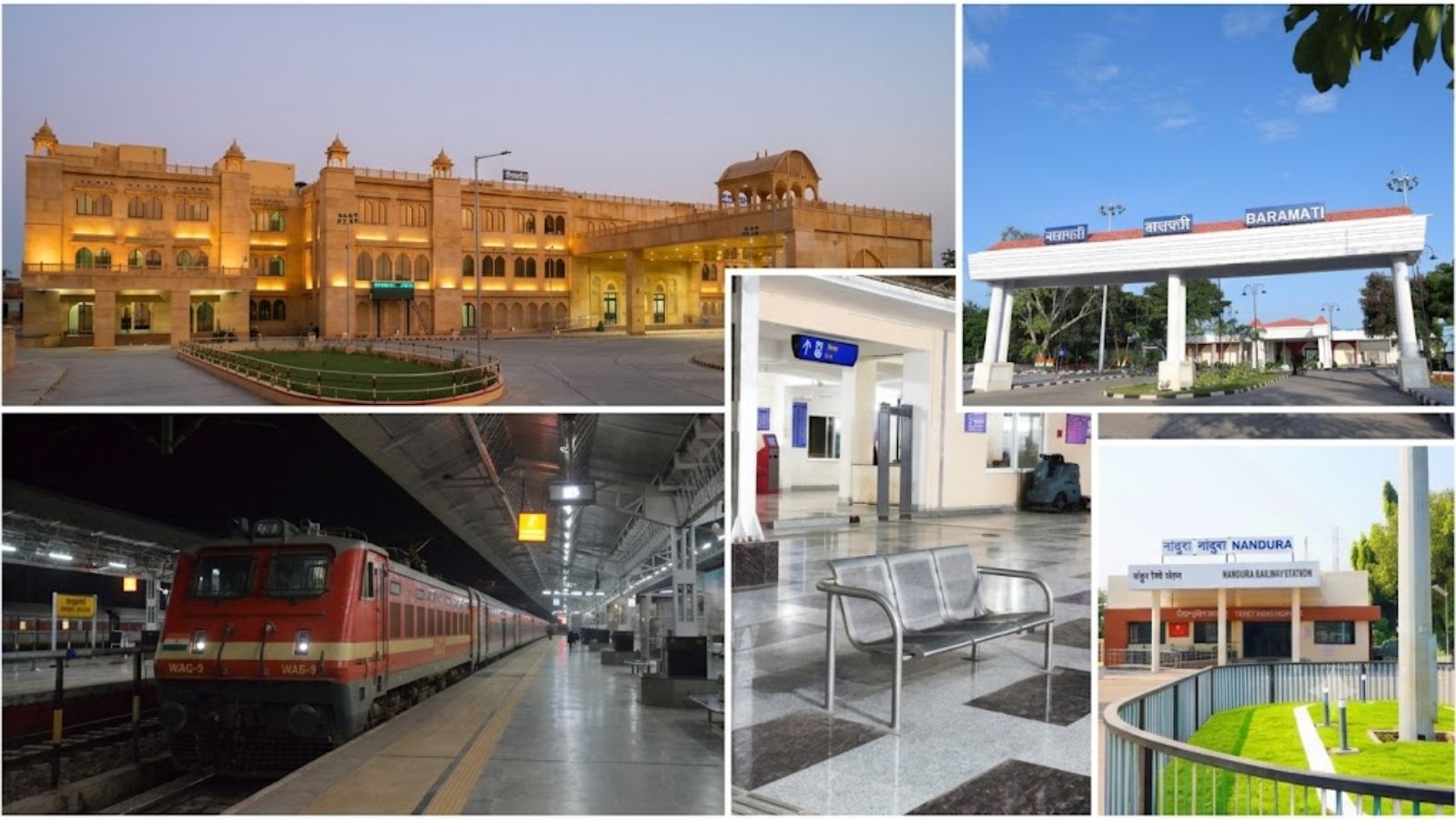
Redevelopment of Baramati railway station
The Central Railway has redeveloped Baramati railway station in Maharashtra’s Pune at a cost of Rs 11.40 crore. The station serves around 1,800 passengers daily and handles eight passenger train services every day. It was first opened as a narrow-gauge railway station in 1914.
Under the redevelopment project, Baramati railway station has received several upgrades, including improvement of the main station building with enhanced aesthetics, construction of a new entrance gate, development of the circulating area, upgraded parking facilities, new toilet blocks, modernisation of the VIP lounge and waiting hall, platform covers, improved platform surfaces, modern station signages, enhanced drinking water facilities, Divyangjan-friendly amenities, and improvements to the compound wall and station entrance infrastructure.
Story continues below this ad
Redevelopment of Baramati station (Image: Central Railway)
Redevelopment of Nandura railway station in Maharashtra
The redevelopment of Nandura railway station in Maharashtra has been completed at a cost of Rs 10.63 crore. It falls under Bhusawal Division of Central Railway. The station is located on the Howrah-Nagpur-Mumbai main line. It handles an average daily passenger footfall of 4,545 and caters to 26 trains daily.
Under the Amrit Bharat Station Scheme, Nandura railway station has been upgraded with several new facilities including a new booking office with four booking counters, a passenger waiting hall, separate toilets for men, women and Divyangjan passengers, and a covered entrance porch.
The circulating area has also been improved with the demolition of the old booking office, construction of a new 9-metre-wide entrance and exit gate, development of a 1,307 sqm parking area for two-wheelers and four-wheelers, and construction of a boundary wall.
Passenger amenities have been enhanced with renovated waiting rooms, modern toilet blocks, vitrified flooring, contemporary ceiling finishes, an air-conditioned waiting room, drinking water coolers, and furniture on platforms and in waiting halls. The station’s platform infrastructure has also been upgraded with new platform shelters on platform number 1 extending 160 m and platform number 2 extending 224 m.
Story continues below this ad
Redevelopment of Nandura station (Image: Central Railway)
Redevelopment of Telangana’s Hi-Tech City railway station
Telangana’s Hi-tech City railway station has been modernised at a cost of Rs 26 crore. It is the nearest railhead to reach the Cyber city, an important place for the Information Technology (IT) industry located in the twin cities of Hyderabad. It falls under Secunderabad Division and is categorised as Sub-urban station. The station serves around 62 trains to Secunderabad, Hyderabad, Umdanagar, Falaknuma, Medchal and Ghatkesar. The footfall of the station is around 3,000 passengers per day.
Redevelopment of Hi-Tech City station (Image: South Central Railway)
Redevelopment of Delhi’s Modi Nagar railway station
The Modi Nagar railway station in Delhi has been redeveloped at a cost of 25.75 crore. It falls under the administrative control of Northern Railway (NR) zone. As part of the modernisation, the station building has been renovated.
The station has been upgraded with several new facilities, including a 12-metre-wide Foot Over Bridge (FOB), a new parking area and an improved circulating area. A new waiting room and toilet block have also been constructed. The platform shelter and surface have been improved to enhance passenger convenience.
The station now has Divyangjan-friendly facilities, including entry ramps, tactile pathways, toilets, water booths, parking facilities, and other amenities. Two lifts have been installed to provide easier access for passengers, especially senior citizens and Divyangjan passengers.
Story continues below this ad
Redevelopment of Modi Nagar railway station (Image: Northern Railway)
Redevelopment of Odisha’s Kesinga railway station
Kesinga railway station in Odisha has been redeveloped at a cost of Rs 22 crore. Established in 1931, it serves as an important railway station on the Raipur-Vizianagaram line of East Coast Railway (ECoR) zone.
The redevelopment project includes modernisation of the existing station building, development of a new second entry to ensure smoother passenger movement, construction of a 12-metre-wide Foot Over Bridge equipped with three lifts for barrier free accessibility, improvement of platform surfaces and platform shelters, widening of approach roads, development of pedestrian pathways and a modern drainage system.
“Passenger amenities have also been substantially upgraded with improved toilets, a retiring room and dormitory, making the station more convenient and welcoming for travellers,” the ECoR said.
Redevelopment of Kesinga station (Image: ECoR)
Redevelopment of Rajasthan’s Jaisalmer railway station
Rajasthan’s Jaisalmer railway station has been redeveloped at a cost of Rs 140 crore. It falls under the administrative control of North Western Railway (NWR).
Story continues below this ad
According to Amit Sudarshan, Chief Public Relations Officer (CPRO) of NWR, the new main station building is a G+2 structure spanning an area of 8,327 sqm. The building’s exterior features Jaisalmer’s famous golden-yellow stone.
The station is equipped with 10 lifts, 10 escalators, two 6-meter-wide foot-over-bridges connecting the platforms, an air-conditioned concourse, modern waiting halls, a circulating area, parking, facilities for the differently-abled, and a 480-sqm commercial zone.
“Recognizing the high passenger footfall during the tourism season in the Jaisalmer region, the allocation of all major commercial assets at the station has been successfully outsourced. These include kiosks within the station complex, retiring rooms and dormitories, a waiting lounge and multi-purpose hall adjacent to the air-conditioned concourse, and modern vehicle parking facilities. Additionally, a rail coach restaurant and catering stalls have been established at the station,” the CPRO said.
Redevelopment of Jaisalmer station (Image: NWR)
Redevelopment of Rajasthan’s Dausa railway station
The Dausa railway station in Rajasthan has been redeveloped at a cost of Rs 15 crore. The station falls on the Delhi-Ahmedabad rail route. It is situated about 60 km from Jaipur. Currently, 74 trains halt at Dausa station, serving an average of 15,000 passengers daily.
Story continues below this ad
According to Amit Sudarshan, CPRO of NWR, the station building has been completely renovated. “Separate parking areas have been designated for two-wheelers and four-wheelers. A FOB has been constructed featuring ramps and covered roofing. Existing toilet blocks have been renovated with modern fittings. Train information boards and coach indication boards have been installed at the station. Furthermore, CCTV systems have been provided to ensure security,” he said.
Redevelopment of Dausa station (Image: NWR)
Redevelopment of Uttar Pradesh’s Panki Dham railway station
Panki Dham railway station in Uttar Pradesh has been modernised at a cost of Rs 25 crore. Established in 1981, Panki Dham station has been developed to ease the growing passenger congestion at Kanpur Central railway station and to improve rail connectivity for the city’s western and suburban areas.
Now, as part of the upgradation, the railway station has been equipped with a 12-metre-wide Foot Over Bridge (FOB) along with an additional 6-metre-wide FOB. Around 4,500 sqm of the station premises have been developed into a circulating area with separate entry and exit points, parking facilities, green spaces and barrier-free movement for all passengers.
Redevelopment of Panki Dham station (Image: NCR)
Redevelopment of Vindhyachal railway station in Uttar Pradesh
The redevelopment of Vindhyachal railway station has been completed at a cost of Rs 23.24 crore. Located on the Delhi-Howrah rail route, the station comes under the jurisdiction of the North Central Railway (NCR) zone. The station now features a G+1 station building, entrance plaza, concourse, executive lounge, waiting halls, retiring rooms, and upgraded ticket booking counters to provide improved passenger facilities, among others.
Story continues below this ad
Redevelopment of Vindhyachal station (Image: NCR)
View original source — Indian Express ↗
Related stories

The Punch
WorldJul 14, 2026 · 1 min
FG grants N6bn tax waivers to drug manufacturers
The Punch
The Punch
WorldJul 14, 2026 · 1 min
My path shines brighter because I walk with you, Adeboye celebrates wife at 78
The Punch
CNA
WorldJul 13, 2026 · 1 min
Bus arrival timing system unavailable due to 'technical issues'
CNA

TASS
WorldJul 13, 2026 · 1 min
US military aircraft spotted over Persian Gulf amid Trump’s threats of strikes on Iran
TASS