The Next Web
Cursor is building a Claude Cowork rival, and Musk may decide its fate
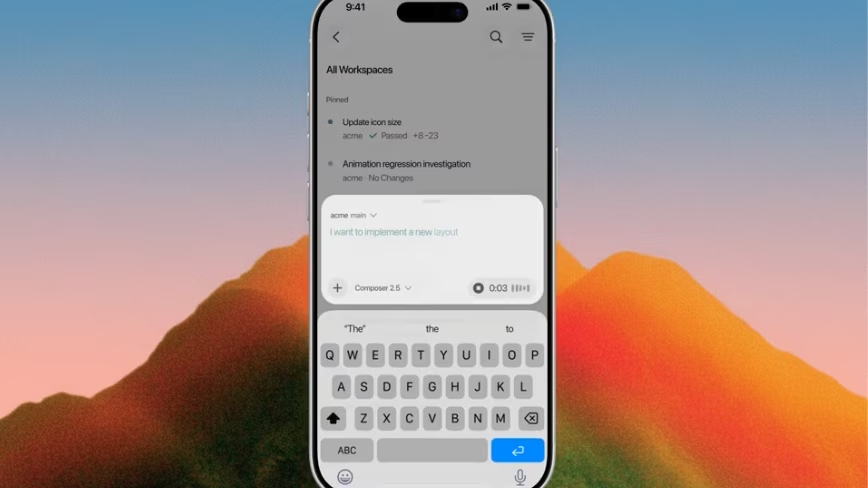
The race to automate the office just gained a third runner. Cursor is building Sand, a general-purpose agent to rival Claude Cowork. Whether it ever ships may come down to Elon Musk.
Cursor made its name as a tool for people who write code. Now it is building one for people who do not. According to The Information, the company is developing a general-purpose AI agent, codenamed Sand, meant to take on Anthropic’s Claude Cowork.
It is designed to answer emails and texts, wrangle spreadsheets and organise documents, and it also reaches into engineering work. It would be Cursor’s first product aimed at ordinary office workers rather than developers.
The company began testing Sand internally in late June, on computing power it started leasing from Elon Musk’s SpaceXAI in April. A public launch is not promised.
A three-way fight for the office
The 💜 of EU tech
The latest rumblings from the EU tech scene, a story from our wise ol' founder Boris, and some questionable AI art. It's free, every week, in your inbox. Sign up now!
Sand leaked in a crowded week. On 7 July, Anthropic pushed Claude Cowork beyond the desktop to mobile and web. Two days later, OpenAI launched ChatGPT Work, an agent powered by its GPT-5.6 model. Both labs are racing to own the working day, and now Cursor wants in.
Cursor’s pitch would be different. Cowork and ChatGPT Work are good at gathering files, summarising them and drafting new ones. Cursor has spent years building integrations through the Model Context Protocol, the open standard Anthropic first published in 2024. Its agents already plug into Vercel, GitHub, Slack and more.
That lets Cursor take a draft and actually deploy it to the web, not just hand it back. For a freelancer who wants a landing page live rather than merely written, that gap matters.
From coders to everyone
The move is a real departure.
Cursor built its whole identity around software engineers. Its AI code editor, forked from Microsoft’s Visual Studio Code, reached around $4bn in annualised revenue by early June, roughly double where it sat in February. It now runs across nearly two-thirds of the Fortune 500.
Nvidia’s Jensen Huang has called it his favourite enterprise AI service, and Stripe says all 40,000 of its engineers use it. Sand would carry that machinery to a far larger audience of finance, HR and marketing staff.
The Musk question
Here is the catch. Sand’s future is tangled up in the biggest deal in AI. In June, SpaceX agreed to buy Cursor’s parent, Anysphere, for $60bn in stock, days after its own record Nasdaq debut.
The deal is due to close this quarter.
Cursor started leasing SpaceXAI compute in April, the same month Sand’s development reportedly began, and the two firms jointly shipped Grok 4.5 last week. So the question of whether Sand launches at all may not be Cursor’s to answer. It may be Musk’s.
Whose model reads your email
That ownership creates a deeper tension. Cursor’s rise was built on staying neutral. It lets developers route each task to whichever model fits, from Claude to OpenAI’s GPT, Google’s Gemini or Cursor’s own Composer. Many enterprise teams chose it precisely so they could keep sensitive code on Claude.
SpaceX now owns xAI, the maker of Grok, and every task Cursor sends to a rival is revenue leaving Musk’s ecosystem. As Tech Times notes, analysts now worry that Cursor becomes a single-vendor bet rather than a neutral layer. Cursor’s chief executive, Michael Truell, has said model agnosticism “remains central to the product”.
That promise carries no contractual weight once the merger closes.
Read that way, Sand looks less like a Cursor product and more like a channel. A workplace agent embedded in Cursor’s infrastructure would give Grok its first mass-market route to non-developers, at the very firms already hooked on Cursor’s coding tools.
The field of would-be office agents keeps growing, but Cursor is the rare entrant that arrives with a million users already fluent in delegating work to AI. The real contest may not be Sand against Cowork. It is whether the neutral tool those users adopted survives its new owner.
View original source — The Next Web ↗
Related stories
ABC News
TechnologyJul 13, 2026 · 1 min
'Gatekeeping septuagenarians': 'Inappropriate' TikTok video deleted
ABC News

TechRadar
TechnologyJul 13, 2026 · 1 min
Space Force has a new weapon to target enemy satellites
TechRadar

Mexico News Daily
TechnologyJul 13, 2026 · 1 min
10,000+ arrests, 50,000 guns seized: US ambassador touts anti-cartel firearms push
Mexico News Daily

TechCrunch
TechnologyJul 13, 2026 · 1 min
Apple says former employee exploited ‘rare’ bug to download confidential files after leaving for OpenAI
TechCrunch