The Guardian
Israel courted Iran’s former hardline president for post-regime role, reports claim
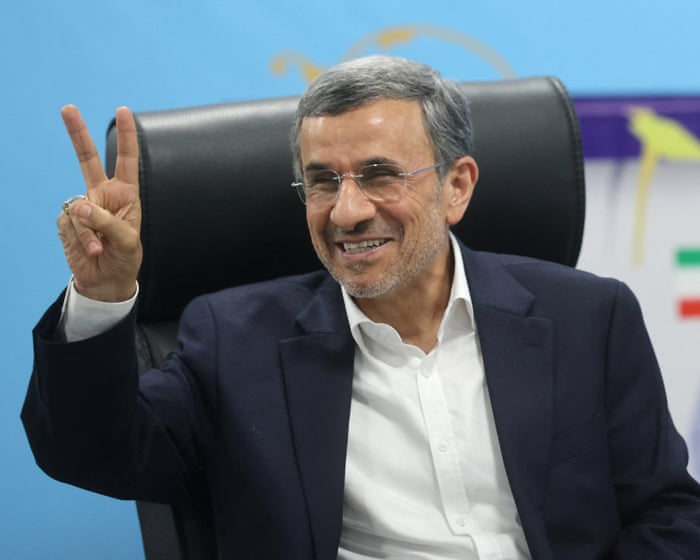
Israel tried to recruit Iran’s intensely anti-Zionist former president Mahmoud Ahmadinejad to lead a new post-Islamic regime in Tehran, and even sent its top spy to Budapest to meet him, according to media reports.
The remarkable quest to turn a leader who had denied the Holocaust and called for Israel’s erasure began in 2022, according to reporting by the New York Times and the Israeli newspaper Haaretz, and continued even after Israel became engaged in a brutal campaign in Gaza against Hamas, a key Iranian ally.
Ahmadinejad – who is now believed to be in the custody of the Islamic Revolutionary Guard Corps (IRGC), according to a New York Times report citing Iranian officials – had begun in previous years to distance himself from the regime, improve his English and redefine his image.
The effort to install him as a new Iranian leader gathered steam after Ahmadinejad was invited to speak at the same university in the Hungarian capital that had been addressed just two months earlier by Benjamin Netanyahu, Israel’s prime minister, in 2025.
According to the New York Times, recruiting Ahmadinejad became such a priority that David Barnea – then the head of the Mossad, Israel’s foreign intelligence agency – travelled to Hungary to meet him after he had been invited to speak at Ludovika University at a climate conference the year before.
Barnea’s involvement was confirmed in Haaretz’s report, which suggested that the former Mossad director even skipped a security consultation with Netanyahu, aimed at discussing the war in Gaza at a time when the fighting with Hamas was at its peak, to focus on Ahmadinejad.
After the meeting with Barnea, the NYT reported, the Mossad informed the CIA that it had been in contact with Ahmadinejad. The relationship apparently initially gained momentum after the former president visited Guatemala in 2023.
Israeli officials are even said to have paid Ahmadinejad for housing and travel, with Mossad operatives meeting him several times, including on trips to Hungary at a time when the country was led by the far-right prime minister Viktor Orbán, a close ally of Israel and Donald Trump.
Details of the effort have emerged amid speculation about Ahmadinejad’s fate after the US and Israel began military strikes against Iran on 28 February, which killed several Iranian senior figures, including the supreme leader, Ali Khamenei.
Ahmadinejad appeared last week among mourners at Khamenei’s funeral, his first public appearance in several months. The NYT – which has previously reported that Israeli and US officials had identified him as a potential leader of a new post-theocratic regime – reported he had been driven from his home after the strike by four Mossad agents, who then kept him at a safe house in Tehran.
However, Ahmadinejad is said to have become upset about the “frantic” rescue mission and disillusioned about the plan to install him in power. He left the safe house under “mysterious circumstances” and is since believed to have been taken into the custody of the IRGC intelligence wing, the NYT reported, citing Iranian officials.
The attempt to woo Ahmadinejad is striking in part because of his key role in intensifying tensions with Israel and the west over Iran’s nuclear programme after he was elected president in 2005.
During his presidency, Ahmadinejad sponsored a “scientific” conference purporting to examine the authenticity of the Holocaust, but in practice setting out his then vocal belief that the murder of six million Jews by the Nazis during the second world war was a “myth”.
But Israeli officials are said to have been alerted to the deterioration of his relationship with Khamenei and other regime elements after he left office in 2013, which was exacerbated by his being rejected three times in another attempt to run for president by the Guardian Council vetting body for candidates.
For his part, Ahmadinejad began to moderate his previously hardline views, and worked to improve his English, even giving a speech in Budapest in the language. He also underwent an image makeover, trimming his once-straggly beard, shedding his trademark white jacket and appearing to receive botox treatment.
He also became critical of brutal regime crackdowns on protest movements, despite the fact that he himself had been at the centre of one of the most notorious of such actions: the suppression of the “green movement” that arose in response to his 2009 election victory, which opponents alleged was fraudulent.
Ahmadinejad’s loyalties began to come into question as he concluded that Iran could not survive the international sanctions that had been imposed over its nuclear activities, which he believed had become a burden rather than an asset, according to Haaretz.
The paper reported on disagreement within Israeli ranks over the regime change mission, called Operation Puss in Boots by Israel. Tzachi Hanegbi, the former national security adviser, dismissed the plans as “wild fantasies” and the Israel Defense Forces’ chief of staff, Eyal Zamir, ordered a halt three days before launch. Netanyahu overrode the disagreements and ordered it to proceed.
Iranian officials had grown suspicious of Ahmadinejad after he slipped his security detail twice during a 2025 trip to Budapest, shortly before last summer’s 12-day war waged against the regime by Israel and the US, and confronted him about his disappearances.
Alex Vatanka, the head of the Iran programme at the Middle East Institute in Washington, said Ahmadinejad’s disaffection with the Iranian regime was known to insiders, including Khamenei, who is said to have been unsettled by his former protege’s decision to visit Guatemala, which has close diplomatic ties to Israel.
But he questioned the timing and motivation of the latest reports. “Why did the Mossad let Ahmadinejad walk out after rescuing him?” he said. “Would you, if you invested so much? Maybe these are just an effort to create tension inside the regime, which has its merits from the point of view of the regime’s adversaries.”
View original source — The Guardian ↗
Related stories

The Punch
PoliticsJul 14, 2026 · 1 min
2027: Kano gov retains deputy as running mate
The Punch
The Punch
PoliticsJul 13, 2026 · 1 min
Trump vows to hit Iran hard, impose Hormuz transit fees
The Punch

France 24
PoliticsJul 13, 2026 · 1 min
Trump says to deliver 'speech to the nation' Thursday as Iran tensions escalate
France 24

RNZ
PoliticsJul 13, 2026 · 1 min
Paul Henry to stand for ACT in this year's election
RNZ