The Guardian
Mahmood offers Farage security meeting after Ann Widdecombe’s death
Shabana Mahmood has offered Nigel Farage a personal meeting with the Home Office unit that works on security for high-profile politicians, insisting all MPs are treated equally in how they are offered protection.
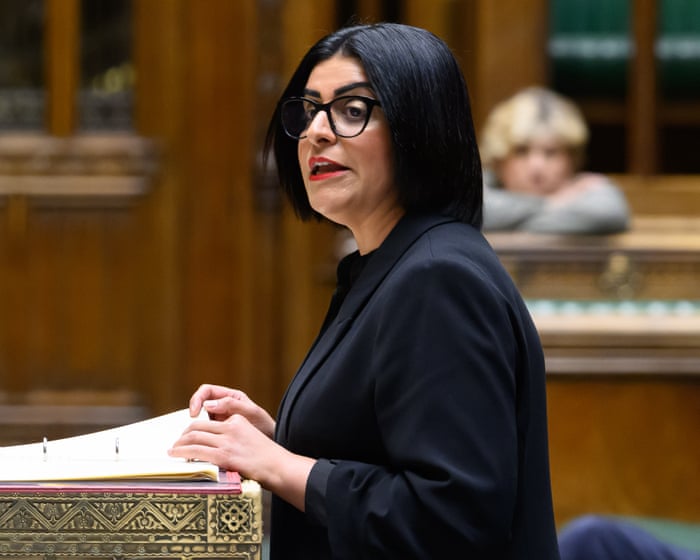
Addressing the Commons after the death of Ann Widdecombe, the Reform spokesperson whose body was found with serious injuries by the ambulance service at her home in Devon, the home secretary said the incident raised questions about the security of former MPs and politicians from smaller parties, including those not in parliament.
After Reform claimed that Farage and its other MPs were being neglected when it came to security, both Mahmood and Lindsay Hoyle, the Commons speaker, insisted this was not the case, and that people were considered in similar ways for protection, regardless of party.
The speaker’s office reacted angrily to comments over the weekend by Zia Yusuf, the Reform home affairs spokesperson, who suggested the government, parliament and police did not “care at all” about the security of the party’s MPs.
Parliamentary sources suggested Reform UK was trying to “weaponise” a previous complaint about its MPs getting harassed outside Westminster to get more attention before the Clacton byelection.
“It’s disappointing because security is a massive priority for the speaker,” one source said. “We’re always reviewing security, and this sort of thing just causes general anxiety,”
Lee Anderson, the Reform chief whip, is understood to have been called in for a meeting with Hoyle after Yusuf’s comments.
Counter-terrorism police are leading the investigation into the death of Widdecombe, whose body was found on Thursday morning. On Saturday, a 28-year-old man was arrested on suspicion of the murder of the former Tory minister. The suspect was rearrested on suspicion of commission, preparation or instigation of acts of terrorism.
Addressing wider concerns about the scale of threats to MPs, Mahmood said she could offer Farage a meeting with the Home Office’s royal and VIP executive committee (Ravec), which decides on the scale of official protection offered to politicians, among others.
The Reform leader replied on X by thanking the home secretary, adding: “I will meet with the chair of Ravec and discuss the security of all Reform politicians, including those who are not MPs.”
Farage has previously said he had been refused sufficient protection from the state, and that this is why he accepted £5m from the crypto billionaire Christopher Harborne, so he could pay for his own security. It is understood he was offered a similar level of protection to other high-profile politicians but turned it down.
At the weekend, Yusuf said the state was “providing no protection whatsoever” to the party.
Mahmood rejected Yusef’s comments. “I think all those of us who are members can attest to the fact that all of us are treated equally in this place by the speaker, and also for the purposes of the parliamentary security department when it comes to our safety on this estate and also in our constituencies,” she said.
Hoyle echoed her point: “Just for the record, every member of parliament is equal in security to me. There is no difference between any member, I want to assure you.”
Hoyle has previously said that MPs’ safety “keeps me awake at night” and last year set up a cross-party speakers’ conference on the issue that called for strengthened protections for MPs and election candidates.
Anderson told MPs he believed the party was being “labelled as racists, as Nazis, as bigots”, and asked Mahmood if she was aware of any increased risks to Reform representatives.
Mahmood said she was not, but also that she could not comment on specific security arrangements.
Responding to an earlier question, Mahmood said one possible consideration was whether security protections should be expanded.
She said: “There is a question that is raised as a result of this murder, which relates not just to the security arrangements for sitting members of parliament, but for those who have left this place but nevertheless retain a public profile as a result of their political party membership or their political activities.
“There are also, given the range of new political parties that are contesting the political and democratic space, I think, questions about those who are not represented at all here in the House of Commons.”
View original source — The Guardian ↗
Related stories

The Punch
PoliticsJul 14, 2026 · 1 min
2027: Kano gov retains deputy as running mate
The Punch
The Punch
PoliticsJul 13, 2026 · 1 min
Trump vows to hit Iran hard, impose Hormuz transit fees
The Punch

France 24
PoliticsJul 13, 2026 · 1 min
Trump says to deliver 'speech to the nation' Thursday as Iran tensions escalate
France 24

RNZ
PoliticsJul 13, 2026 · 1 min
Paul Henry to stand for ACT in this year's election
RNZ