Indian Express
Accused showed no remorse: Gujarat HC in 2,215-page judgment upholding death penalty for 38
In its judgment on the 2008 Ahmedabad serial blasts upholding the judgment of a special trial court, the Gujarat High Court has observed that the accused persons had “not exhibited any remorse” for their act or conduct during the trial or even before the HC during the appeals.
A detailed written judgment of the division bench – running into 2,215 pages – was made available on Monday.
Considering the conduct of the accused, the court also observed that nothing appeared on record for the court to take a lenient view while sentencing the accused.
In its judgment, the court also postponed the order of execution of the death sentences of the convicts for three months following a request made by one of the defence lawyers on behalf of the convicts to prefer an appeal before the Supreme Court.
On July 7, a division bench of the HC comprising Justices Alpesh Kogje and Samir Dave pronounced its judgment on the case while confirming the verdict of a special trial court in the case pronounced in February 2022.
The special trial court had, in February 2022, convicted a total 49 of the 77 accused persons in the case while awarding death sentence to 38 and life imprisonment to 11. The HC pronounced the judgment while acting on criminal confirmation of death sentence for the 39 and appeal against conviction of the 11 who were awarded life imprisonment in the case.
The court, after confirming the convictions of the accused, has observed, “…upon perusing the record, this court takes note of the fact that the accused persons have been involved in offences of similar nature and that even while in judicial custody, the conduct of the accused persons have been such, that disciplinary actions have been taken against them. Moreover, throughout the course of trial and even during the hearing of the present appeals before this court, the accused persons have not exhibited any remorse. Therefore, upon considering their overall conduct as a whole, nothing appears on record so as to persuade this court to take a lenient view while sentencing the accused persons.”
Story continues below this ad
In its judgment, the HC has also highlighted that many of the persons accused in the case were also allegedly involved in the infamous digging of tunnel in Sabarmati Jail in February 2013 while many of them were facing criminal cases elsewhere as well.
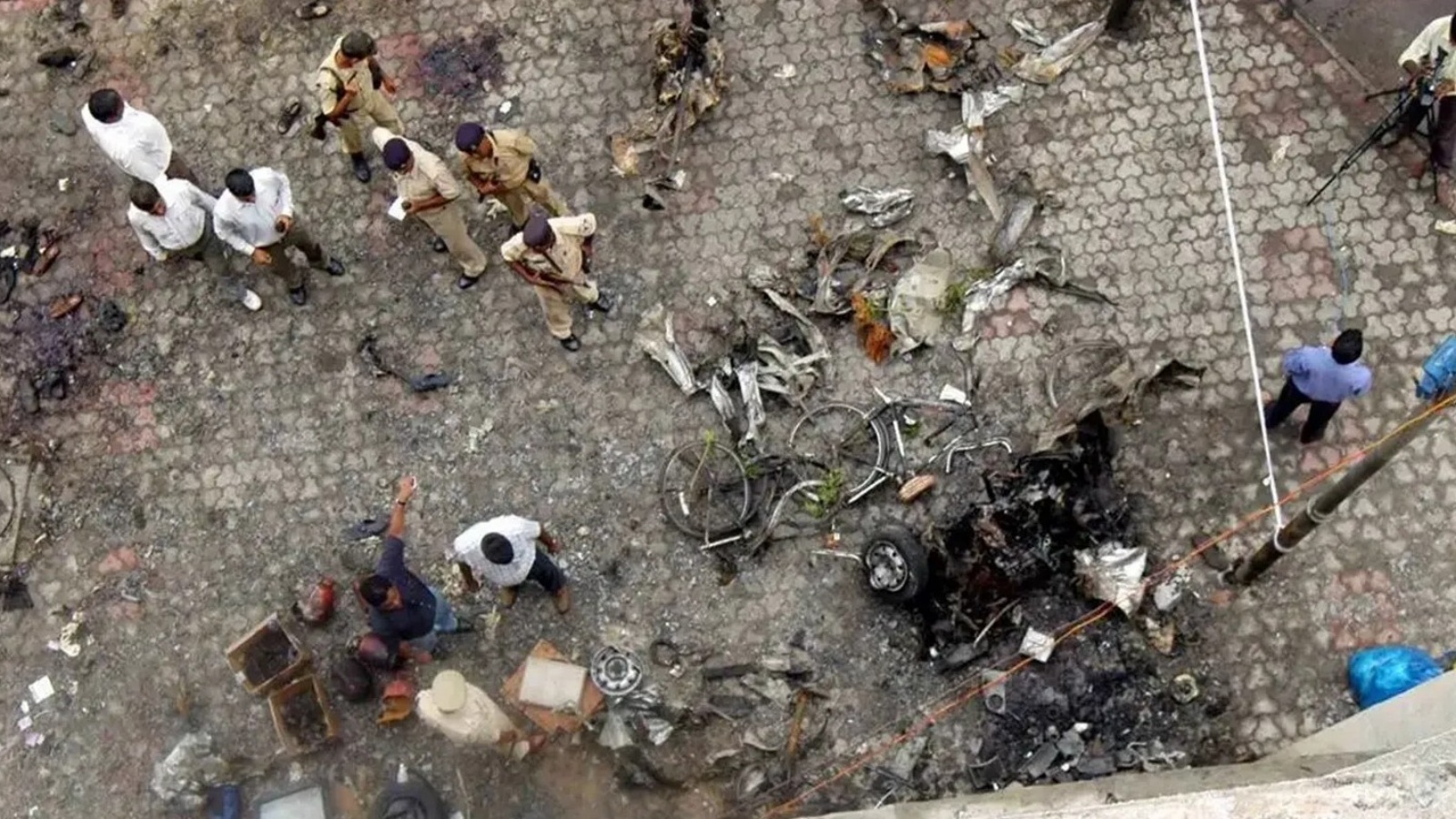
As many as 22 bombs went off in Ahmedabad on July 26, 2008, at various spots, including the state government-run civil hospital, Ahmedabad Municipal Corporation-run LG Hospital, on buses, parked bicycles, in cars and other places, killing 56 people and leaving around 200 injured. Of the 24 bombs, one each at Kalol and Naroda did not go off.
The prosecution had claimed that the accused planned the serial blasts as “revenge” for the 2002 post-Godhra riots in Gujarat and to overthrow a democratically elected government.
A total of 77 persons faced criminal trial in the case who were alleged to be associated with ‘Indian Mujahideen’, believed to be an offshoot of the banned Students Islamic Movement of India (SIMI).
Story continues below this ad
Discussing circumstances of the case including planting of a bomb at Ahmedabad Civil Hospital, the HC observed, “…it is not a case of causing murder simpliciter but it is an act of striking terror and, therefore, this act of accused persons is not an ordinary act of committing murder, but is an act of striking terror which had led to loss of lives of 56 innocent persons and 256 persons who received different injuries, which can be termed as hurt to grievous hurt, which would also include causing of disability as well.”
Highlighting the conduct of the accused persons during the criminal trial in the case, the court has mentioned an episode, among many others, when the accused had not been rising in the court to give respect to the trial judge on her arrival, forcing the latter to apply curtain in the court to avoid humiliation for her before her arrival in the court.
In its judgment, the HC has also ordered the state government to pay compensation to the victims in the case; Rs 10 lakh for death (for the family members of each deceased), Rs 5 lakh for serious injury and Rs 1 lakh for simple injury.
In this context, the court has observed, “A trend is in vogue to be susceptible to clever defence arguments and misplace sympathies that the court may be driven to think only about the accused who is before the court, day in and day out. However, the victim is often hidden and most of the time covered under the prosecution is never visible.”
Story continues below this ad
“Here also, no appeals against the acquittals and absolutely no representation of the large number of victims and no effort by the State to ask them whether they want to be represented by legal aid whereas, a tall order is made out, whether the accused is given or offered legal aid at the cost of the taxpayers’ money certainly cannot be treated as an aspiration of a civilized society wedded to the rule of law and fair criminal justice system. Therefore, the court is inclined to direct the state to pay compensation to the victims of this terror attack,“ it added.
View original source — Indian Express ↗
Related stories

Indian Express
WorldJul 14, 2026 · 1 min
Daily Briefing: Wangchuk’s hunger strike, Hormuz crisis and Assam’s border policy in focus today
Indian Express

Philippine Daily Inquirer
WorldJul 14, 2026 · 1 min
China protests Japan ships sheltering in Taiwan Strait amid Typhoon Bavi
Philippine Daily Inquirer

RNZ
WorldJul 14, 2026 · 1 min
Who is Paul Henry? A look at the veteran broadcaster and ACT’s new candidate
RNZ

Straits Times
WorldJul 14, 2026 · 1 min
Iran shipped 57 million barrels of crude between US blockades
Straits Times