Dawn
Battery storage made mandatory for power auctions
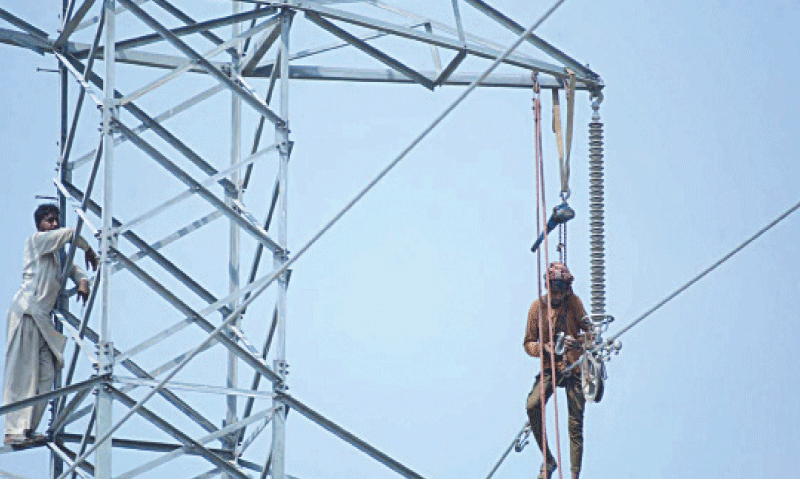
ISLAMABAD: Facing serious duck-curve challenges, the government has decided to make Battery Energy Storage System (BESS) mandatory as part of the upcoming auction of 800MW of surplus power capacity at a wheeling charge to help stabilise electricity supply.
After more than 30 years’ delay, the government has announced the auction process for a notional 800MW capacity to gradually move towards a competitive energy market and is currently engaging with the private sector to finalise the bidding schedule.
Based on these engagements, particularly with prospective auction participants for feedback on different aspects of the wheeling auction framework, the state-run Independent System and Market Operator (ISMO) under the power division has now proposed three major changes to the Wheeling Auction Process to ensure smooth implementation of wheeling and the auction framework.
The first one is the mandatory BESS requirement as part of the auction. Under this, the auction participants would be required to include a BESS of a minimum 10pc firm capacity with their solar or wind generation technologies. “This proposal is being made in order to not only address grid challenges including curtailment and duck curve but also beneficial for the auction participants as it improves their returns”, the ISMO said in its request to the National Electric Power Regulatory Authority (Nepra) for approval. The regulator has sought stakeholders’ comments within seven days before approval.
Move to help tackle duck curve challenges as govt set to auction surplus 800MW
ISMO reported that during the course of its multiple stakeholder meetings and a public consultation session, most of the stakeholders supported the recommendation to start with a minimum mandatory requirement of BESS while ensuring financial viability.
ISMO’s extensive modelling of the BESS and its financial implications also suggested very encouraging financial numbers, as returns showed an increasing trend with the installation of BESS up to a certain percentage. However, based on feedback from the participants, a minimum percentage (10pc) has been finalised as a mandatory requirement. Auction participants may install more BESS than this minimum requirement to further improve their financial viability, as the financial model showed higher returns for greater BESS capacity.
In its summary to the Nepra, the ISMO said international markets showed two approaches to integrate BESS into the grid system. Countries having mature markets generally published all relevant information and let the market players take appropriate decisions while developing countries followed this integration through mandatory requirements. Developing markets such as India, Philippine, China and Dominican Republic have implemented mandatory requirements for BESS.
Most of the prospective auction participants and other stakeholders, according to ISMO, acknowledged BESS importance to address grid flexibility and mitigate duck curve challenge because of renewable energy — for example solar consumers exiting the grid in daytime in large quantities and returning suddenly to grid in the evening with surging demand.
Another amendment seeks to grant the ISMO powers to extend the proposal submission deadline for prospective auction participants by a month or so. Under the already approved auction process, the proposal submission timeline is fixed as one month and there is no flexibility of extending the proposal submission timeline.
The rationale for including this provision, apart from it being a standard feature in many procurement and auction frameworks, is to provide ISMO with the necessary flexibility during the implementation of the first auction as a significant number of prospective participants may seek an extension of the submission deadline.
The third amendment to the already approved scheme is the constitution of a Grievance Redressal Committee, which has been suggested on the request of prospective auction participants. There would be two independent members of the ISMO board of directors along with its ISMO for redressal complaints from the bidders.
Under the current mechanism, the auction committee is responsible for eligibility evaluations as well as redressal of grievances on such eligibility evaluation. Nepra has already declared the Competitive Market Operation Date (CMOD) effective from Jan 22, 2026, but the first auction has not yet been held. The ISMO is required to publish an annual auction calendar by June 15 every year for auctions to be held in the following fiscal year.
Published in Dawn, July 14th, 2026
Follow Dawn Business on X, LinkedIn, Instagram and Facebook for insights on business, finance and tech from Pakistan and across the world.
Related stories

Business Bhutan
BusinessJul 14, 2026 · 1 min
DoT Urges Hotels to Embrace Green Standards
Business Bhutan

Business Bhutan
BusinessJul 14, 2026 · 1 min
Inflation Climbs to 7.72% in May Despite Monthly Decline in Consumer Prices
Business Bhutan
Bloomberg
BusinessJul 14, 2026 · 1 min
Australia Sees No Mass Layoffs From AI Just Yet
Bloomberg
Bloomberg
BusinessJul 14, 2026 · 1 min
Bank of Singapore Global CIO on Market Outlook
Bloomberg