Indian Express
S Janaki’s granddaughter to trolls questioning her grief: ‘Don’t measure my love with tears’
Legendary playback singer S Janaki died last Saturday at the age of 88 in Mysuru following a respiratory problem. She was cremated with full state honours at her Kaniyanahundi farm house here on Sunday evening. As announced by Chief Minister D K Shivakumar, a police team offered her gun salute amid the National Anthem.
Janaki’s granddaughter Apsara Vydyula performed the last rites by lighting her grandmother’s pyre amid the chanting of Vedic hymns. Carrying the earthen pot, she circumambulated the burning pyre. Breaking the convention, which traditionally had been restricted to men, Apsara completed the rituals. Apsara Vydyula is the daughter of Murali Krishna, Janaki’s son, who died earlier this year.
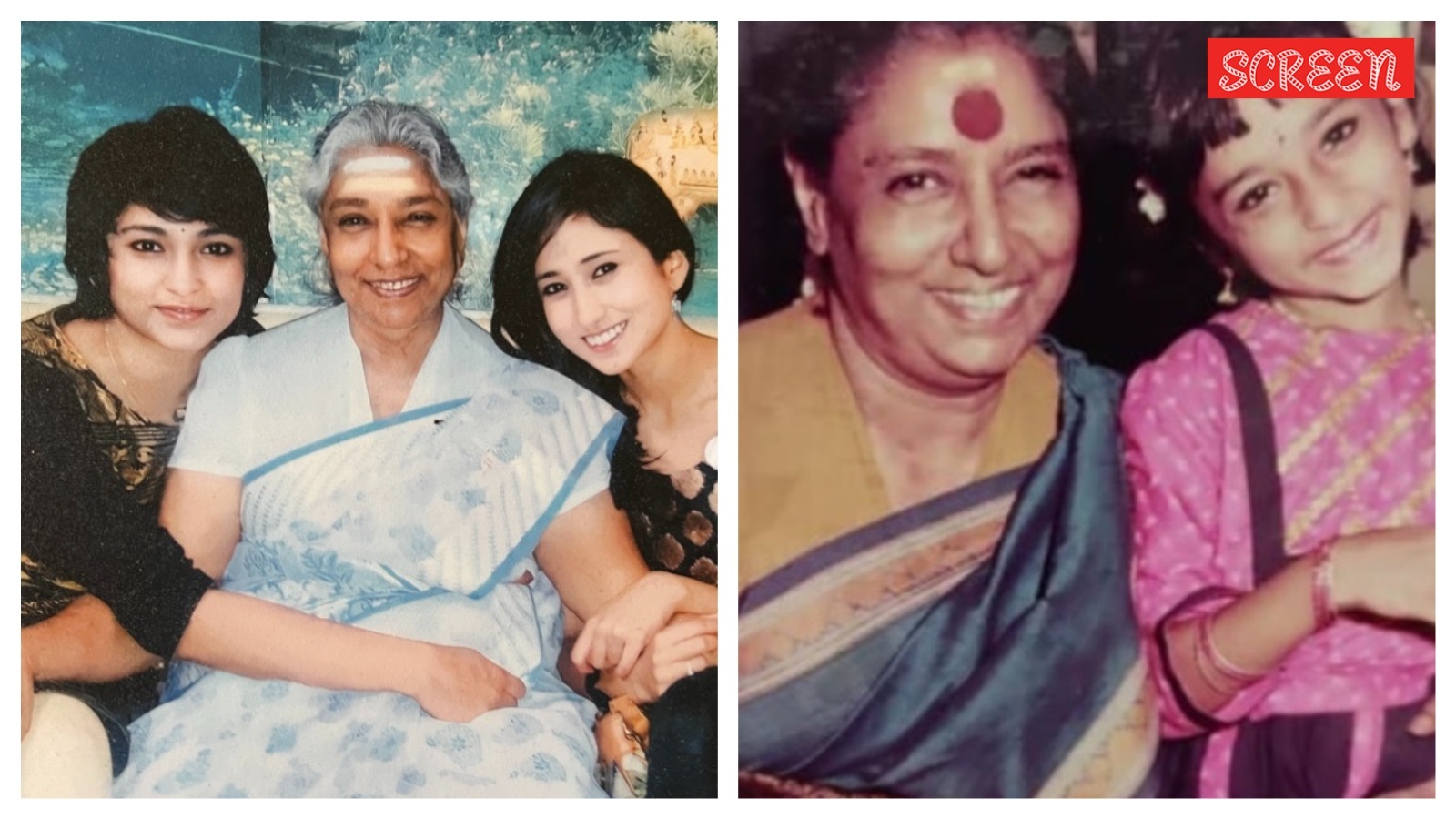
Since her grandmother’s death, there are some on social media who’ve questioned Apsara’s grief, asking why they don’t see tears in her eyes. She took to her Instagram handle on Tuesday morning to give a befitting yet graceful response to them, sharing pictures with Janaki and the singer’s elder granddaughter, Varsha, who died in 2023.
Apsara’s response to those who ‘don’t see her grief’S
“My grandmother’s favourite person in the world was my elder sister, Varsha. They were so alike. They understood each other in a way that words could never fully explain. They were, in every sense, made for each other,” wrote Apsara on Instagram. “I don’t want the world to forget that Varsha is the one who should have been standing where I am today, taking care of our grandmother and doing everything that now falls upon me,” she added.
“Our family will never truly recover from that loss,” said Apsara, referring to her elder sister’s death. “Grief doesn’t disappear. It simply becomes something you learn to carry for the rest of your life. The only comfort I find is knowing that they are together again. Please don’t measure my love for my grandmother by the tears you do or do not see,” she reasoned.
“We were taught, especially by her, to understand death from a deeply spiritual place. She taught us that love does not end when a life does. My experiences have made me stronger than I ever wished I had to be. Grief is not always loud. Sometimes it is quiet, steady and deeply personal,” explained Apsara. She admitted it’s “painful” for people to form opinions about her family, whom they’ve never truly known.
“I want people to know who my grandmother really was. She was gentle, kind, deeply humble and completely free of judgement. She saw the good in everyone. Varsha was exactly the same. What they shared, more than anything else, was an infectious childlike spirit. They carried wonder into every room they entered, and almost everyone who met them loved them instantly,” wrote Apsara. “They are together now. And somehow, that thought brings me peace,” she concluded.
Story continues below this ad
About S Janaki
Known for her versatility, Janaki recorded over 48,000 songs in multiple languages, predominantly the South Indian languages of Kannada, Tamil, Telugu, and Malayalam. Over a career spanning six decades, she sang for films, albums, television, and radio in about 20 Indian languages, including Hindi, Odia, Tulu, Urdu, Punjabi, and Bengali.
Fondly known as “Janaki Amma” among her disciples and followers, she was regarded as “Gana Kogile”. Janaki began her singing career with the Tamil film Vidhiyin Vilayattu (1957) at the age of 19. Though she was highly popular in other South Indian languages, Janaki is said to have sung the most songs in her career in Kannada. Her duets with legends such as PB Srinivas, SP Balasubrahmanyam, and Dr Rajkumar are considered evergreen hits.
Also Read — ‘Please give me a job. I have 2 daughters’: Bhagyashri Borse on her father begging for work
She also sang in English, Japanese, German, and Sinhala. Janaki won four National Film Awards and 33 different state film awards. She received an honorary doctorate from the University of Mysore, the Kalaimamani award from the Tamil Nadu government, and the Rajyotsava Prashasti from the Government of Karnataka. In 2013, she refused to accept the Padma Bhushan, the third-highest civilian award of the Government of India, saying it came too late.
View original source — Indian Express ↗
Related stories

Indian Express
EntertainmentJul 14, 2026 · 1 min
Shah Rukh Khan forces watch on Lady Gaga in old video; asks why she won’t date him: ‘Cringe’
Indian Express

The New York Times
EntertainmentJul 14, 2026 · 1 min
In ‘The Westies,’ Chris Brancato Expands His ‘Scumbag Universe’ (Again)
The New York Times

The New York Times
EntertainmentJul 14, 2026 · 1 min
‘Difficult People’ a Decade Later: A Sarcastic Time Capsule
The New York Times

The New York Times
EntertainmentJul 14, 2026 · 1 min
As White House Leans on Smithsonian, Little Uproar Over Board Vacancies
The New York Times