Indian Express
Elephant trackers, face recognition database to scan ‘suspects’, drones to avoid stampede
Elephants that will be part of the 149th Rath Yatra procession to be held on July 16, will have a GPS tracker sound monitoring sensors, gyroscope based movement detectors and be under live surveillance to prevent incidents like last year when two elephants ran amok injuring two and trampling on a media crew camera, causing panic.
Taking no chances the Ahmedabad City Police will be using advanced “Gajarakshak” Elephant Monitoring System to enhance both public safety and animal welfare.
Each of the 18 elephants that will take part in the 16-km-long procession, will be equipped with these devices for real-time monitoring from the Central Control Room. PI Dhenu Thakar told the Indian Express, “The system will enable early detection of abnormal movement, excessive noise exposure, and route deviations, allowing immediate response by police, mahouts, veterinary teams, and Quick Response Teams (QRTs).”
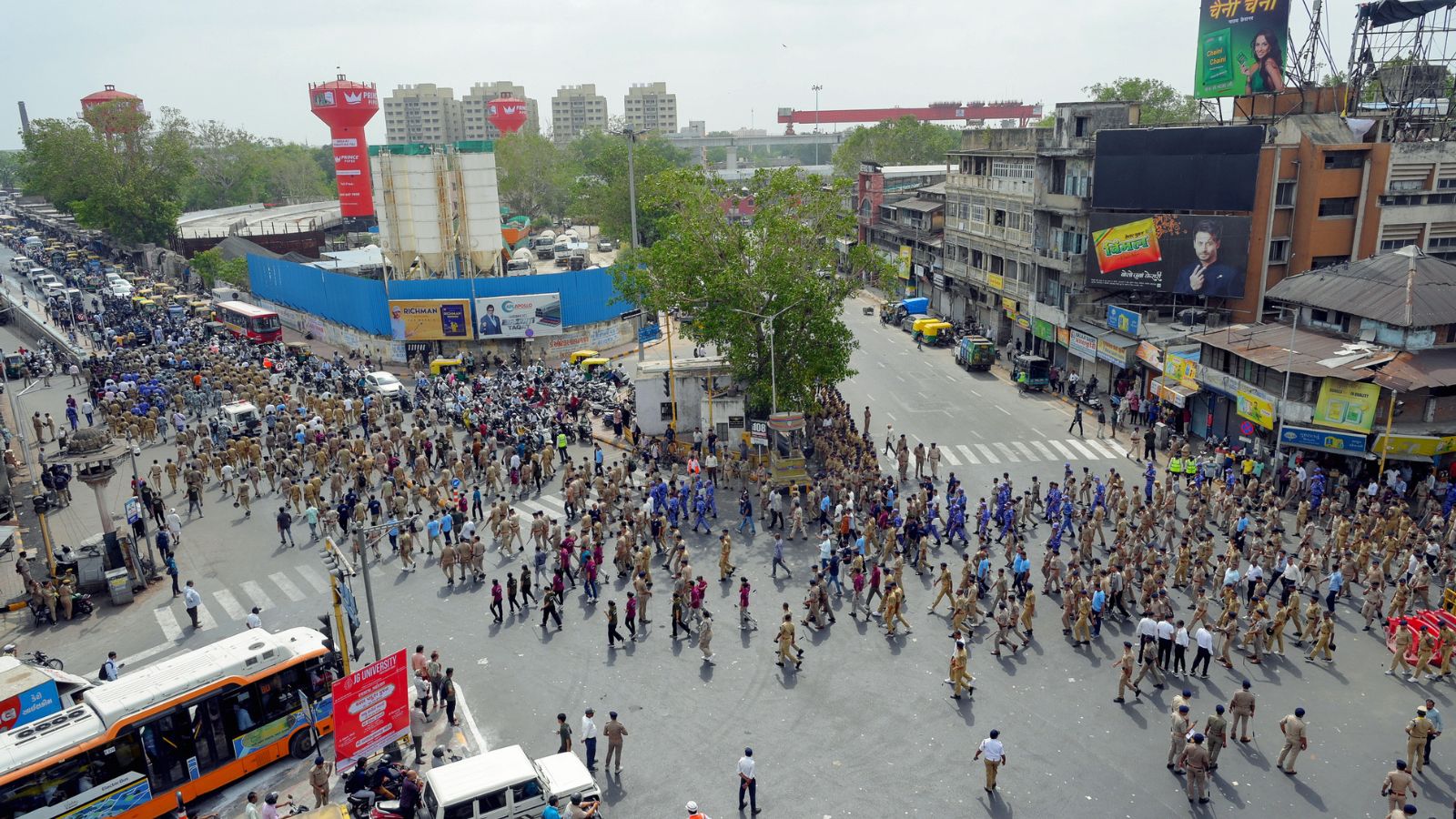
Ahmedabad Rath Yatra is the largest after the Puri-Jagannath yatra which sees nearly one lakh participants and passes through the narrow streets of the old city, including areas known to be communally sensitive.
Facial Recognition at temple entry
The Ahmedabad City Police will use its in-house developed PINAC 2.0 Facial Recognition System at the main gate of the Jagannath Temple. The AI-enabled system is integrated with a database of over 65,000 known pickpockets and other criminals, enabling real-time identification of suspicious persons and strengthening preventive security measures for devotees during the festival.
AI-Based Stampede Avoidance System
The Detection of Crime Branch (DCB) will deploy more than 65 drones for continuous aerial surveillance across the RathYatra route, covering live crowd monitoring, procession movement, traffic regulation, sensitive locations, and critical junctions as part of AI-based Stampede avoidance System that was introduced in the 2025 Rath Yatra.
It will calculate the density of people in a particular area of certain square metres and determine, based on space parameters, if a stampede is imminent or not. Based on the results of this system, alerts will be sent out to officers deployed in the Rath Yatra, to disperse crowds at certain places to avoid the unfortunate outcome of a stampede.
Story continues below this ad
Cameras and CCTV Surveillance
A network of 3,465 CCTV cameras across 84 points will provide continuous monitoring of the entire Rath Yatra route, with special focus on vulnerable and dark zones to ensure that no critical location remains uncovered. The integrated surveillance system will enable faster incident detection, improved coordination, and effective law-and-order management.
Further, at least 2,862 Police personnel deployed during the Rath Yatra will have body worn cameras while there will also be vehicle-mounted cameras on modified Isuzu pick-up trucks and mobile control rooms.
There will be 44 Public Assistance Stalls while personnel will have Pocket Voice amplifiers, and speakers to make announcements for public movement as well as to facilitate announcements regarding missing persons, emergency information, public advisories, and other important communications.
Chatbot for Police Deployment
There will be more than 30,000 uniformed personnel and officers of the local and armed police deployed during the Rath Yatra, which comes to about 1,875 per kilometre of the Rath Yatra through the old city of Ahmedabad.
Story continues below this ad
These will include local police, State Reserve Police Force (SRPF), Central Armed Police Forces (CAPF), and Home Guards. There will be a total of 19 Bomb Detection and Disposal Squad (BDDS) teams, Dog Squad units,
15 Quick Response Teams (QRTs) as well as Chetak Commandos stationed in strategic locations across the procession route, said a statement shared by JCP Sector-1 Neerajkumar Badgujar.
“An AI-Based Calling System has been implemented for the 149th Rath Yatra to automatically deliver deployment details to police personnel assigned to the Crime Moving Bandobast. Through automated voice calls, officers receive their duty point, reporting officer details, reporting time, deployment instructions, emergency contact information, and other important bandobast-related updates, ensuring accurate communication and efficient deployment,” said Inspector Dhenu Thakar.
However, not all personnel will be at the procession route. The cyber time Police will be at their stations monitoring social media and the dark web for rumours, conspiracies and disonformation that could cause problems in the biggest event of this city.
Specialised Police Vehicles
The Rath Yatra will have 4 command and control vehicles, 17 Vajra anti-riot vehicles, 7 water cannons, and 8 Light Armoured Troop Carriers (LATCs).
Story continues below this ad
The Divya Netra Van that will be used this year, is an advanced mobile surveillance vehicle equipped with a 360-degree camera system, that will continuously monitor the surrounding area, automatically scan vehicle number plates for real-time identification.
Route of the Rath Yatra
The process will include the three massive chariots of the deities, 18 bhajan mandalis, and 101 decorated trucks.
The procession will leave from the Jagannath Temple and head to Jamalpur Darwaza, then to Vaishya Sabha, through Dhal Ni Pol to reach Raipur Chakla and from there to Sarangpur Chakla. From there, it will proceed to Khadia crossroads, Panchkuva Darwaza, and the Kalupur railway station to reach Kalupur circle. From there, it will proceed to Itwada circle to reach its destination at the Ranchhodji Mandir at Sarangpur crossroads.
The Rath Yatra then returns to the Jagannath temple via Prem Darwaza, Shahpur Adda, Gheekanta road, and Manek Chowk.
View original source — Indian Express ↗
Related stories

The New York Times
TechnologyJul 14, 2026 · 1 min
Trump Will Let Ukraine Build Patriots. Ukraine Wants to Make Homegrown Missiles Too.
The New York Times

The New York Times
TechnologyJul 14, 2026 · 1 min
Researchers Claim to Have Solved the Perplexing ‘Reverse Sprinkler’ Problem
The New York Times

The New York Times
TechnologyJul 14, 2026 · 1 min
Dark Sky Defenders Raise Alarm Along the Border of West Texas
The New York Times

The Verge
TechnologyJul 14, 2026 · 1 min
New York becomes the first state to enact a data center moratorium
The Verge