VnExpress
Australia leaves 2027 international student cap unchanged despite weaker visa applications
Australia will maintain its target of 295,000 new international student commencements in 2027, unchanged from last year, despite a continued slowdown in overseas student visa applications under tighter migration policies.
Public universities will continue to account for the majority of commencements, while allocations for vocational education and training (VET), private higher education providers and other institutions will remain broadly in line with 2026.
In a joint press release, Minister for Education Jason Clare, Minister for Skills and Training Andrew Giles, and Assistant Minister for International Education as well as Assistant Minister for Citizenship, Customs and Multicultural Affairs Julian Hill said maintaining the National Planning Level would provide "stability and certainty" while ensuring Australia's international education sector remained resilient, high quality and globally competitive.
"International education is an incredibly important export industry for Australia, but we need to manage it sustainably. This is about making sure international education supports students, universities and the national interest," Clare said.
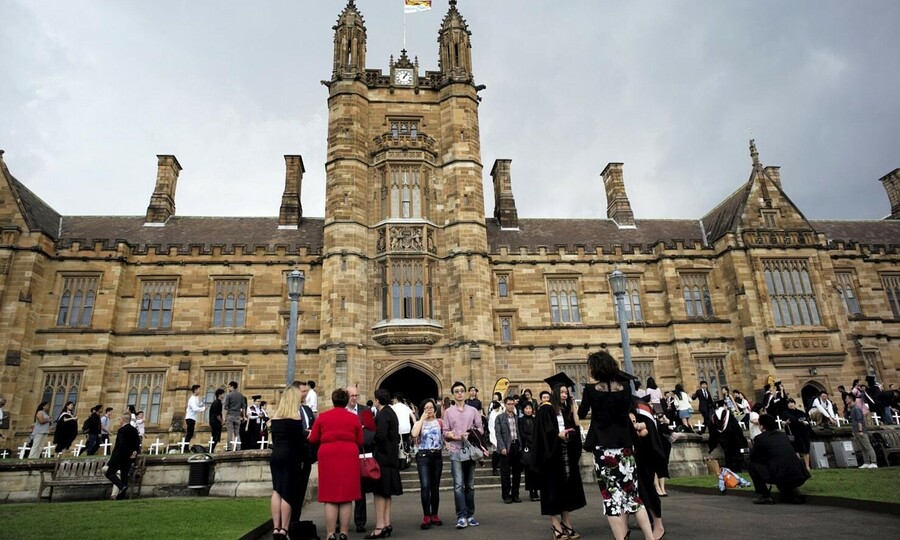
University students walk on the campus of the University of Sydney following a graduation ceremony in Sydney, Australia. Photo by Reuters
The government also confirmed that all active international education providers will receive at least the same student allocation in 2027 as they did in 2026, preserving the higher quotas granted to regional universities last year.
Under the government's "TAFE at the Heart" policy, Technical and Further Education (TAFE) students will continue to be excluded from the NPL, according to an announcement on the Department of Education website.
Other priority groups, including students from Pacific island countries, Timor-Leste and recipients of Australian government scholarships, will also remain exempt from the cap and continue to receive priority processing for student visas.
The decision comes as student visa applications and commencements continue to soften following a series of migration reforms introduced over the past year. The government has tightened visa assessment rules, increased financial requirements for applicants and stepped up scrutiny of education providers in an effort to reduce net overseas migration.
Officials expect actual student commencements in 2027 to remain below the planning level, with current enrolments already tracking under the cap. Existing education providers are not expected to receive lower allocations than they received this year.
"Current tracking indicates international student commencements are on track to be below the NPL for both 2026 and 2027. Commencements in 2026 are down 8% compared to the same period in 2025, and 13% lower than 2019."
The announcement follows the recent 25% increase in student and temporary graduate visa fees, which raised the Subclass 500 student visa application fee to A$2,500 (US$1,734), the highest among the "Big Four" study destinations.
The changes also introduced a separate A$2,050 fee for standalone English Language Intensive Courses for Overseas Students (ELICOS), reduced fees for applicants from ASEAN countries and non-award courses, while retaining lower fees for students from Pacific nations and Timor-Leste.
"The Government will not back off from managing the size and the shape of the onshore international student market and ongoing moderation in student numbers towards a more sustainable sector," assistant minister Hill is quoted in the press release.
"Australia continues to welcome genuine international students seeking a premium Australian education which is great for our unis, domestic students and research."
International education remains one of Australia's largest export industries, contributing tens of billions of dollars annually through tuition fees and student spending. However, universities have warned that stricter visa policies and rising costs could erode Australia's competitiveness against rival destinations such as Canada and the U.K.
Universities Australia Chief Executive Officer Luke Sheehy issued a separate statement on behalf of the sector, as quoted by the ICEF Monitor: "If the government keeps making Australia more expensive and more difficult for genuine students to choose, we’re going to fall short – and we’re already seeing that risk emerge.
"That’s bad for our sector and Australia. It means fewer skilled workers, weaker productivity and a $55 billion export sector supporting 250,000 jobs put at risk."
View original source — VnExpress ↗
Related stories

The Punch
WorldJul 14, 2026 · 1 min
Iran executes two over charges of IS membership
The Punch
The Punch
WorldJul 14, 2026 · 1 min
What Nigerians can use US B1/B2 visa for – Embassy
The Punch
The Punch
WorldJul 14, 2026 · 1 min
Kano donates food items, N1m to family of slain police officer
The Punch
The Punch
WorldJul 14, 2026 · 1 min
Ekiti gov approves recruitment of primary school teachers
The Punch