The Guardian
Alexandra Eala is the giantkiller who lit up Wimbledon – but will she rise to the top?
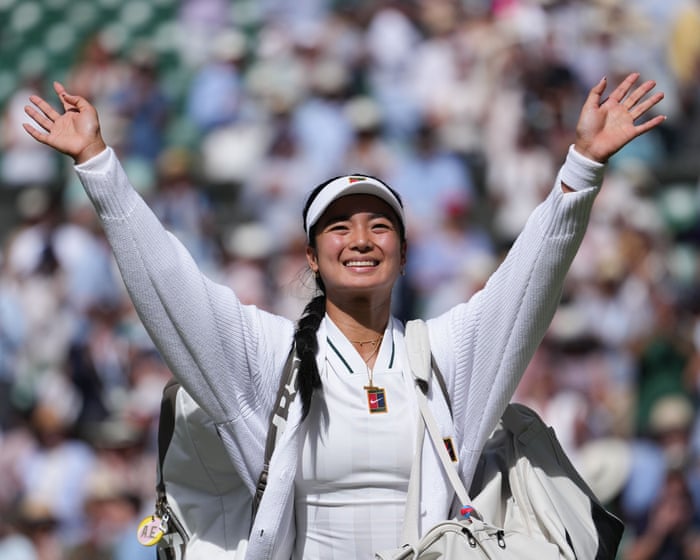
In the opening week at Wimbledon queues snaked around the grounds as fans lined up for the chance to catch one of the 32 second-round matches. Afterwards, they thronged the exit of Court 3 so densely that the eventual winner was preceded by two men in suits and panama hats struggling to clear a path. You’d be forgiven for thinking that, if you peered through the mass of bodies, you might catch a glimpse of a former grand slam champion or leading British player such as Katie Boulter. But the figure that emerged, signing notebooks, balls, and whatever fans waved blindly in her direction was 21-year-old Filipino sensation Alexandra Eala.
Eala’s Wimbledon run was one to note. Already the highest-ranked Filipino player of all time, after winning on Court 3 she went on to upset the defending champion, Iga Swiatek, in straight sets on Centre Court to achieve her deepest grand slam run before bowing out against Jasmine Paolini in the fourth round. She’s been billed as the star turn of September’s WTA 500 Singapore Open and features on the poster for the upcoming Mubadala Citi DC Open. Her company on the publicity material? Four-time grand slam champion Naomi Osaka, former world No 1 Venus Williams, and current world No 10, Elina Svitolina, among a host of equally decorated players.
It is not uncontroversial to say Eala’s star power disproportionately outweighs her career achievements. On tour, she has won only two WTA 125 titles – analogous to Challenger-level tournaments – and has only one other finals appearance. Of her two titles, one was the 2025 Guadalajara 125 Open; rising star Iva Jovic, two years younger than Eala, won the tournament’s WTA 500 edition the following week.
Yet it’s Eala pulling the crowds that one might have expected more accomplished talents such as Jovic or Canada’s Victoria Mboko – before her injury – to attract instead. Watch parties for Eala’s matches fill stadiums back home. The president, Ferdinand Marcos Jr, heaped lavish praise on her following her victory on Centre Court. The senator and former president pro tempore Panfilo Lacson has even hailed her as “an influential unifier of a deeply divided nation”.
The Philippines has not had a prominent sporting superstar to throw its weight behind since the indomitable Manny Pacquiao. With a far-ranging diaspora of roughly 10 million, Eala feels the presence of home support wherever the tour takes her.
Her country has embraced her not just as an athlete, but as an embodiment of its ability to overcome adversity and succeed on the world’s largest stages. The Philippines is by no means small – its population of 117 million puts it above France, Italy and the UK – but in the world of tennis, it is virtually nonexistent. Without the infrastructure and facilities that more traditional tennis countries can provide, Eala honed her game on painted-over basketball courts in Quezon City before moving to Spain to attend the Rafa Nadal Academy on a scholarship at age 13. “I couldn’t really step back a lot because then I would hit the basketball hoop,” she said in her post-Swiatek press conference. “So to answer your question: no, I did not grow up on grass.”
Eala’s star wattage is also driven because she has proven a bit of a giantkiller, with a career record of 7-4 against top 10 opponents. She burst on to the scene with a wildcard run at the 2025 Miami Open, defeating Jelena Ostapenko, Madison Keys and the second seed, Swiatek, before eventually losing to Jessica Pegula in a three-set semi-final. These are the sorts of runs that make headlines, that fuel media buzz and make for good all-caps Instagram posts. Ironically, though, she falters against lower-ranked opponents: that record falls to 18-27 against top 50 players.
Recent critique from former world no. 1 Martina Navratilova has provided a realistic assessment of where she stands to improve: not just in her serve – which averaged 86 mph on first serves and only 75 mph on second serves, well below Wimbledon averages – but in her general game decisions. “This is crazy,” Navratilova said of Eala’s loss to Paolini. “Only a third of her serves are slices to the backhand, particularly in the ad court. She is not using her ‘leftyness’ to her advantage nearly as much as she can.”
Earlier last week, Eala posted a simple photo on Instagram: the back of her custom white Nike visor, embroidered with a Tagalog saying: “Kapag lumago, hindi na hihinto.” Every dream begins with a seed; once it grows, it cannot be stopped. Eala is on track to bloom – but just how tall remains to be seen.
View original source — The Guardian ↗
Related stories

The Punch
SportsJul 14, 2026 · 1 min
FULL LIST: 10 Ballon d’Or award winners in World Cup semi-finals
The Punch

BBC Sport
SportsJul 14, 2026 · 1 min
The origin story of France star Michael Olise
BBC Sport

France 24
SportsJul 14, 2026 · 1 min
Senegal football coach sacked after World Cup defeat
France 24
Sky Sports
SportsJul 14, 2026 · 1 min
How do England stop Messi as more history beckons for Argentina legend?
Sky Sports